4,068 posters, 219 videos, 101 topics, 69 sessions, 14,365 authors, 6,128 institutions
ePostersLive by SciGen Technologies S.A. All rights reserved.
Alzheimer's Association International Conference 2026
July 12-15, 2026 | London, United Kingdom, and Online

13847
Serum Lipid Ratios Reveal Early Metabolic Signatures Of Genetic Alzheimer’s Risk Beyond Protein Biomarkers (PSEN 1-E280A)
Poster Presenter
Authors
Part of Topic
Biomarkers -> Biomarkers (non-neuroimaging) -> Novel biomarkers
Serum Lipid Ratios Reveal Early Metabolic Signatures Of Genetic Alzheimer’s Risk Beyond Protein Biomarkers (PSEN 1-E280A):
Author Block:Nelson David Galvis-Garrido1, Ivan Daniel Salomón-Cruz1, Juan Pablo Barbosa Carvajal1, Laura Alejandra Lozano Trujillo2,3, Kenneth S. Kosik, Professor2,4, Daniel Camilo Aguirre Acevedo5, David Aguillon-Niño3, Estela Area Gómez2,6, Gloria Patricia Cardona-Gomez2,3.
1Neurosciences, Grupo de Neurociencias de Antioquia, Medellín, Colombia, 23Grupo de Neurociencias de Antioquia, Medellín, Colombia, 4UCSB USA, Santa Barbara, CA, USA, 5USA, 6CSIC Spain, Madrid, Spain.
Abstract:
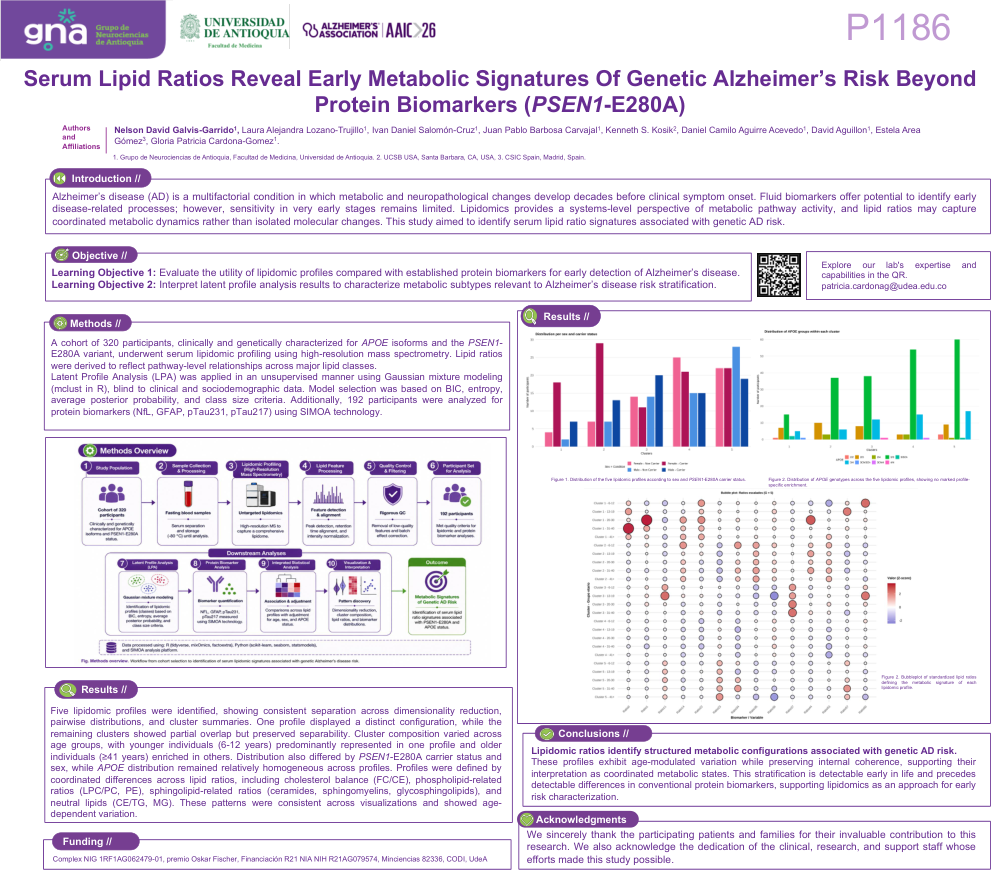
Background: Alzheimer’s disease (AD) is a multifactorial condition in which metabolic and neuropathological changes develop decades before clinical symptom onset. Fluid biomarkers offer potential to identify early disease-related processes; however, sensitivity in very early stages remains limited. Lipidomics provides a systems-level perspective of metabolic pathway activity, and lipid ratios may capture coordinated metabolic dynamics rather than isolated molecular changes. This study aimed to identify serum lipid ratio signatures associated withgenetic AD risk.
Methods: A cohort of 320 participants, clinically and genetically characterized for APOE isoforms and the PSEN1-E280A variant, underwent serum lipidomic profiling using high-resolution mass spectrometry. Lipid ratios were derived to reflect pathway-level relationships across major lipid classes.Latent Profile Analysis (LPA) was applied in an unsupervised manner using Gaussian mixture modeling (mclust in R), blind to clinical and sociodemographic data. Model selection was based on BIC, entropy, average posterior probability, and class size criteria.Additionally, 192 participants were analyzed for protein biomarkers (NfL, GFAP, pTau231, pTau217) using SIMOA technology.
Results: Five lipidomic profiles were identified, showing consistent separation across dimensionality reduction, pairwise distributions, and cluster summaries. One profile displayed a distinct configuration, while the remaining clusters showed partial overlap but preserved separability.
Cluster composition varied across age groups, with younger individuals (6-12 years) predominantly represented in one profile and older individuals (≥41 years) enriched in others. Distribution also differed by PSEN1-E280A carrier status and sex, while APOE distribution remained relatively homogeneous across profiles.Profiles were defined by coordinated differences across lipid ratios, including cholesterol balance (FC/CE), phospholipid-related ratios (LPC/PC, PE), sphingolipid-related ratios (ceramides, sphingomyelins, glycosphingolipids), and neutral lipids (CE/TG, MG). These patterns were consistent across visualizations and showed age-dependent variation in magnitude within clusters.Protein biomarkers did not distinguish genetically at-risk individuals under 20 years, whereas lipidomic profiles enabled stratification across the lifespan.
Conclusion: Lipidomic ratios identify structured metabolic configurations associated with genetic AD risk.
These profiles exhibit age-modulated variation while preserving internal coherence, supporting their interpretation as coordinated metabolic states.
This stratification is detectable early in life and precedes detectable differences inconventional protein biomarkers, supporting lipidomics as a complementary approach for early risk characterization in autosomal dominant AD.
Comments
Email is required but is not shown publicly.
Loading comments...