4,068 posters, 219 videos, 101 topics, 69 sessions, 14,365 authors, 6,128 institutions
ePostersLive by SciGen Technologies S.A. All rights reserved.
Alzheimer's Association International Conference 2026
July 12-15, 2026 | London, United Kingdom, and Online

13303
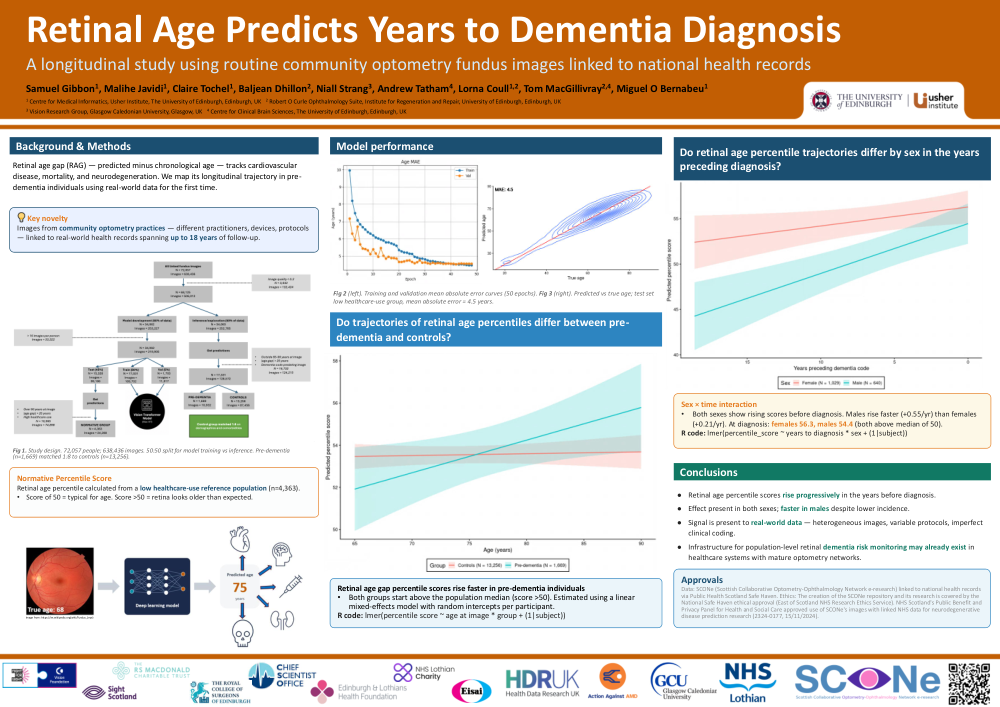
Retinal Age Gap Trajectories Differ Between Future Dementia Patients And Matched Controls
Poster Presenter
Authors
Samuel Gibbon, Malihe Javidi, Claire Tochel, Baljean Dhillon, Niall Strang, Andrew Tatham, Lorna Coull, Tom MacGillivray, Miguel Bernabeu
Affiliations
Centre for Medical Informatics, Usher Institute, The University of Edinburgh, Edinburgh, UK, Robert O Curle Ophthalmology Suite, Institute for Regeneration and Repair, University of Edinburgh, Edinburgh, UK, Vision Research Group, Glasgow Caledonian University, Glasgow, UK, Centre for Clinical Brain Sciences, The University of Edinburgh, Edinburgh, UK
Part of Topic
Biomarkers -> Biomarkers (non-neuroimaging) -> Longitudinal
Video
Hi, I'm Sam from the University of Edinburgh. The question behind this work is simple: can a photograph of the retina tell us, years in advance, that someone is on a path towards dementia?
The retina is the one place in the body where we can directly see blood vessels and nervous tissue, with a simple photograph. The retina is directly connected to the brain via the optic nerve — sharing blood supply, embryological origins, and features — so changes in one are to some extent mirrored by changes in the other.
Researchers can train a model to predict a person's age from a retinal photo. When the retina looks older than it should, that "retinal age gap" has been linked to many diseases — including dementia. But that work used a single image per person. We wanted to track change over time, using repeat images from the same people.
We used SCONe dataset — over 600,000 routinely collected photographs from over 70,000 people across Scotland, linked to health records. We trained an age-prediction model and turned it into a simple 0-to-100 score: 50 is average for your age, above 50 means the retina looks older than expected.
We compared people who later developed dementia with matched controls. Two findings. First: in those who go on to develop dementia, the retina ages faster — the groups pull apart years before diagnosis. Second: that rise is faster in males.
The key point is this: these are ordinary eye-test photos, already being taken every day at optician practices. The infrastructure to detect this signal at scale may already exist in countries with a mature optometry sector. Thank you — please do explore the poster.
Comments
Email is required but is not shown publicly.
Loading comments...