4,068 posters, 219 videos, 101 topics, 69 sessions, 14,365 authors, 6,128 institutions
ePostersLive by SciGen Technologies S.A. All rights reserved.
Alzheimer's Association International Conference 2026
July 12-15, 2026 | London, United Kingdom, and Online

13428
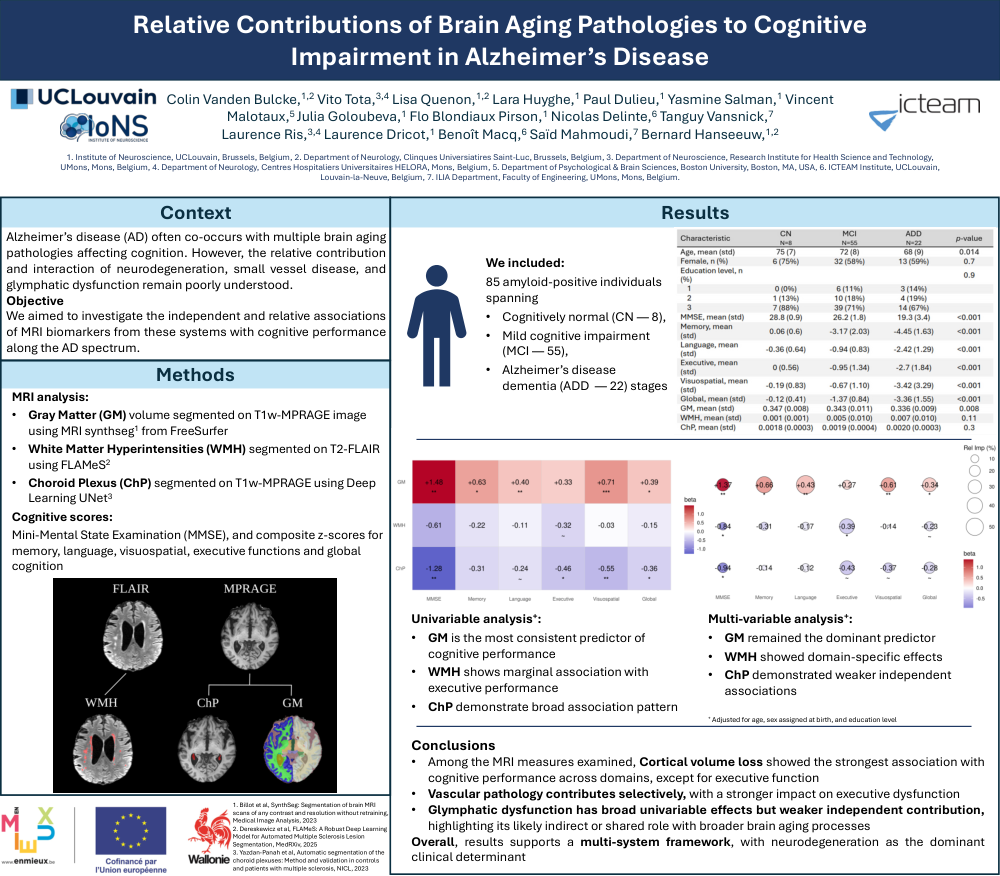
Relative Contributions Of Brain Aging Pathologies To Cognitive Impairment In Alzheimer’S Disease
Poster Presenter
Authors
Part of Topic
Biomarkers -> Neuroimaging -> Multi-modal comparisons
Context:
Alzheimer’s disease (AD) often co-occurs with multiple brain aging
pathologies affecting cognition. However, the relative contribution
and interaction of neurodegeneration, small vessel disease, and
glymphatic dysfunction remain poorly understood.
Objective:
We aimed to investigate the independent and relative associations
of MRI biomarkers from these systems with cognitive performance
along the AD spectrum.
Methods:
MRI analysis:
- Gray Matter (GM) volume segmented on T1w-MPRAGE image
using MRI synthseg1 from FreeSurfer
- White Matter Hyperintensities (WMH) segmented on T2-FLAIR
using FLAMeS2
- Choroid Plexus (ChP) segmented on T1w-MPRAGE using Deep
Learning UNet3
Cognitive scores:
Mini-Mental State Examination (MMSE), and composite z-scores for
memory, language, visuospatial, executive functions and global
cognition
We included:
85 amyloid-positive individuals spanning
- Cognitively normal (CN — 8),
- Mild cognitive impairment (MCI — 55),
- Alzheimer’s disease dementia (ADD — 22) stage
Results:
Univariable analysis+:
- GM is the most consistent predictor of
cognitive performance
- WMH shows marginal association with
executive performance
- ChP demonstrate broad association pattern
Multi-variable analysis+:
- GM remained the dominant predictor
- WMH showed domain-specific effects
- ChP demonstrated weaker independent
associations
Conclusion:
- Among the MRI measures examined, Cortical volume loss showed the strongest association with
cognitive performance across domains, except for executive function
- Vascular pathology contributes selectively, with a stronger impact on executive dysfunction
- Glymphatic dysfunction has broad univariable effects but weaker independent contribution,
highlighting its likely indirect or shared role with broader brain aging processes
Overall, results supports a multi-system framework, with neurodegeneration as the dominant
clinical determinant
Comments
Email is required but is not shown publicly.
Loading comments...