4,068 posters, 219 videos, 101 topics, 69 sessions, 14,365 authors, 6,128 institutions
ePostersLive by SciGen Technologies S.A. All rights reserved.
Alzheimer's Association International Conference 2026
July 12-15, 2026 | London, United Kingdom, and Online

13654
Real-world Diagnostic Performance Of Plasma P-tau217 In Memory Clinics: A Multicenter Study From Northwest China
Poster Presenter
Part of Topic
Biomarkers -> Biomarkers (non-neuroimaging) -> Fluid biomarkers
Title: Real-world Diagnostic Performance Of Plasma P-tau217 In Memory Clinics:A Multicenter Study From Northwest China
Poster Number: Sunday-1179
Authors: Chunyu Li¹, Peijie Liu¹,Simeng Cui¹,Jin Wang¹, Qiumin Qu¹, Ling Gao¹
1Neurology,The First Affiliated Hospital of Xi'an Jiaotong University,Xi'an,Shaanxi,China
Plasma p-tau217 retained robust diagnostic accuracy for Alzheimer’s disease in a real-world memory clinic cohort with heterogeneous comorbidities.Compared with p-tau181 and GFAP, p-tau217 showed the most stable performance when the reference group shifted from healthy controls to diverse non-AD neurological disorders.These findings support plasma p-tau217 as a promising first-line triage biomarker in routine memory clinic practice.
INTRODUCTION:
Alzheimer’s disease is the most common cause of dementia and requires accurate early diagnosis, particularly in the era of disease-modifying therapies[2]. Amyloid PET and cerebrospinal fluid biomarkers provide high diagnostic accuracy but are limited by cost, invasiveness, and accessibility in routine memory clinics. Blood-based biomarkers offer a scalable alternative. Plasma p-tau217 has shown excellent accuracy for Alzheimer’s disease in well-controlled case-control studies, with reported AUCs of approximately 0.94–0.98[1]. However, real-world memory clinic populations are more complex. Patients frequently have vascular risk factors, metabolic comorbidities, Parkinson’s disease, vascular cognitive impairment, cerebrovascular disease, or other neurological disorders. Whether plasma p-tau217 maintains its diagnostic performance in this heterogeneous clinical setting remains insufficiently defined[3,4].
METHODS:
We conducted a multicenter real-world study across 38 memory clinics in Northwest China. Participants aged 40–85 years were consecutively enrolled and classified into three groups: Alzheimer’s disease: amyloid PET-positive or CSF-confirmed AD Non-AD neurological disorders: including vascular cognitive impairment, Parkinson’s disease, cerebrovascular disease, neuroimmune disorders, and other neurological conditions Cognitively normal controls: individuals with common age-related comorbidities but without cognitive impairment Peripheral blood samples were collected in EDTA tubes. Six plasma biomarkers were measured using chemiluminescence immunoassay: Aβ42, Aβ40, p-tau181, p-tau217, GFAP, NfL. The Aβ42/Aβ40 ratio was calculated for diagnostic evaluation. Diagnostic performance was assessed using receiver operating characteristic curves. AUCs were compared across diagnostic scenarios. In the accepted abstract analysis, cross-scenario AUC differences were evaluated using DeLong’s test.
RESULTS:
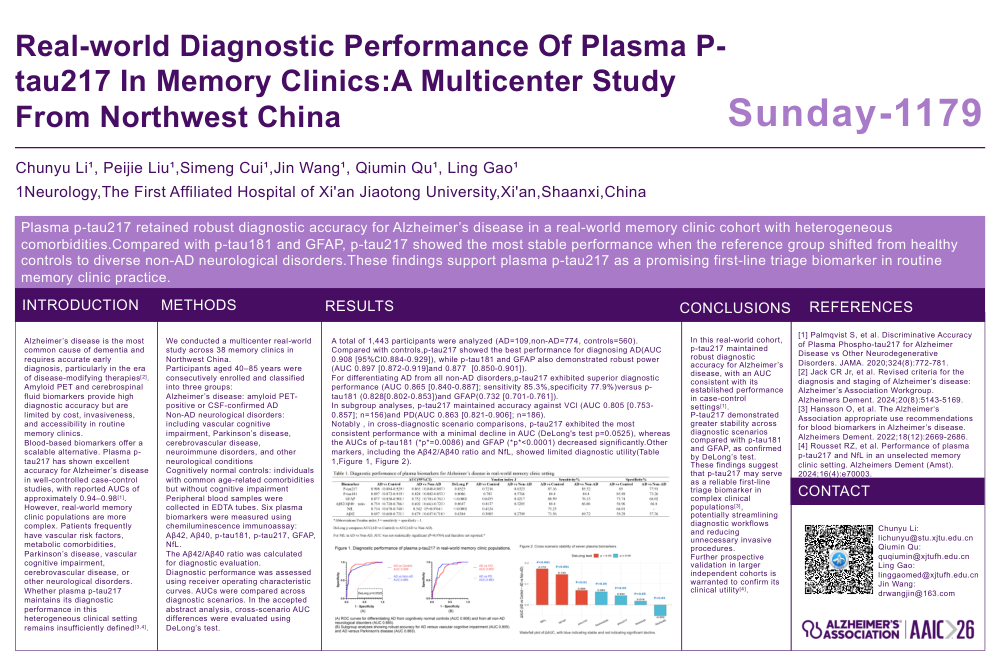
A total of 1,443 participants were analyzed (AD=109,non-AD=774, controls=560). Compared with controls,p-tau217 showed the best performance for diagnosing AD(AUC 0.908 [95%CI0.884-0.929]), while p-tau181 and GFAP also demonstrated robust power (AUC 0.897 [0.872-0.919]and 0.877 [0.850-0.901]). For differentiating AD from all non-AD disorders,p-tau217 exhibited superior diagnostic performance (AUC 0.865 [0.840-0.887]; sensitivity 85.3%,specificity 77.9%)versus p-tau181 (0.828[0.802-0.853])and GFAP(0.732 [0.701-0.761]). In subgroup analyses, p-tau217 maintained accuracy against VCl (AUC 0.805 [0.753-0.857]; n=156)and PD(AUC 0.863 [0.821-0.906]; n=186). Notably , in cross-diagnostic scenario comparisons, p-tau217 exhibited the most consistent performance with a minimal decline in AUC (DeLong's test p=0.0525), whereas the AUCs of p-tau181 (*p*=0.0086) and GFAP (*p*<0.0001) decreased significantly.Other markers, including the Aβ42/Aβ40 ratio and NfL, showed limited diagnostic utility(Table 1,Figure 1, Figure 2).
CONCLUSIONS:
In this real-world cohort, p-tau217 maintained robust diagnostic accuracy for Alzheimer’s disease, with an AUC consistent with its established performance in case-control settings[1]. P-tau217 demonstrated greater stability across diagnostic scenarios compared with p-tau181 and GFAP, as confirmed by DeLong’s test. These findings suggest that p-tau217 may serve as a reliable first-line triage biomarker in complex clinical populations[3], potentially streamlining diagnostic workflows and reducing unnecessary invasive procedures. Further prospective validation in larger independent cohorts is warranted to confirm its clinical utility[4].
REFERENCES:
[1] Palmqvist S, et al. Discriminative Accuracy of Plasma Phospho-tau217 for Alzheimer Disease vs Other Neurodegenerative Disorders. JAMA. 2020;324(8):772-781. [2] Jack CR Jr, et al. Revised criteria for the diagnosis and staging of Alzheimer‘s disease: Alzheimer’s Association Workgroup. Alzheimers Dement. 2024;20(8):5143-5169. [3] Hansson O, et al. The Alzheimer‘s Association appropriate use recommendations for blood biomarkers in Alzheimer’s disease. Alzheimers Dement. 2022;18(12):2669-2686. [4] Rousset RZ, et al. Performance of plasma p-tau217 and NfL in an unselected memory clinic setting. Alzheimers Dement (Amst). 2024;16(4):e70003.
CONTACT:
Chunyu Li: lichunyu@stu.xjtu.edu.cn ; Qiumin Qu: quqiumin@xjtufh.edu.cn ; Ling Gao: linggaomed@xjtufh.edu.cn; Jin Wang: drwangjin@163.com
Comments
Email is required but is not shown publicly.
Loading comments...