4,068 posters, 219 videos, 101 topics, 69 sessions, 14,365 authors, 6,128 institutions
ePostersLive by SciGen Technologies S.A. All rights reserved.
Alzheimer's Association International Conference 2026
July 12-15, 2026 | London, United Kingdom, and Online

12014
Real-world Diagnostic And Prognostic Performance Of Plasma Biomarkers For Alzheimer’s Disease In A Mild Cognitive Impairment Cohort
Poster Presenter
Authors
Guido Maria Giuffrè, Alessandro Scalese, Domenico Fusco, Davide Quaranta, Maria Gabriella Vita, Cinzia Carrozza, Paolo Calabresi, Camillo Marra
Affiliations
Part of Topic
Biomarkers -> Biomarkers (non-neuroimaging) -> Fluid biomarkers
Introduction
Blood-based biomarkers (BBMs) are emerging as promising tools to detect Alzheimer’s disease (AD) pathology in vivo.
The present study aimed to provide evidence on the potential of plasma biomarkers in supporting clinical decision-making in the prodromal stages of AD in real-world clinical practice.
Specifically, the objectives of the study were to: (i) characterize the associations between CSF and plasma biomarkers in AD and non-AD (NAD) MCI; (ii) assess the diagnostic performance of plasma biomarkers (Aβ40, Aβ42, p-tau181, p-tau217, NfL) in detecting AD pathology using single-cutoff and two-cutoff strategies; (iii) examine their prognostic utility in predicting cognitive decline and progression to dementia over two years.
Methods
CSF and plasma samples were collected from 137 mild cognitive impairment (MCI) subjects, classified as AD or non-AD (NAD) based on their CSF biomarkers profile. CSF Aβ40, Aβ42, p-tau181 and t-tau and plasma Aβ40, Aβ42, p-tau181, p-tau217 and NfL quantification were conducted using Lumipulse immunoassays (Fujirebio).
Associations between CSF and plasma biomarkers, diagnostic accuracy (ROC curves, single- and two-cutoff strategies) and prognostic value for cognitive decline and progression to dementia over two years (regression analyses) were evaluated.
Results
All CSF and plasma biomarkers showed significant inter-correlations, except plasma NfL.
As expected, significant between-group differences were observed in plasma Aβ and p-tau biomarkers levels.
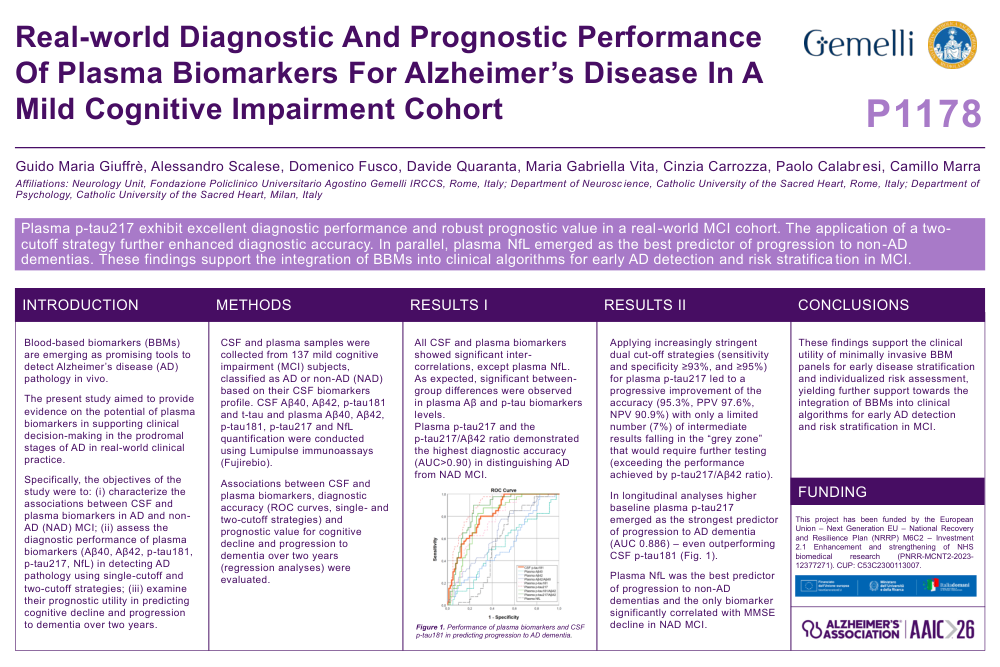
Plasma p-tau217 and the p-tau217/Aβ42 ratio demonstrated the highest diagnostic accuracy (AUC>0.90) in distinguishing AD from NAD MCI.
Applying increasingly stringent dual cut-off strategies (sensitivity and specificity ≥93%, and ≥95%) for plasma p-tau217 led to a progressive improvement of the accuracy (95.3%, PPV 97.6%, NPV 90.9%) with only a limited number (7%) of intermediate results falling in the “grey zone” that would require further testing (exceeding the performance achieved by p-tau217/Aβ42 ratio).
In longitudinal analyses higher baseline plasma p-tau217 emerged as the strongest predictor of progression to AD dementia (AUC 0.886) – even outperforming CSF p-tau181 (Fig. 1).
Plasma NfL was the best predictor of progression to non-AD dementias and the only biomarker significantly correlated with MMSE decline in NAD MCI.
Conclusions
These findings support the clinical utility of minimally invasive BBM panels for early disease stratification and individualized risk assessment, yielding further support towards the integration of BBMs into clinical algorithms for early AD detection and risk stratification in MCI.
Comments
Email is required but is not shown publicly.
Loading comments...