4,068 posters, 219 videos, 101 topics, 69 sessions, 14,365 authors, 6,128 institutions
ePostersLive by SciGen Technologies S.A. All rights reserved.
Alzheimer's Association International Conference 2026
July 12-15, 2026 | London, United Kingdom, and Online

13431
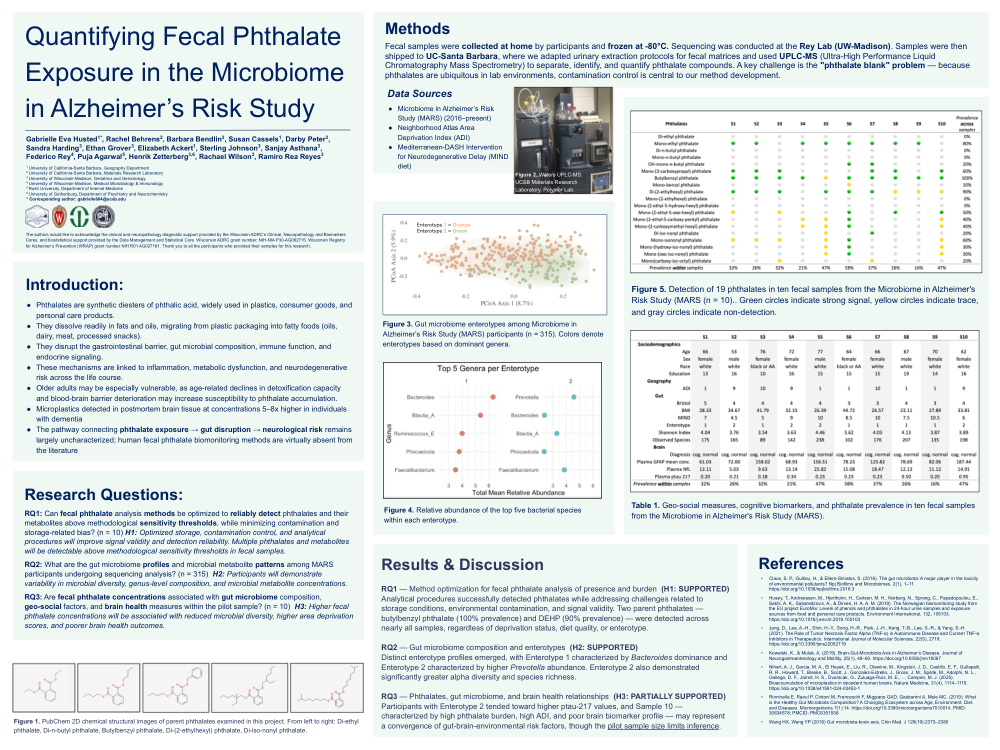
Quantifying Phthalate Levels In Human Fecal Samples In The Wisconsin Microbiome In Alzheimer’s Risk Study Cohort
Part of Topic
Biomarkers -> Biomarkers (non-neuroimaging) -> Novel biomarkers
Abstract:
Background: Phthalates are ubiquitous (e.g., plastics, cosmetics, food packaging), and re-
exposure is continuous despite rapid elimination. Phthalates are linked with adverse health
outcomes, however relationships with dementia risk are not known. This proof-of-concept study
generated fecal phthalate metabolomics to examine gut microbiome ecology, geo-social
determinants of health (area deprivation index or ADI), and brain biomarker outcomes.
Methods: This study integrates participant and biospecimen-level data from the Microbiome in
Alzheimer's Risk Study (MARS), drawn from the Wisconsin Registry for Alzheimer's Prevention
(WRAP) and Alzheimer's Disease Research Center (ADRC) cohorts. Four aims guided this work: (1)
method optimization of fecal phthalate analysis (n = 10); (2) quantification of 19 phthalates and
metabolites; (3) characterization of gut microbiome composition via sequencing; and (4)
description of relationships between phthalate prevalence, microbiome composition, geo-social
factors, and brain health measures. Key outcomes include Alzheimer's diagnosis and plasma
biomarkers (GFAP, NfL, ptau-217). Key predictors include phthalate presence/absence, age, sex,
race, education, Area Deprivation Index (ADI), Bristol score, BMI, MIND diet score, enterotype,
Shannon index, and observed species count.
Results: PERMANOVA confirmed significant differences in microbial community composition
between the Bacteroides dominant enterotype and the Prevotella dominant enterotype (R² =
0.04, F = 14.28, p = 0.001); the modest effect size suggests enterotypes reflect shifts in relative
abundance among shared taxa rather than discrete ecosystems. In this pilot cohort of
ten cognitively unimpaired adults, ADI did not consistently predict within-sample phthalate
burden — samples from both low- and high-deprivation areas spanned wide detection ranges.
Butylbenzyl phthalate and DEHP were detected across nearly all samples regardless of
socioeconomic context.
Conclusion: This pilot study demonstrates that fecal phthalate measurement is analytically
feasible. Measuring phthalate metabolites in feces, where gut microbes are directly present,
provides the opportunity to examine direct phthalate effects on gut microbiome, compared to
the more common use of urinary metabolites, which primarily reflect downstream metabolic and
excretory processes. Consistent with the Brain Health Synercome framework (Baez et al., 2026),
findings underscore the need to integrate structural and individual-level exposure
characterization to understand plastic-associated risk for brain health.
Comments
Email is required but is not shown publicly.
Loading comments...