4,068 posters, 219 videos, 101 topics, 69 sessions, 14,365 authors, 6,128 institutions
ePostersLive by SciGen Technologies S.A. All rights reserved.
Alzheimer's Association International Conference 2026
July 12-15, 2026 | London, United Kingdom, and Online

13008
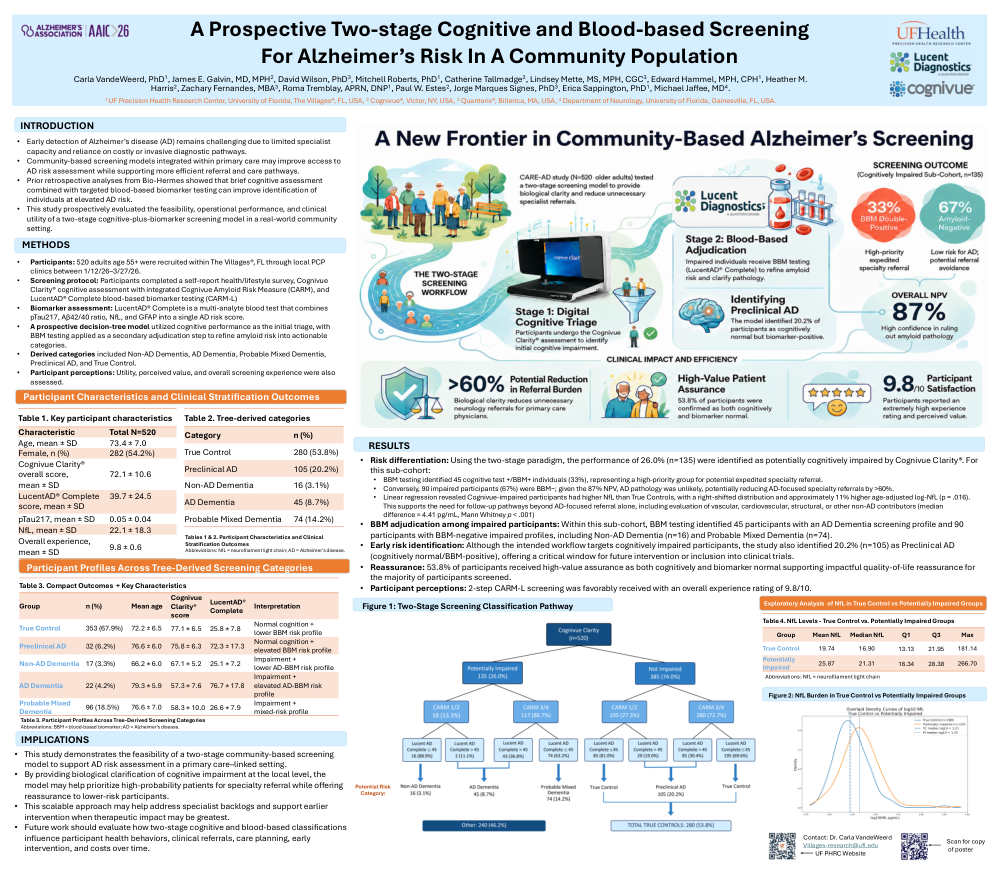
Prospective Two-stage Cognitive And Blood-based Screening For Alzheimer’s Risk In A Community Population
Poster Presenter
Authors
Carla VandeWeerd, PhD, James E. Galvin, MD, MPH, David Wilson, PhD, Mitchell Roberts, PhD, Catherine Tallmadge, Lindsey Mette, MS, MPH, CGC, Edward Hammel, MPH, CPH, Heather M. Harris, Zachary Fernandes, MBA, Roma Tremblay, APRN, DNP, Paul W. Estes, Jorge Marques Signes, PhD, Erica Sappington, PhD, Michael Jaffee, MD
Affiliations
UF Precision Health Research Center, University of Florida, The Villages®, FL, USA, Cognivue®, Victor, NY, USA, Quanterix®, Billerica, MA, USA, Department of Neurology, University of Florida, Gainesville, FL, USA
Part of Topic
Biomarkers -> Biomarkers (non-neuroimaging) -> Fluid biomarkers
A Prospective Two-stage Cognitive and Blood-based Screening For Alzheimer’s Risk In A Community Population
Background: Early Alzheimer’s disease (AD) detection is limited by costly, specialist-dependent diagnostics. Scalable, community-based screening (CBS)
overseen by primary care physicians (PCPs) is needed to improve care pathway efficiencies. Previously, a two-stage model combining brief cognitive
assessment with targeted blood-based biomarker (BBM) testing demonstrated strong retrospective performance in the Bio-Hermes study.1 Here, we
prospectively evaluated the feasibility and utility of this approach in a real-world community setting.
Methods: The first 453 older adults (55+) in The Villages®, FL were enrolled in the CARE-AD study 1/12/26-3/26/26 through local PCP clinics. Participants
completed a self-report health/lifestyle survey, the Cognivue Clarity® digital cognitive assessment with integrated Cognivue Amyloid Risk Measure
(CARM),2 and the LucentAD® Complete multi-analyte blood test which combines pTau217, Ab42/40 ratio, NfL, and GFAP into a single score.3 A
prospective decision-tree model utilized cognitive performance as the initial triage, with BBM testing applied as a secondary adjudication step to refine
amyloid risk into actionable categories: Non-AD dementia, AD Dementia, Probable-Mixed Dementia, and Preclinical AD. Participant perceptions of utility
and value were also assessed.
Results: Mean age was 73.4. Using the 2-stage paradigm, 24.7% (n=112) were identified as cognitively impaired via Clarity. For this sub-cohort, the BBM
provided biological clarification: 41 (~37%) were double-positive, representing a high-priority group for potential expedited referral. Conversely, the BBM
identified 71 impaired individuals (63%) as amyloid-negative; given the 96% NPV, amyloid pathology could be ruled out, potentially reducing the
specialty referral burden by >60%. Although the intended clinical workflow targets only the impaired, this study’s design also identified 21.4%(n=97) as
Preclinical AD (cognitively normal/BBM-positive), offering a critical window for future intervention. Finally, 54.4% of participants received high-value
assurance as both cognitively and biomarker normal, contributing to an overall experience rating of 9.7/10.
Conclusion: This study demonstrates the feasibility of a two-stage CBS model to optimize resource allocation in a community screening context. By
providing biological clarification of cognitive impairment at the local level, the model prioritizes high-probability patients for potential specialty referral
while offering meaningful assurance to the majority of participants. This scalable approach addresses specialist backlogs and enables earlier intervention
when therapeutic impact is greatest.
Comments
Email is required but is not shown publicly.
Loading comments...