4,068 posters, 219 videos, 101 topics, 69 sessions, 14,365 authors, 6,128 institutions
ePostersLive by SciGen Technologies S.A. All rights reserved.
Alzheimer's Association International Conference 2026
July 12-15, 2026 | London, United Kingdom, and Online

1287
Predicting Amyloid-β Positivity In Alzheimer's Disease Neuroimaging Initiative Cohort: Implications For Clinical Pre-screening
Poster Presenter
Authors
Durjoy Lahiri, Anne Liu, Shaaminy Kathir, Rose Lucina, Leslie Gao, Taylor Cole, Joelle Ghobrial, Stamatoula Pasvanis, Bruna Seixas-Lima, Carlos Roncero, Howard Chertkow
Affiliations
Medicine, Queen's University, Kingston, ON, Canada; LACE Lab, Queen's University, Kingston, ON, Canada, LACE Lab, Queen's University, Kingston, ON, Canada; Queen's University, Kingston, ON, Canada, LACE Lab, Kingston, ON, Canada; Clinical Trials Unit, Queen's University, Kingston, ON, Canada, Baycrest Academy for Research and Education, Toronto, ON, Canada, Medicine, Baycrest Academy for Research and Education, Toronto, ON, Canada, University of Toronto, Toronto, ON, Canada
Part of Topic
Video
Predicting Amyloid-β Positivity In Alzheimer's Disease Neuroimaging Initiative (ADNI) Cohort: Implications For Clinical Pre-screening
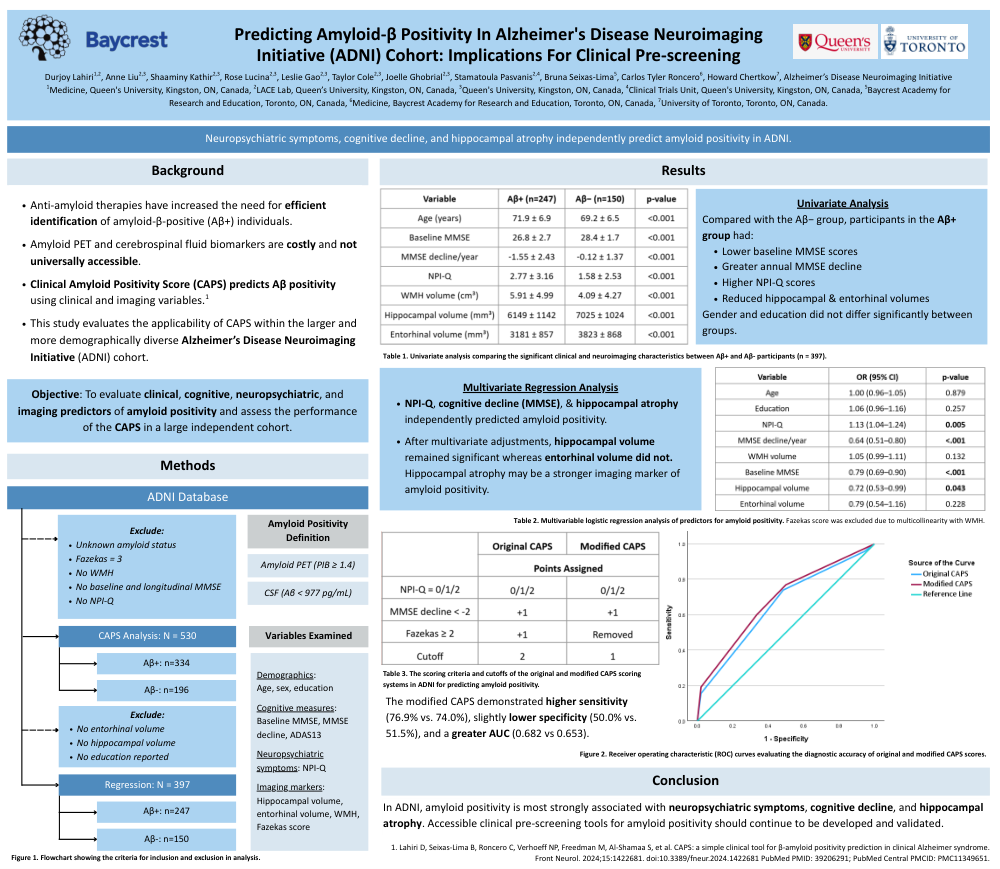
Anti-amyloid therapies have increased the need for efficient identification of amyloid-β-positive (Aβ+) individuals.
Amyloid PET and cerebrospinal fluid biomarkers are costly and not universally accessible.
Clinical Amyloid Positivity Score (CAPS) predicts Aβ positivity using clinical and imaging variables.
This study evaluates the applicability of CAPS within the larger and more demographically diverse Alzheimer’s Disease Neuroimaging Initiative (ADNI) cohort.
Objective: To evaluate clinical, cognitive, neuropsychiatric, and imaging predictors of amyloid positivity and assess the performance of the CAPS in a large independent cohort.
Univariate Analysis
Compared with the Aβ− group, participants in the Aβ+ group had:
Lower baseline MMSE scores
Greater annual MMSE decline
Higher NPI-Q scores
Reduced hippocampal & entorhinal volumes
Gender and education did not differ significantly between groups.
Multivariate Regression Analysis
NPI-Q, cognitive decline (MMSE), & hippocampal atrophy independently predicted amyloid positivity.
After multivariate adjustments, hippocampal volume remained significant whereas entorhinal volume did not. Hippocampal atrophy may be a stronger imaging marker of amyloid positivity.
The modified CAPS demonstrated higher sensitivity (76.9% vs. 74.0%), slightly lower specificity (50.0% vs. 51.5%), and a greater AUC (0.682 vs 0.653).
In ADNI, amyloid positivity is most strongly associated with neuropsychiatric symptoms, cognitive decline, and hippocampal atrophy. Cohort-specific adaptations improved predictive accuracy of moderate CAPS performance in ADNI. Accessible clinical pre-screening tools for amyloid positivity should continue to be developed and validated.
Comments
Email is required but is not shown publicly.
Loading comments...