4,068 posters, 219 videos, 101 topics, 69 sessions, 14,365 authors, 6,128 institutions
ePostersLive by SciGen Technologies S.A. All rights reserved.
Alzheimer's Association International Conference 2026
July 12-15, 2026 | London, United Kingdom, and Online

13920
Prioritizing Knowledge Frontiers In Alzheimer’S Disease Using A Graph-based Semantic Potential Framework
Poster Presenter
Authors
Part of Topic
Biomarkers -> Biomarkers (non-neuroimaging) -> Method development and/or quality control
Video
The previous two posters showed how we built a knowledge graph for Alzheimer's disease, and how we transformed that graph into a semantic landscape for exploration. But I want to start with a question: what if the graph could grow — continuously — as science advances?
That is exactly what we are doing now.
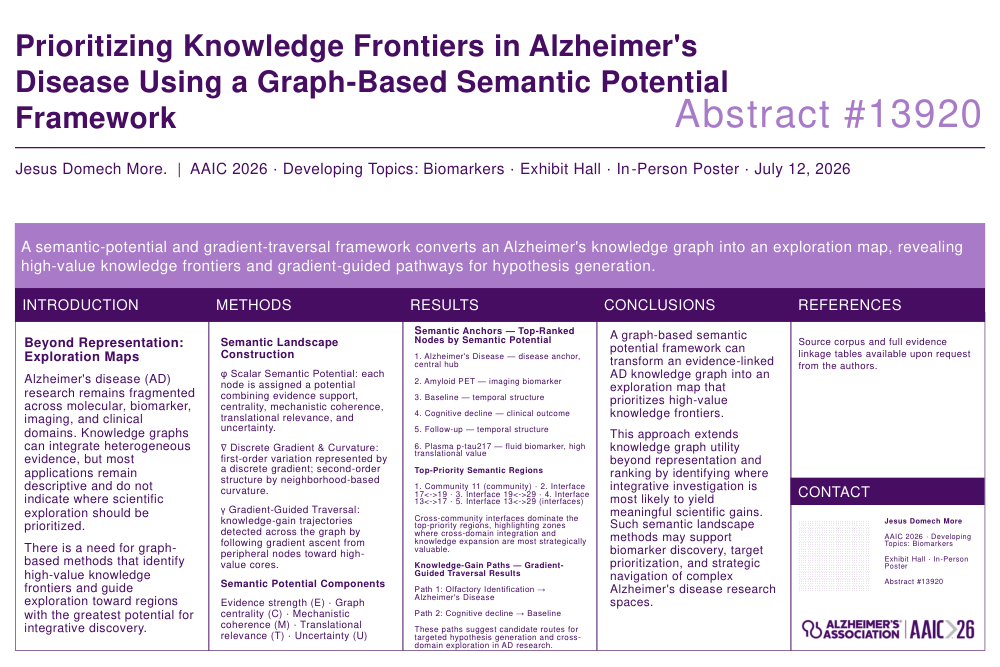
The graph submitted to AAIC was built from the analysis of approximately 250 scientific articles. That was already enough to reveal meaningful patterns — knowledge frontiers, semantic anchors, gradient-guided paths.
But since then, we have developed a platform that scales this process. Today, the system automatically analyzes and integrates over 1,000 articles — and builds the ontological graph in real time, applying the full semantic potential pipeline we saw in the previous posters.
The platform ingests scientific articles, extracts entities and relations using large language models, links each relation back to its source document, and dynamically builds the ontological graph. It then applies the semantic potential framework — automatically computing the highest-value nodes, the priority regions, and the highest knowledge-gain paths.
What we are looking at here is a living graph — one that reflects the current state of Alzheimer's science, and is updated as new articles are incorporated.
The findings in this poster confirm what we saw in the smaller version — with much greater robustness. The highest-potential semantic anchors remain Alzheimer's disease, Amyloid PET, Baseline, Cognitive decline, Follow-up, and plasma p-tau217. Inter-community interfaces continue to emerge as the highest-priority exploration zones. And gradient-guided paths reveal concrete hypothesis-generation routes — from peripheral nodes toward high-value cores.
What we are building is not a static analysis of a corpus. It is a continuous scientific intelligence infrastructure — one capable of monitoring the field, identifying where knowledge is growing, and pointing to where the next discoveries are most likely to emerge.
Immediate applications include biomarker prioritization, therapeutic target identification, and systematic hypothesis generation in translational Alzheimer's research.
Alzheimer's science needs maps, not just data. We are building those maps — and making them richer, more precise, and more actionable with every new article incorporated. Thank you.
Comments
Email is required but is not shown publicly.
Loading comments...