4,068 posters, 219 videos, 101 topics, 69 sessions, 14,365 authors, 6,128 institutions
ePostersLive by SciGen Technologies S.A. All rights reserved.
Alzheimer's Association International Conference 2026
July 12-15, 2026 | London, United Kingdom, and Online

13448
Predicting Blood-Based Biomarker Positivity For Pre-Clinical Alzheimer’s Trial Recruitment Using RWD And Predictive Modeling
Poster Presenter
Authors
Sean Black, Jackson Dooley, Conner Phalen, Alex Li, Silvia Metelli
Affiliations
Part of Topic
Biomarkers -> Biomarkers (non-neuroimaging) -> Clinical trials
PredictingBlood-Based Biomarker Positivity for Pre-Clinical Alzheimer’s Trial Recruitment Using RWD and Predictive Modeling
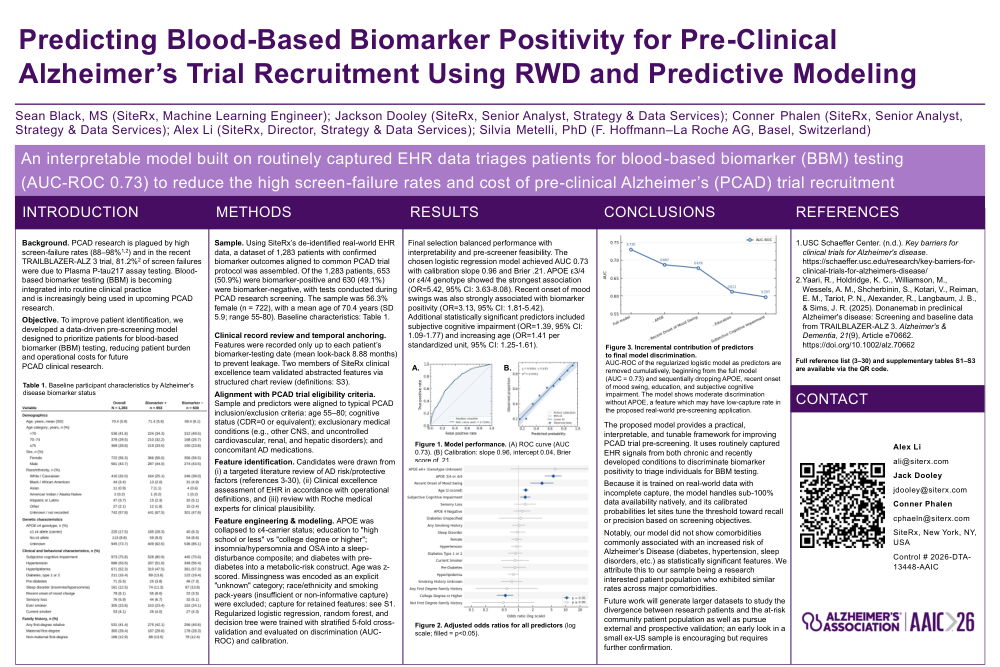
An interpretable model built on routinely captured EHR data triages patients for blood-based biomarker (BBM) testing (AUC-ROC 0.73) to reduce the high screen-failure rates and cost of pre-clinical Alzheimer’s (PCAD) trial recruitment.
Introduction
Background. PCAD research is plaguedby high screen-failure rates (88–98%1,2)and in the recent TRAILBLAZER-ALZ 3 trial,81.2%2of screen failures were due to Plasma P-tau217 assay testing.Blood based biomarker testing (BBM)isbecoming integrated into routine clinical practice andisincreasingly being used inupcomingPCAD research. Objective. To improve patient identification, we developed a data-driven pre-screening model designed to prioritize patients for blood-based biomarker (BBM) testing, reducing patient burden and operational costs forfuture
Methods
Sample. UsingSiteRx’sde-identifiedreal-world EHR data, a dataset of1,283 patientswith confirmed biomarker outcomes aligned to common PCAD trial protocolwasassembled.Of the 1,283 patients, 653 (50.9%) were biomarker-positive and 630 (49.1%) were biomarker-negative,with tests conducted during PCAD research screening.The samplewas 56.3% female (n = 722), with a mean age of 70.4 years (SD 5.9; range 55-80). Baseline characteristics: Table 1. Clinical record review and temporal anchoring. Features were recorded only up to each patient’s biomarker-testing date (mean look-back 8.88 months) to prevent leakage. Two members of SiteRxclinical excellence teamvalidated abstracted features via structured chart review (definitions: S3). Alignment with PCAD trial eligibility criteria. Sample and predictors were aligned to typical PCAD inclusion/exclusion criteria: age 55–80; cognitive status (CDR=0 or equivalent); exclusionary medical conditions (e.g., other CNS, and uncontrolled cardiovascular, renal, and hepatic disorders); and concomitant AD medications. Feature identification. Candidates were drawn from (i) a targeted literature review of AD risk/protective factors (references 3-30), (ii) Clinical excellence assessment of EHR in accordance with operational definitions, and (iii) review with Roche medical experts for clinical plausibility. Feature engineering & modeling. APOE was collapsed to ε4-carrier status; education to "high school or less" vs "college degree or higher"; insomnia/hypersomnia and OSA into a sleep disturbance composite; and diabetes with pre diabetes into a metabolic-risk construct. Age was z scored. Missingness was encoded as an explicit "unknown" category; race/ethnicity and smoking pack-years (insufficient or non-informative capture) were excluded; capture for retained features: see S1. Regularized logistic regression, random forest, and decision tree were trained with stratified 5-fold cross validation and evaluated on discrimination (AUC ROC) and calibration.
Results
Final selection balanced performance with interpretability and pre-screener feasibility. The chosenlogistic regressionmodel achieved AUC 0.73 with calibration slope 0.96 and Brier .21. APOE ε3/4 or ε4/4 genotypeshowedthe strongest association (OR=5.42, 95% CI: 3.63-8.08). Recent onset of mood swings was also strongly associated with biomarker positivity (OR=3.13, 95% CI: 1.81-5.42). Additionalstatistically significantpredictors included subjective cognitive impairment (OR=1.39, 95% CI: 1.09-1.77) and increasing age (OR=1.41per standardized unit, 95% CI: 1.25-1.61).
Conclusions
The proposed model provides a practical, interpretable, and tunable framework for improving PCAD trial pre-screening. It uses routinely captured EHR signals from both chronic and recently developed conditions to discriminate biomarker positivity to triage individuals for BBM testing. Because it is trained on real-world data with incomplete capture, the model handles sub-100% data availability natively, and its calibrated probabilities let sites tune the threshold toward recall or precision based on screening objectives. Notably, our model did not show comorbidities commonly associated with an increased risk of Alzheimer’s Disease (diabetes, hypertension, sleep disorders, etc.) as statistically significant features. We attribute this to our sample being a research interested patient population who exhibited similar rates across major comorbidities. Future work will generate larger datasets to study the divergence between research patients and the at-risk community patient populationas well as pursue external and prospective validation; an early look in a small ex-US sample is encouraging but requires further confirmation
Comments
Email is required but is not shown publicly.
Loading comments...