4,068 posters, 219 videos, 101 topics, 69 sessions, 14,365 authors, 6,128 institutions
ePostersLive by SciGen Technologies S.A. All rights reserved.
Alzheimer's Association International Conference 2026
July 12-15, 2026 | London, United Kingdom, and Online

13277
Plasma P-tau217 As A Potential Independent Biomarker For Predicting The Progression From MCI To AD Dementia
Poster Presenter
Authors
Qingjie Lian, Qingyuan Sun, Xiaodong Han, Aidi Shan, Qingyuan Sun
Affiliations
School of Biological Science and Medical Engineering, Beihang University, 100191, Beijing, China. Innovation Center for Neurological Disorders and Department of Neurology, Xuanwu Hospital, Capital Medical University, National Clinical Research Center for Geriatric Diseases, 100053, Beijing, China., Innovation Center for Neurological Disorders and Department of Neurology, Xuanwu Hospital, Capital Medical University, National Clinical Research Center for Geriatric Diseases, 100053, Beijing, China., Innovation Center for Neurological Disorders and Department of Neurology, Xuanwu Hospital, Capital Medical University, National Clinical Research Center for Geriatric Diseases, 100053, Beijing, China. Jinan Hospital of Xuanwu Hospital, Shandong First Medical University, 250102, Jinan, China. Clinical Research Center, Xuanwu Hospital, Capital Medical University, National Clinical Research Center for Geriatric Diseases, 100053, Beijing, China.
Part of Topic
Biomarkers -> Biomarkers (non-neuroimaging) -> Prognostic utility
Qingjie Lian1, 2, Qingyuan Sun2, Xiaodong Han2, Aidi Shan2, Cuibai Wei2, 3, 4
1School of Biological Science and Medical Engineering, Beihang University, 100191, Beijing, China. 2Innovation Center for Neurological Disorders and Department of Neurology, Xuanwu Hospital, Capital Medical University, National Clinical Research Center for Geriatric Diseases, 100053, Beijing, China. 3Jinan Hospital of Xuanwu Hospital, Shandong First Medical University, 250102, Jinan, China. 4Clinical Research Center, Xuanwu Hospital, Capital Medical University, National Clinical Research Center for Geriatric Diseases, 100053, Beijing, China.
INTRODUCTION: Alzheimer's disease (AD) is the leading cause of dementia. Mild cognitive impairment (MCI) represents a critical stage for the early prevention and treatment of AD. Multiple plasma biomarkers, including phosphorylated tau 217 (p-tau217), have shown predictive potential for AD at the MCI stage. However, the comparative predictive performance of p-tau217 and Aβ-PET for AD remains uncertain. Furthermore, whether multi-biomarker plasma panels can improve clinical utility for AD prediction is unclear. Accordingly, this study aimed to assess whether plasma p-tau217 could serve as an alternative to Aβ-PET and multi-biomarker plasma panels for predicting AD in MCI individuals.
METHODS: Using follow-up diagnostic information, we included 47 MCI-Converters (patients who progressed to AD) and 66 MCI-Nonconverters (patients who did not progress) from the Alzheimer’s Disease Neuroimaging Initiative. Wilcoxon rank-sum tests, five-fold cross-validated logistic regression models, DeLong tests, Akaike information criterion, Bayesian information criterion, Cox proportional hazards models, Spearman correlations, and linear mixed-effects models (LMM) were applied to evaluate inter-group differences, discriminative performance, conversion risk, and associations of plasma biomarkers with Aβ-PET measures (centiloid, summary SUVR) and longitudinal cognitive decline. Risk stratification analyses were further conducted using LMM after categorizing participants into low-, moderate-, and high-risk strata according to a p-tau217-based two-cut-point approach.
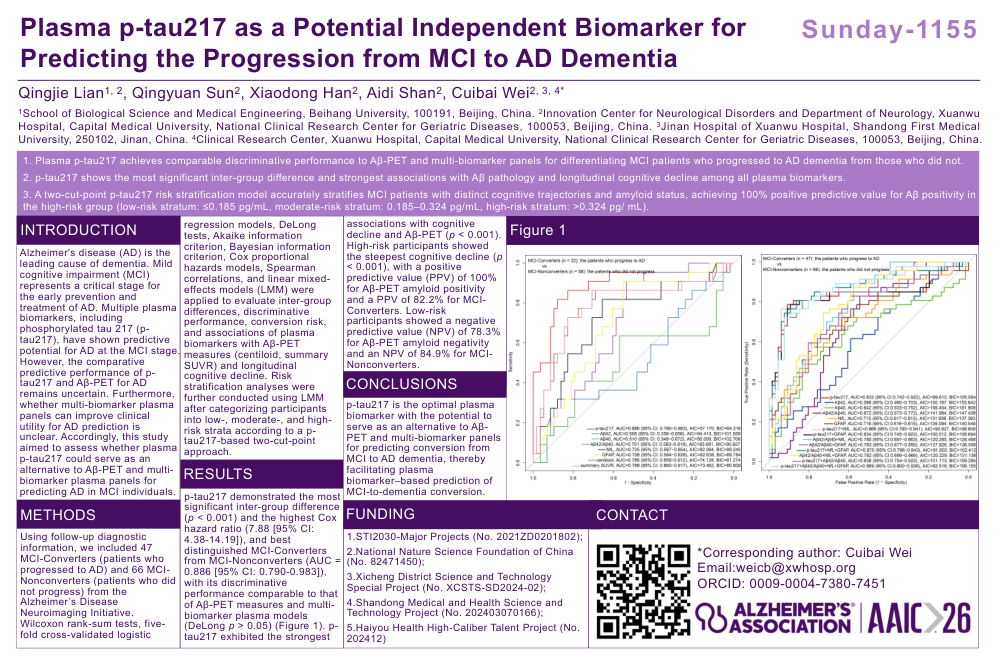
RESULTS: p-tau217 demonstrated the most significant inter-group difference (p < 0.001) and the highest Cox hazard ratio (7.88 [95% CI: 4.38-14.19]), and best distinguished MCI-Converters from MCI-Nonconverters (AUC = 0.886 [95% CI: 0.790-0.983]), with its discriminative performance comparable to that of Aβ-PET measures and multi-biomarker plasma models (DeLong p > 0.05). p-tau217 exhibited the strongest associations with cognitive decline and Aβ-PET (p < 0.001). High-risk participants showed the steepest cognitive decline (p < 0.001), with a positive predictive value (PPV) of 100% for Aβ-PET amyloid positivity and a PPV of 82.2% for MCI-Converters. Low-risk participants showed a negative predictive value (NPV) of 78.3% for Aβ-PET amyloid negativity and an NPV of 84.9% for MCI-Nonconverters.
CONCLUSIONS: p-tau217 is the optimal plasma biomarker with the potential to serve as an alternative to Aβ-PET and multi-biomarker panels for predicting conversion from MCI to AD dementia, thereby facilitating plasma biomarker–based prediction of MCI-to-dementia conversion.
Comments
Email is required but is not shown publicly.
Loading comments...