Loading...

4,068 posters, 219 videos, 101 topics, 69 sessions, 14,365 authors, 6,128 institutions

ePostersLive by SciGen Technologies S.A. All rights reserved.

Alzheimer's Association International Conference 2026

July 12-15, 2026 | London, United Kingdom, and Online

Alzheimer's Association International Conference 2026 banner

13490

Plasma MTBR-tau243 As An Advanced Disease Biomarker Across Alzheimer’s Disease Clinical Variants
Part of Topic

Biomarkers -> Biomarkers (non-neuroimaging) -> Fluid biomarkers

Background
 
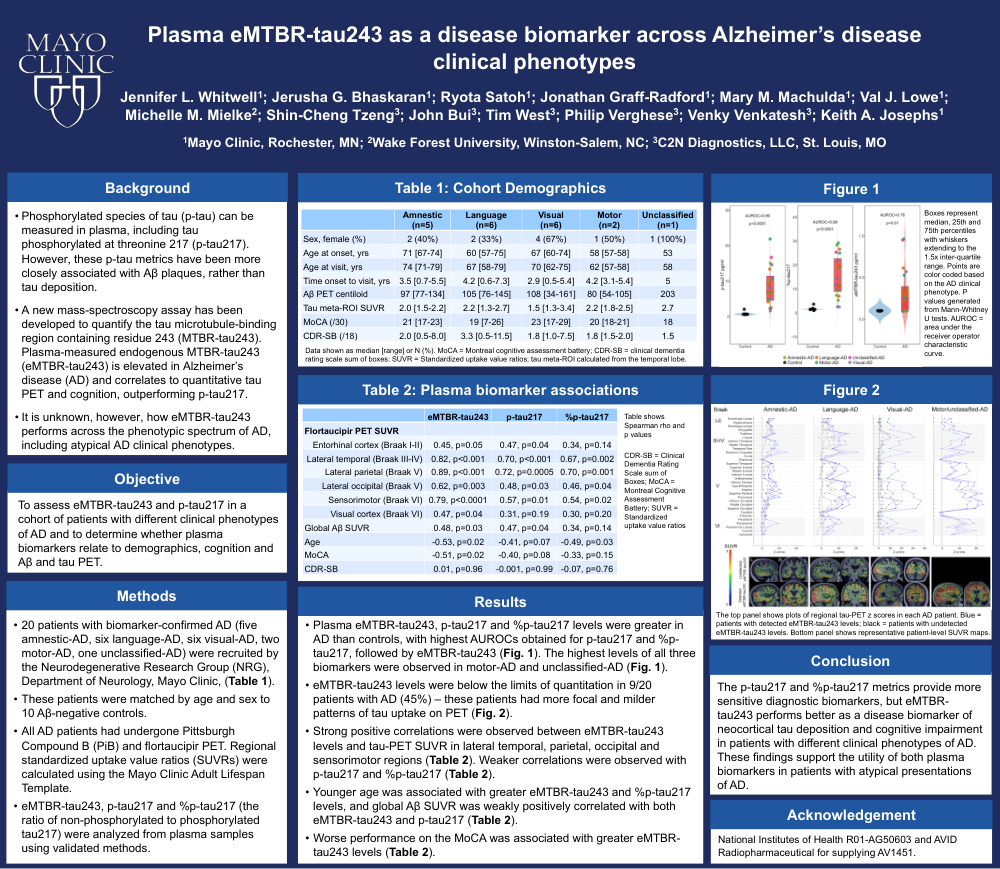
•Phosphorylated species of tau (p-tau) can be measured in plasma, including tau phosphorylated at threonine 217 (p-tau217). However, these p-tau metrics have been more closely associated with Aβ plaques, rather than tau deposition.
•A new mass-spectroscopy assay has been developed to quantify the tau microtubule-binding region containing residue 243 (MTBR-tau243). Plasma-measured endogenous MTBR-tau243 (eMTBR-tau243) is elevated in Alzheimer’s disease (AD) and correlates to quantitative tau PET and cognition, outperforming p-tau217.
It is unknown, however, how eMTBR-tau243 performs across the phenotypic spectrum of AD, including atypical AD clinical phenotypes
 
Aims

To assess eMTBR-tau243 and p-tau217 in a cohort of patients with different clinical phenotypes of AD and to determine whether plasma biomarkers relate to demographics, cognition and Aβ and tau PET.

Results

•Plasma eMTBR-tau243, p-tau217 and %p-tau217 levels were greater in AD than controls, with highest AUROCs obtained for p-tau217 and %p-tau217, followed by eMTBR-tau243 (Fig. 1). The highest levels of all three biomarkers were observed in motor-AD and unclassified-AD (Fig. 1).
•eMTBR-tau243 levels were below the limits of quantitation in 9/20 patients with AD (45%) – these patients had more focal and milder patterns of tau uptake on PET (Fig. 2).
•Strong positive correlations were observed between eMTBR-tau243 levels and tau-PET SUVR in lateral temporal, parietal, occipital and sensorimotor regions (Table 2). Weaker correlations were observed with p-tau217 and %p-tau217 (Table 2).
•Younger age was associated with greater eMTBR-tau243 and %p-tau217 levels, and global Aβ SUVR was weakly positively correlated with both eMTBR-tau243 and p-tau217 (Table 2).
•Worse performance on the MoCA was associated with greater eMTBR-tau243 levels (Table 2).
 
Conclusion

The p-tau217 and %p-tau217 metrics provide more sensitive diagnostic biomarkers, but eMTBR-tau243 performs better as a disease biomarker of neocortical tau deposition and cognitive impairment in patients with different clinical phenotypes of AD. These findings support the utility of both plasma biomarkers in patients with atypical presentations of AD.

Acknowledgement

National Institutes of Health R01-AG50603 and AVID Radiopharmaceutical for supplying AV1451


Comments

Email is required but is not shown publicly.

Loading comments...

aaic2026 banner
Copyright © 2015-2026, ePostersLive® SciGen is a registered trademark of SciGen Technologies S.A. Patent pending.

This website and third-party tools we use rely on cookies for the best user experience. By selecting "I agree", you agree to cookie usage as described in our Privacy Policy.