4,068 posters, 219 videos, 101 topics, 69 sessions, 14,365 authors, 6,128 institutions
ePostersLive by SciGen Technologies S.A. All rights reserved.
Alzheimer's Association International Conference 2026
July 12-15, 2026 | London, United Kingdom, and Online

6859
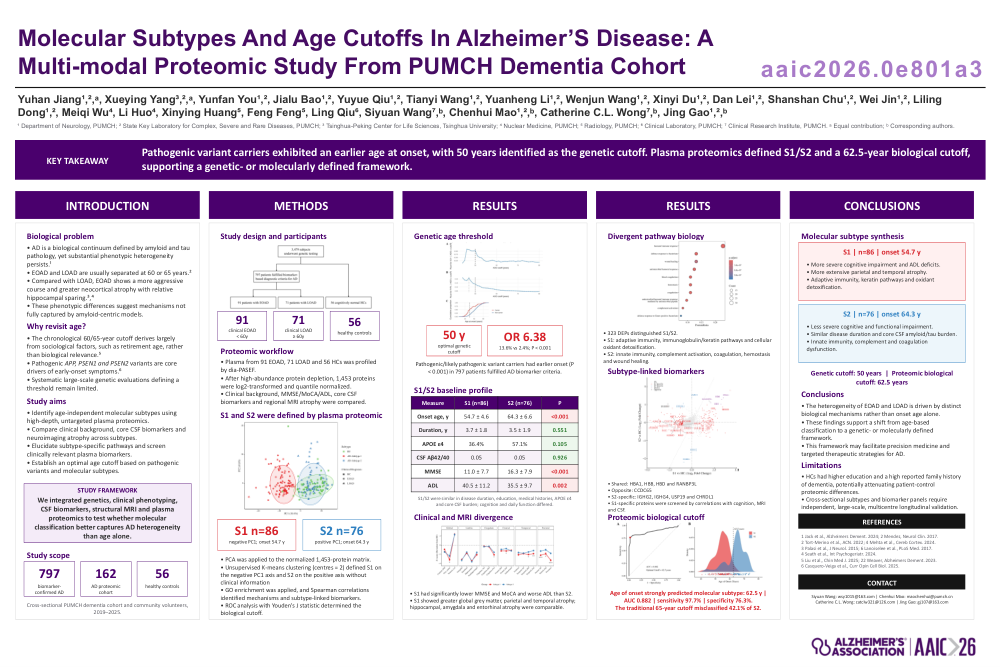
Molecular Subtypes And Age Cutoffs In Alzheimer’S Disease: A Multi-modal Proteomic Study From PUMCH Dementia Cohort
Poster Presenter
Authors
Yuhan Jiang, Xueying Yang, Yunfan You, Jialu Bao, Yuyue Qiu, Tianyi Wang, Yuanheng Li, Wenjun Wang, Xinyi Du, Dan Lei, Shanshan Chu, Wei Jin, Liling Dong, Meiqi Wu, Li Huo, Xinying Huang, Feng Feng, Ling Qiu, Siyuan Wang, Chenhui Mao, Catherine CL Wong, Jing Gao
Affiliations
Department of Neurology, Peking Union Medical College Hospital, Peking Union Medical College & China Academy of Medical Science, Beijing, China, Tsinghua-Peking Center for Life Sciences, School of Medicine, Tsinghua University, Beijing, China, Department of Nuclear Medicine, Peking Union Medical College Hospital, Peking Union Medical College & China Academy of Medical, Beijing, China, Department of Radiology, Peking Union Medical College Hospital, Peking Union Medical College & China Academy of Medical, Beijing, China, Department of Clinical Laboratory, Peking Union Medical College Hospital, Beijing, China, State Key Laboratory for Complex, Severe and Rare Diseases, Clinical Research Institute, Peking Union Medical College Hospital, Chinese Academy of Medical Science & Peking Union Medical College, Beijing, China
Part of Topic
Molecular Subtypes And Age Cutoffs In Alzheimer’S Disease: A Multi-modal Proteomic Study From PUMCH Dementia Cohort
aaic2026.0e801a3
Yuhan Jiang¹,²,ᵃ, Xueying Yang³,²,ᵃ, Yunfan You¹,², Jialu Bao¹,², Yuyue Qiu¹,², Tianyi Wang¹,², Yuanheng Li¹,², Wenjun Wang¹,², Xinyi Du¹,², Dan Lei¹,², Shanshan Chu¹,², Wei Jin¹,², Liling Dong¹,², Meiqi Wu⁴, Li Huo⁴, Xinying Huang⁵, Feng Feng⁵, Ling Qiu⁶, Siyuan Wang⁷,ᵇ, Chenhui Mao¹,²,ᵇ, Catherine C.L. Wong⁷,ᵇ, Jing Gao¹,²,ᵇ
¹ Department of Neurology, PUMCH; ² State Key Laboratory for Complex, Severe and Rare Diseases, PUMCH; ³ Tsinghua-Peking Center for Life Sciences, Tsinghua University; ⁴ Nuclear Medicine, PUMCH; ⁵ Radiology, PUMCH; ⁶ Clinical Laboratory, PUMCH; ⁷ Clinical Research Institute, PUMCH. ᵃ Equal contribution; ᵇ Corresponding authors.
KEY TAKEAWAY
Pathogenic variant carriers exhibited an earlier age at onset, with 50 years identified as the genetic cutoff. Plasma proteomics defined S1/S2 and a 62.5-year biological cutoff, supporting a genetic- or molecularly defined framework.
INTRODUCTION
Biological problem
• AD is a biological continuum defined by amyloid and tau pathology, yet substantial phenotypic heterogeneity persists.¹
• EOAD and LOAD are usually separated at 60 or 65 years.²
• Compared with LOAD, EOAD shows a more aggressive course and greater neocortical atrophy with relative hippocampal sparing.³,⁴
• These phenotypic differences suggest mechanisms not fully captured by amyloid-centric models.
Why revisit age?
• The chronological 60/65-year cutoff derives largely from sociological factors, such as retirement age, rather than biological relevance.⁵
• Pathogenic APP, PSEN1 and PSEN2 variants are core drivers of early-onset symptoms.⁶
• Systematic large-scale genetic evaluations defining a threshold remain limited.
Study aims
• Identify age-independent molecular subtypes using high-depth, untargeted plasma proteomics.
• Compare clinical background, core CSF biomarkers and neuroimaging atrophy across subtypes.
• Elucidate subtype-specific pathways and screen clinically relevant plasma biomarkers.
• Establish an optimal age cutoff based on pathogenic variants and molecular subtypes.
STUDY FRAMEWORK
We integrated genetics, clinical phenotyping, CSF biomarkers, structural MRI and plasma proteomics to test whether molecular classification better captures AD heterogeneity than age alone.
Study scope
797
biomarkerconfirmed AD
162
AD proteomic cohort
56
healthy controls
Cross-sectional PUMCH dementia cohort and community volunteers, 2019–2025.
METHODS
Study design and participants
91
clinical EOAD < 60y
71
clinical LOAD ≥ 60y
56
healthy controls
Proteomic workflow
• Plasma from 91 EOAD, 71 LOAD and 56 HCs was profiled by dia-PASEF.
• After high-abundance protein depletion, 1,453 proteins were log2-transformed and quantile normalized.
• Clinical background, MMSE/MoCA/ADL, core CSF biomarkers and regional MRI atrophy were compared.
S1 and S2 were defined by plasma proteomic
S1 n=86
negative PC1; onset 54.7 y
S2 n=76
positive PC1; onset 64.3 y
• PCA was applied to the normalized 1,453-protein matrix.
• Unsupervised K-means clustering (centres = 2) defined S1 on the negative PC1 axis and S2 on the positive axis without clinical information
• GO enrichment was applied, and Spearman correlations identified mechanisms and subtype-linked biomarkers.
• ROC analysis with Youden's J statistic determined the biological cutoff.
RESULTS
Genetic age threshold
50 y
optimal genetic cutoff
OR 6.38
13.6% vs 2.4%; P < 0.001
Pathogenic/likely pathogenic variant carriers had earlier onset (P < 0.001) in 797 patients fulfilled AD biomarker criteria.
S1/S2 baseline profile
|
Measure |
S1(n=86) |
S2(n=76) |
P |
|
Onsetage,y |
54.7±4.6 |
64.3±6.6 |
<0.001 |
|
Duration,y |
3.7±1.8 |
3.5±1.9 |
0.551 |
|
APOEε4 |
36.4% |
57.1% |
0.105 |
|
CSFAβ42/40 |
0.05 |
0.05 |
0.926 |
|
MMSE |
11.0±7.7 |
16.3±7.9 |
<0.001 |
|
ADL |
40.5±11.2 |
35.5±9.7 |
0.002 |
S1/S2 were similar in disease duration, education, medical histories, APOE ε4 and core CSF burden; cognition and daily function differed.
Clinical and MRI divergence
• S1 had significantly lower MMSE and MoCA and worse ADL than S2.
• S1 showed greater global grey matter, parietal and temporal atrophy; hippocampal, amygdala and entorhinal atrophy were comparable.
RESULTS
Divergent pathway biology
• 323 DEPs distinguished S1/S2.
• S1: adaptive immunity, immunoglobulin/keratin pathways and cellular oxidant detoxification.
• S2: innate immunity, complement activation, coagulation, hemostasis and wound healing.
Subtype-linked biomarkers
• Shared: HBA1, HBB, HBD and RANBP3L
• Opposite: CCDC65
• S2-specific: IGHG2, IGHG4, USP19 and CHRDL1
• S1-specific proteins were screened by correlations with cognition, MRI and CSF.
Proteomic biological cutoff
Age of onset strongly predicted molecular subtype: 62.5 y | AUC 0.882 | sensitivity 97.7% | specificity 76.3%. The traditional 65-year cutoff misclassified 42.1% of S2.
CONCLUSIONS
Molecular subtype synthesis
S1 | n=86 | onset 54.7 y
• More severe cognitive impairment and ADL deficits.
• More extensive parietal and temporal atrophy.
• Adaptive immunity, keratin pathways and oxidant detoxification.
S2
|
n=76
|
onset
64.3
y
• Less severe cognitive and functional impairment.
• Similar disease duration and core CSF amyloid/tau burden.
• Innate immunity, complement and coagulation dysfunction.
Genetic cutoff: 50 years | Proteomic biological cutoff: 62.5 years
Conclusions
• The heterogeneity of EOAD and LOAD is driven by distinct biological mechanisms rather than onset age alone.
• These findings support a shift from age-based classification to a genetic- or molecularly defined framework.
• This framework may facilitate precision medicine and targeted therapeutic strategies for AD.
Limitations
• HCs had higher education and a high reported family history of dementia, potentially attenuating patient-control proteomic differences.
• Cross-sectional subtypes and biomarker panels require independent, large-scale, multicentre longitudinal validation.
REFERENCES
1 Jack et al., Alzheimers Dement. 2024; 2 Mendez, Neurol Clin. 2017. 2 Tort-Merino et al., ACN. 2022; 4 Mehta et al., Cereb Cortex. 2024. 3 Palasi et al., J Neurol. 2015; 6 Lanoiselee et al., PLoS Med. 2017.
4 Seath et al., Int Psychogeriatr. 2024.
5 Liu et al., Chin Med J. 2025; 22 Weaver, Alzheimers Dement. 2023. 6 Casquero-Veiga et al., Curr Opin Cell Biol. 2025.
CONTACT
Siyuan Wang: wsy1015@163.com | Chenhui Mao: maochenhui@pumch.cn Catherine C.L. Wong: catclw321@126.com | Jing Gao: gj107@163.com
Comments
Email is required but is not shown publicly.
Loading comments...