4,068 posters, 219 videos, 101 topics, 69 sessions, 14,365 authors, 6,128 institutions
ePostersLive by SciGen Technologies S.A. All rights reserved.
Alzheimer's Association International Conference 2026
July 12-15, 2026 | London, United Kingdom, and Online

13343
Plasma Biomarker Profiles In Heterozygous APOE3-Christchurch Carriers From The Colombian PSEN1 E280A Kindred
Poster Presenter
Authors
Vincent Malotaux, Catarina Tristão-Pereira, Yesica Zuluaga, Claudia Munoz, Alejandro Guerrero, Yamile Bocanegra, Diana Alzate, Laura Serna, Claudia Guzman, Carolina Ospina, Yinghua Chen, Yi Su, Joseph F. Arboleda-Velasquez, David Aguillon, Yakeel T. Quiroz
Affiliations
Grupo de Neurociencias de Antioquia, Facultad de Medicina, Universidad de Antioquia, Medellín, Colombia, Department of Psychological & Brain Sciences, Boston University, MA, USA, Banner Alzheimer's Institute, Phoenix, Arizona, USA, Schepens Eye Research Institute of Mass Eye and Ear and Department of Ophthalmology at Harvard Medical School, Boston, MA, USA, Department of Psychological & Brain Sciences, Boston University, MA, USA.
Part of Topic
Biomarkers -> Biomarkers (non-neuroimaging) -> Fluid biomarkers
Background:
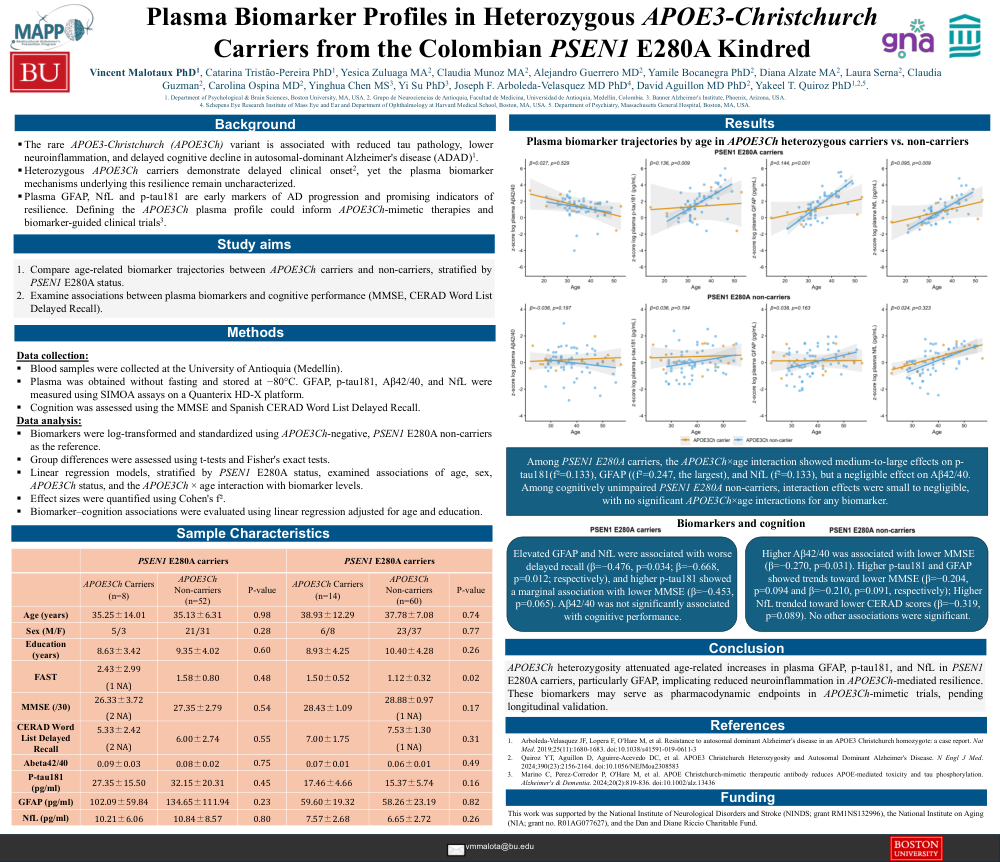
The rare APOE3-Christchurch (APOE3Ch) variant is associated with reduced tau pathology, lower neuroinflammation, and delayed cognitive decline in autosomal-dominant Alzheimer's disease (ADAD). Heterozygous APOE3Ch carriers demonstrate delayed clinical onset yet, the plasma biomarker mechanisms underlying this resilience remain uncharacterized. Plasma GFAP, NfL and p-tau181 are early markers of AD progression and promising indicators of resilience. Defining the APOE3Ch plasma profile could inform APOE3Ch-mimetic therapies and biomarker-guided clinical trials.
Study aims:
1. Compare age-related biomarker trajectories between APOE3Ch carriers and non-carriers, stratified by PSEN1 E280A status.
2. Examine associations between plasma biomarkers and cognitive performance (MMSE, CERAD Word List Delayed Recall).
Methods:
Data collection: Blood samples were collected at the University of Antioquia (Medellín). Plasma was obtained without fasting and stored at −80°C. GFAP, p-tau181, Aβ42/40, and NfL were measured using SIMOA assays on a Quanterix HD-X platform. Cognition was assessed using the MMSE and Spanish CERAD Word List Delayed Recall. Data analysis: Biomarkers were log-transformed and standardized using APOE3Ch-negative, PSEN1 E280A non-carriers as the reference. Group differences were assessed using t-tests and Fisher's exact tests. Linear regression models, stratified by PSEN1 E280A status, examined associations of age, sex, APOE3Ch status, and the APOE3Ch × age interaction with biomarker levels. Effect sizes were quantified using Cohen's f². Biomarker–cognition associations were evaluated using linear regression adjusted for age and education.
Results:
Among PSEN1 E280A carriers, the APOE3Ch×age interaction showed medium-to-large effects on p-tau181(f²=0.133), GFAP ((f²=0.247, the largest), and NfL (f²=0.133), but a negligible effect on Aβ42/40. Among cognitively unimpaired PSEN1 E280A non-carriers, interaction effects were small to negligible, with no significant APOE3Ch×age interactions for any biomarker. In PSEN1 E280A carriers: Elevated GFAP and NfL were associated with worse delayed recall (β=−0.476, p=0.034; β=−0.668, p=0.012; respectively), and higher p-tau181 showed a marginal association with lower MMSE (β=−0.453, p=0.065). Aβ42/40 was not significantly associated with cognitive performance. In PSEN1 E280A non-carriers: Higher Aβ42/40 was associated with lower MMSE (β=−0.270, p=0.031). Higher p-tau181 and GFAP showed trends toward lower MMSE (β=−0.204, p=0.094 and β=−0.210, p=0.091, respectively); Higher NfL trended toward lower CERAD scores (β=−0.319, p=0.089). No other associations were significant.
Conclusion:
APOE3Ch heterozygosity attenuated age-related increases in plasma GFAP, p-tau181, and NfL in PSEN1 E280A carriers, particularly GFAP, implicating reduced neuroinflammation in APOE3Ch-mediated resilience. These biomarkers may serve as pharmacodynamic endpoints in APOE3Ch-mimetic trials, pending longitudinal validation.
Comments
Email is required but is not shown publicly.
Loading comments...