4,068 posters, 219 videos, 101 topics, 69 sessions, 14,365 authors, 6,128 institutions
ePostersLive by SciGen Technologies S.A. All rights reserved.
Alzheimer's Association International Conference 2026
July 12-15, 2026 | London, United Kingdom, and Online

13204
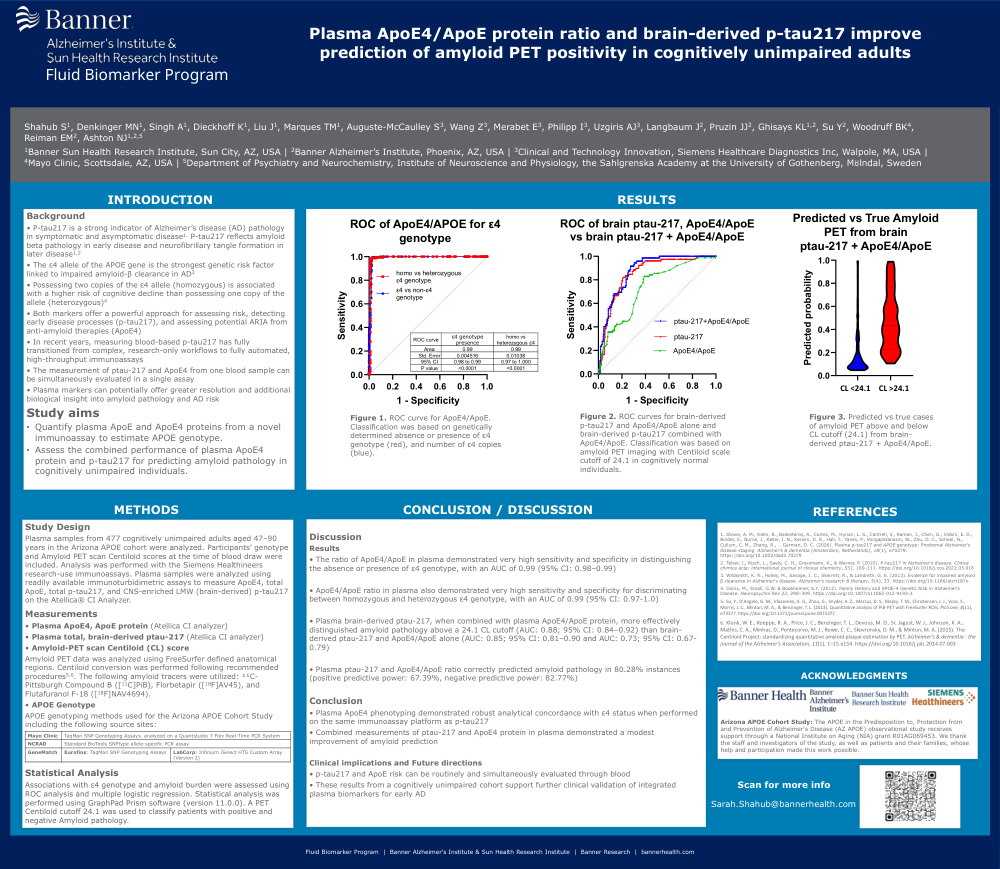
Plasma ApoE4/ApoE Protein Ratio And Brain-derived P-tau217 Improve Prediction Of Amyloid PET Positivity In Cognitively Unimpaired Adults
Poster Presenter
Authors
Part of Topic
Biomarkers -> Biomarkers (non-neuroimaging) -> Fluid biomarkers
Plasma ApoE4/ApoE protein ratio and brain-derived p-tau217 improve prediction of amyloid PET positivity in cognitively unimpaired adults
Background
• P-tau217 is a strong indicator of Alzheimer’s disease (AD) pathology in symptomatic and asymptomatic disease1. P-tau217 reflects amyloid beta pathology in early disease and neurofibrillary tangle formation in later disease1,2
• The ε4 allele of the APOE gene is the strongest genetic risk factor linked to impaired amyloid-β clearance in AD3
• Possessing two copies of the ε4 allele (homozygous) is associated with a higher risk of cognitive decline than possessing one copy of the allele (heterozygous)4
• Both markers offer a powerful approach for assessing risk, detecting early disease processes (p-tau217), and assessing potential ARIA from anti-amyloid therapies (ApoE4)
• In recent years, measuring blood-based p-tau217 has fully transitioned from complex, research-only workflows to fully automated, high-throughput immunoassays
• The measurement of ptau-217 and ApoE4 from one blood sample can be simultaneously evaluated in a single assay
• Plasma markers can potentially offer greater resolution and additional biological insight into amyloid pathology and AD risk
Study aims
Comments
Email is required but is not shown publicly.
Loading comments...