4,068 posters, 219 videos, 101 topics, 69 sessions, 14,365 authors, 6,128 institutions
ePostersLive by SciGen Technologies S.A. All rights reserved.
Alzheimer's Association International Conference 2026
July 12-15, 2026 | London, United Kingdom, and Online

11910
Oxford And Reading Cognitive Health After Recovery From Acute Illness And Delirium-Prospective Study (ORCHARD-PS)
Poster Presenter
Authors
Jasmine Gan, Lily Elderton, Meenu Vijayakumar Sheela, Sanchit Turaga, Jasmine Thomas, Jill Betts, Alexander Bampton, Aubretia McColl, Sarah T Pendlebury
Affiliations
Wolfson Centre for Prevention of Stroke and Dementia, Nuffield Department of Clinical Neurosciences, University of Oxford, Oxford, UK, Neurosciences Research Delivery Team (DENDRON), Oxford University Hospitals NHS Foundation Trust, Oxford, UK, Oxford (Thames Valley) Foundation School, Oxford University Hospitals NHS Foundation Trust, Oxford, UK, Medical Sciences Division, University of Oxford, Oxford, UK, University Department of Elderly Care, Royal Berkshire NHS Foundation Trust, Reading, UK, Wolfson Centre for Prevention of Stroke and Dementia, Nuffield Department of Clinical Neurosciences, University of Oxford, Oxford, UK; Departments of Acute General Internal Medicine and Geratology, Oxford University Hospitals NHS Foundation Trust, Oxford, UK
Part of Topic
Biomarkers -> Biomarkers (non-neuroimaging) -> Longitudinal
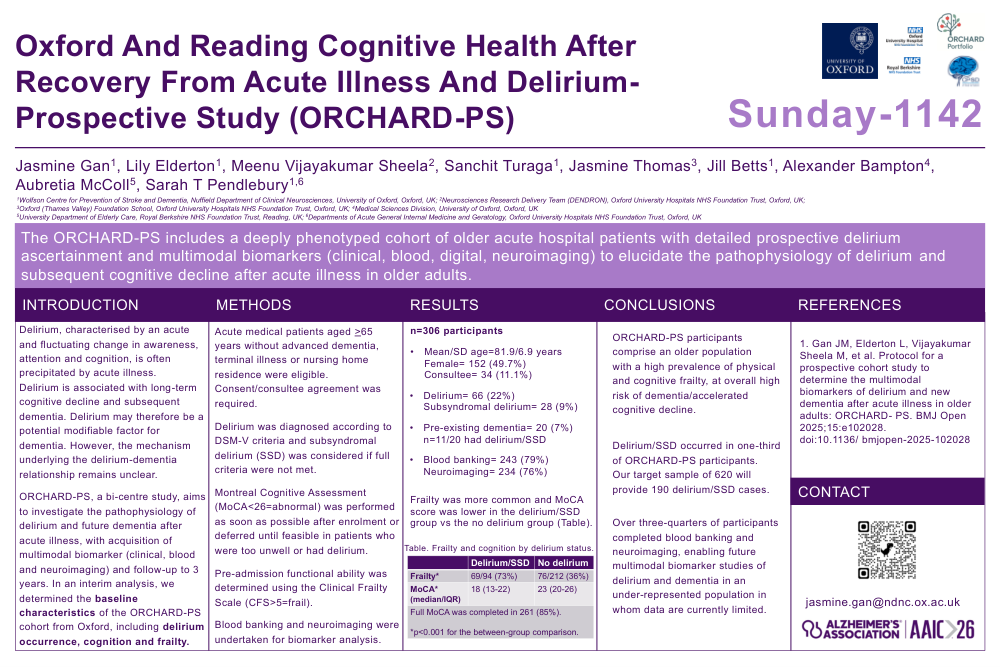
Background: Delirium, characterised by an acute and fluctuating change in awareness, attention and cognition, is often precipitated by acute illness. Delirium is associated with long-term cognitive decline and subsequent dementia. Delirium may therefore be a potential modifiable factor for dementia. However, the mechanism underlying the delirium-dementia relationship remains unclear. ORCHARD-PS, a bi-centre study, aims to investigate the pathophysiology of delirium and future dementia after acute illness, with acquisition of multimodal biomarker (clinical, blood and neuroimaging) and follow-up to 3 years. In an interim analysis, we determined the baseline characteristics of the ORCHARD-PS cohort from Oxford, including delirium occurrence, cognition and frailty.
Method: Acute medical patients aged >65 years without advanced dementia, terminal illness or nursing home residence were eligible. Consent/consultee agreement was required. Delirium was diagnosed according to DSM-V criteria and subsyndromal delirium (SSD) was considered if full criteria were not met. Montreal Cognitive Assessment (MoCA<26=abnormal) was performed as soon as possible after enrolment or deferred until feasible in patients who were too unwell or had delirium. Pre-admission functional ability was determined using the Clinical Frailty Scale (CFS>5=frail). Blood banking and neuroimaging were undertaken for biomarker analysis.
Results: Of 306 participants (mean age/SD=81.9/6.9 years, 152 [49.7%] female, 34 [11.1%] consultee declaration), 66 (22%) developed delirium, and 28 (9%) had subsyndromal delirium. Pre-existing dementia diagnosis was present in 20 (7%) participants (n=11 delirium/SSD and n=9 without delirium). Frailty was more common in delirium/SSD vs no delirium (69/94 [73%] vs 76/212 [36%], p<0.001). Full MoCA was completed in 261 (85%). MoCA was lower in delirium/SSD vs no delirium (median MoCA 18 [IQR 13-22] vs 23 [IQR 20-26], p<0.001). Blood banking was completed in 243 (79%) and neuroimaging was performed in 234 (77%) participants.
Conclusions: ORCHARD-PS participants comprise an older population with a high prevalence of physical and cognitive frailty, at overall high risk of dementia/accelerated cognitive decline. Delirium/SSD occurred in one-third of ORCHARD-PS participants. Our target sample of 620 will provide 190 delirium/SSD cases. Over three-quarters of participants completed blood banking and neuroimaging, enabling future multimodal biomarker studies of delirium and dementia in an under-represented population in whom data are currently limited.
Comments
Email is required but is not shown publicly.
Loading comments...