4,068 posters, 219 videos, 101 topics, 69 sessions, 14,365 authors, 6,128 institutions
ePostersLive by SciGen Technologies S.A. All rights reserved.
Alzheimer's Association International Conference 2026
July 12-15, 2026 | London, United Kingdom, and Online

13275
Neuroimaging Evidence Of Social Cognition Impairment In Mild Cognitive Impairment: A Systematic Review
Part of Topic
Biomarkers -> Neuroimaging -> Early detection measures
Neuroimaging Evidence Of Social Cognition Impairment In Mild Cognitive Impairment: A Systematic Review
Gyeomju Han, B.S.¹, Ji-Hyuk Park, Ph.D., O.T.²
1Dept. of Occupational Therapy, Graduate School, Yonsei University, Republic of Korea
²Dept. of Occupational Therapy, College of Health Sciences, Yonsei University, Republic of Korea
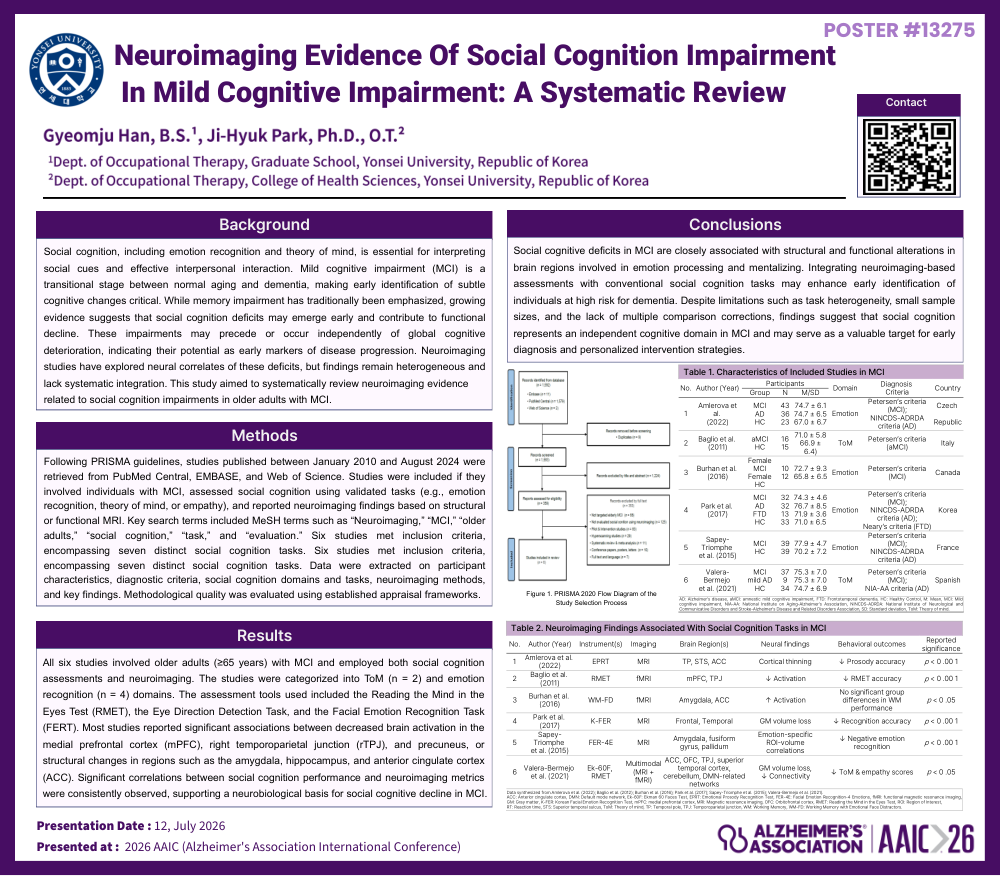
Background: Social cognition, including emotion recognition and theory of mind, is essential for interpreting social cues and effective interpersonal interaction. Mild cognitive impairment (MCI) is a transitional stage between normal aging and dementia, making early identification of subtle cognitive changes critical. While memory impairment has traditionally been emphasized, growing evidence suggests that social cognition deficits may emerge early and contribute to functional decline. These impairments may precede or occur independently of global cognitive deterioration, indicating their potential as early markers of disease progression. Neuroimaging studies have explored neural correlates of these deficits, but findings remain heterogeneous and lack systematic integration. This study aimed to systematically review neuroimaging evidence related to social cognition impairments in older adults with MCI.
Methods: Following PRISMA guidelines, studies published between January 2010 and August 2024 were retrieved from PubMed Central, EMBASE, and Web of Science. Studies were included if they involved individuals with MCI, assessed social cognition using validated tasks (e.g., emotion recognition, theory of mind, or empathy), and reported neuroimaging findings based on structural or functional MRI. Key search terms included MeSH terms such as “Neuroimaging,” “MCI,” “older adults,” “social cognition,” “task,” and “evaluation.” Six studies met inclusion criteria, encompassing seven distinct social cognition tasks. Six studies met inclusion criteria, encompassing seven distinct social cognition tasks. Data were extracted on participant characteristics, diagnostic criteria, social cognition domains and tasks, neuroimaging methods, and key findings. Methodological quality was evaluated using established appraisal frameworks.
Results: All six studies involved older adults (≥65 years) with MCI and employed both social cognition assessments and neuroimaging. The studies were categorized into ToM (n = 2) and emotion recognition (n = 4) domains. The assessment tools used included the Reading the Mind in the Eyes Test (RMET), the Eye Direction Detection Task, and the Facial Emotion Recognition Task (FERT). Most studies reported significant associations between decreased brain activation in the medial prefrontal cortex (mPFC), right temporoparietal junction (rTPJ), and precuneus, or structural changes in regions such as the amygdala, hippocampus, and anterior cingulate cortex (ACC). Significant correlations between social cognition performance and neuroimaging metrics were consistently observed, supporting a neurobiological basis for social cognitive decline in MCI.
Conclusions: Social cognitive deficits in MCI are closely associated with structural and functional alterations in brain regions involved in emotion processing and mentalizing. Integrating neuroimaging-based assessments with conventional social cognition tasks may enhance early identification of individuals at high risk for dementia. Despite limitations such as task heterogeneity, small sample sizes, and the lack of multiple comparison corrections, findings suggest that social cognition represents an independent cognitive domain in MCI and may serve as a valuable target for early diagnosis and personalized intervention strategies.
Comments
Email is required but is not shown publicly.
Loading comments...