4,068 posters, 219 videos, 101 topics, 69 sessions, 14,365 authors, 6,128 institutions
ePostersLive by SciGen Technologies S.A. All rights reserved.
Alzheimer's Association International Conference 2026
July 12-15, 2026 | London, United Kingdom, and Online

13570
Neuro-symbolic Ai For Alzheimer's Disease: Physics-informed Biomarker Prediction And Verifiable Intervention Planning
Poster Presenter
Authors
Affiliations
Part of Topic
Biomarkers -> Biomarkers (non-neuroimaging) -> Novel biomarkers
TITLE: Neuro-Symbolic AI for Alzheimer's Disease: Physics-Informed Biomarker Prediction and Verifiable Intervention Planning
AUTHORS: David Scott Lewis, Enrique Zueco, Haley Yi
AFFILIATION: AIXC Bio, Zaragoza, Spain
EMAIL: reports@aixcbio.com
--- ABSTRACT DETAILS ---
ABSTRACT TYPE: Original
THEME: Biomarkers
TOPIC: Biomarkers (non-neuroimaging)
SUBTOPIC: Novel biomarkers
PRESENTATION PREFERENCE: Oral preferred
TARGET AUDIENCE: Alzheimer's researchers
--- LEARNING OBJECTIVES ---
LO1: Describe how a neuro-symbolic AI architecture combines physics-informed neural operators with formal verification to generate safe, personalized AD intervention plans.
LO2: Distinguish between mechanistic ODE models and Fourier Neural Operator approaches for predicting longitudinal AT(N) biomarker trajectories in Alzheimer's disease.
LO3: Apply Answer Set Programming with SMT-based verification to filter unsafe treatment schedules against clinical safety thresholds.
--- INFOGRAPHIC SECTIONS ---
INTRODUCTION (Background):
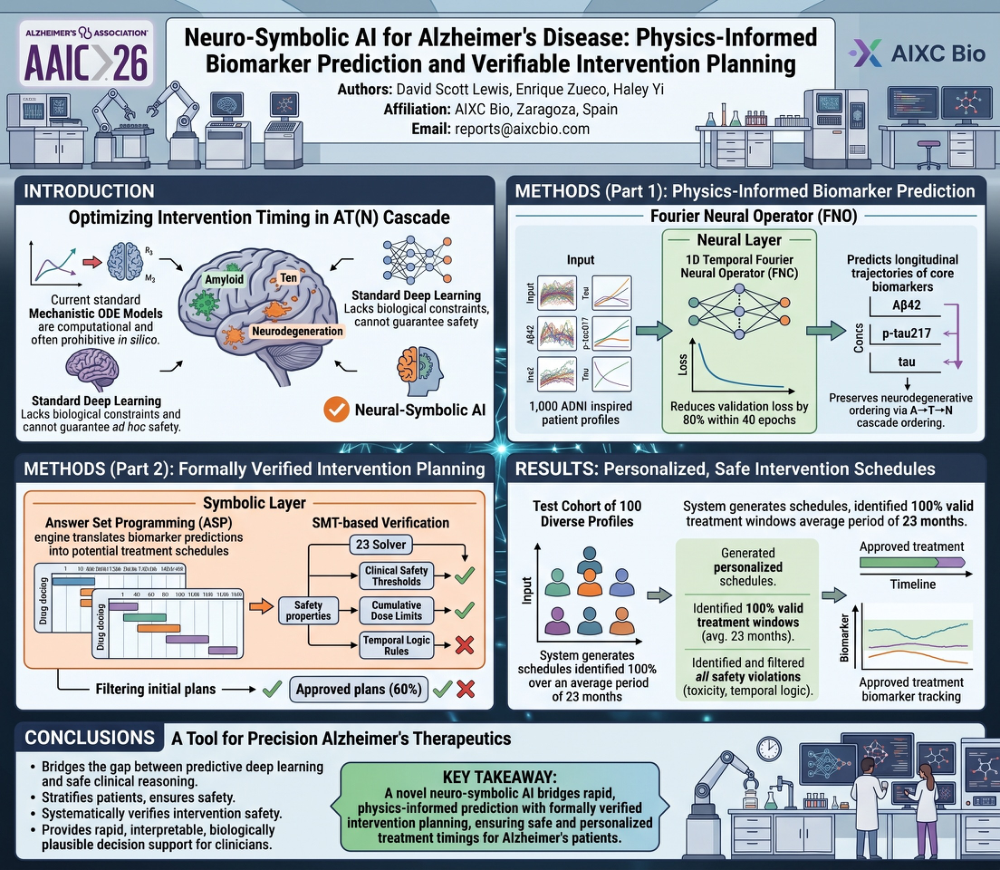
With the advent of disease-modifying therapies for Alzheimer's disease (AD), optimizing intervention timing within the AT(N) biomarker cascade is critical. Current mechanistic ODE models capture cascade dynamics but are computationally prohibitive for real-time use, while standard deep learning approaches lack biological constraints and cannot guarantee safety. We address this gap using a novel neuro-symbolic AI architecture that provides rapid, physics-informed biomarker prediction and formally verified treatment planning.
METHODS:
We developed a dual-layer system. The neural layer utilizes a 1D Temporal Fourier Neural Operator (FNO) trained on 1,000 ADNI-inspired synthetic patient profiles encompassing four AD subtypes. The FNO predicts longitudinal trajectories of core biomarkers (Aβ42, p-tau217, tau) constrained to preserve neurodegenerative ordering via the A→T→N cascade. The symbolic layer translates these predictions into treatment schedules using Answer Set Programming (ASP) and formally verifies them against clinical safety properties (e.g., cumulative dose limits, biomarker safety thresholds) using a Z3 SMT solver. Note: All Latin words (e.g., *in silico*) should be italicized in the final design.
RESULTS:
The physics-informed FNO successfully learned cascade dynamics, reducing validation loss by 86% within 40 epochs. In a test cohort of 100 diverse synthetic profiles, the system generated personalized intervention schedules and identified 100% valid treatment windows over an average period of 23 months. The formal verification layer successfully identified and filtered out all safety violations (e.g., toxicity threshold or temporal logic breaches) from initial neural-generated plans, ensuring only verified, biologically safe treatment strategies (60%) were recommended.
CONCLUSIONS:
This neuro-symbolic approach bridges the gap between predictive deep learning and safe clinical reasoning. By stratifying patients into AD subtypes and systematically verifying intervention plans, this tool provides clinicians with rapid, interpretable, and biologically plausible decision support for precision AD therapeutics.
--- POSTER SPECIFICATIONS ---
Dimensions: Landscape orientation, 96 cm (38 in) width x 84 cm (33 in) height.
Comments
Email is required but is not shown publicly.
Loading comments...