4,068 posters, 219 videos, 101 topics, 69 sessions, 14,365 authors, 6,128 institutions
ePostersLive by SciGen Technologies S.A. All rights reserved.
Alzheimer's Association International Conference 2026
July 12-15, 2026 | London, United Kingdom, and Online

7437
Plasma Metabolomic Pathways In Young Versus Older Onset Mild Cognitive Impairment (mci)
Poster Presenter
Authors
Anjali 0, Hanuman Prasad Sharma, Yashwant Sharma, Abhilasha Dwivedi, Hina Narzari, Nilima N, Aditi Dubey, Roopa Rajan, Vishnu V.Y., Mamta Bhushan Singh, Rohit Bhatia, Gautam Sharma, Anu Gupta
Affiliations
Part of Topic
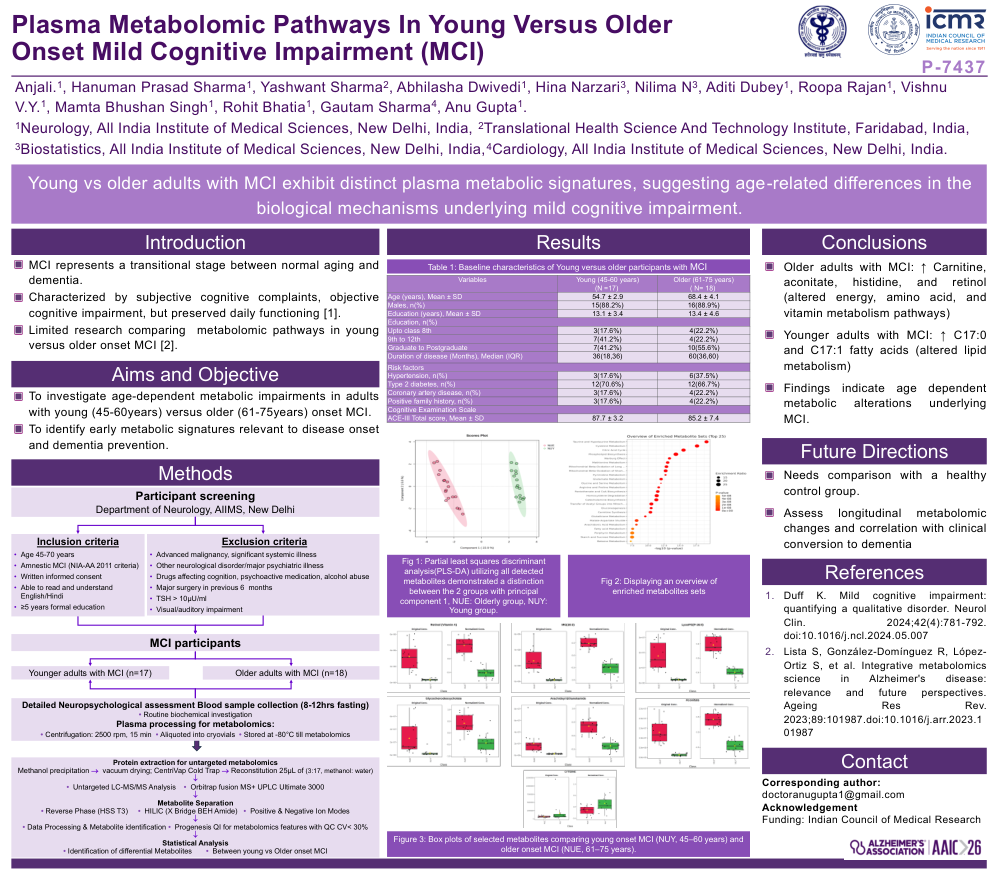
Abstract: Background: Metabolomics research has predominantly focused on Alzheimer’s disease (AD), with comparatively limited studies of early-stage cognitive disorders such as Mild Cognitive Impairment (MCI). MCI represents a transitional stage between normal aging and AD. This study aimed to investigate age-dependent metabolic impairments associated with young versus elderly onset MCI. The objective of identifying early metabolic signatures relevant to disease onset and dementia prevention.
Methods: The study included participants diagnosed with MCI according to the National Institute on Aging-Alzheimer’s Association (NIA-AA) 2011 clinical criteria, participants were stratified into young (45-60 years) and elderly (61-75 years) age groups. Untargeted plasma metabolomics was performed using LC MS/MS on an Orbitrap Fusion mass spectrometer in both positive and negative ion modes, incorporating reverse-phase and hydrophilic interaction liquid chromatography (HILIC) separations following methanol-based protein precipitation. Metabolite identification and data processing were conducted using Progenesis QI with in-house and public spectral libraries. Statistical, pathway, and functional enrichment analyses were performed using MetaboAnalyst 6.0 integrated with Kyoto Encyclopedia of Genes and Genomes (KEGG) and Human Metabolome Database (HMDB ).
Results: The cohort comprised 35 participants with MCI, including 17 younger and 18 elderly individuals (Table 1). Overall pathway analysis in the MCI group revealed that metabolism of taurine and hypotaurine, cysteine, the citric acid cycle, and phospholipid biosynthesis were significantly affected (Figure 1). Partial least squares discriminant analysis (PLS-DA), generated using all detected metabolites, demonstrated clear distinction between the young and elderly groups(Figure 2). In the young group, metabolites such as carnitine, aconitate, histidine, and retinol exhibited comparatively lower heat-map color intensities than those in the elderly group, whereas C17:0 and C17:1 displayed significantly higher intensities in the young group compared to the elderly group (fold change>1.5 and p-value<0.05).
Conclusion: Significant age-related metabolic disruptions were observed, suggesting potential plasma biomarkers associated with onset of cognitive decline at young versus older age. These findings need to be compared with a healthy control group to gain further insight into metabolomic changes with ageing.
Comments
Email is required but is not shown publicly.
Loading comments...