Loading...

4,068 posters, 219 videos, 101 topics, 69 sessions, 14,365 authors, 6,128 institutions

ePostersLive by SciGen Technologies S.A. All rights reserved.

Alzheimer's Association International Conference 2026

July 12-15, 2026 | London, United Kingdom, and Online

Alzheimer's Association International Conference 2026 banner

5358

Quantitative Susceptibility Mapping In AD And DLB: A Comparison Of ADNI4 And ISMRM Protocols
Part of Topic

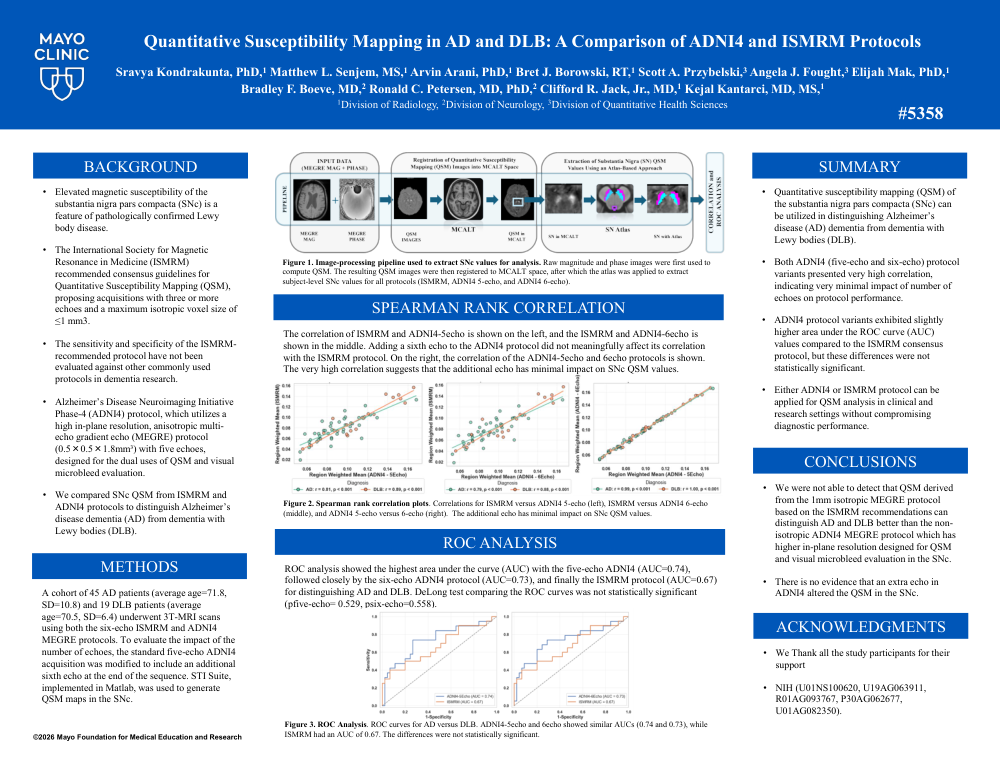
Title: Quantitative Susceptibility Mapping in AD and DLB: A Comparison of ADNI4 and ISMRM Protocols

Authors and Affiliations: 

Sravya Kondrakunta, PhD,1 Matthew L. Senjem, MS,1 Arvin Arani, PhD,1 Bret J. Borowski, RT,1 Scott A. Przybelski,3 Angela J. Fought,3 Elijah Mak, PhD,1 Bradley F. Boeve, MD,2 Ronald C. Petersen, MD, PhD,2 Clifford R. Jack, Jr., MD,1 Kejal Kantarci, MD, MS,1

1Division of Radiology, 2Division of Neurology, 3Division of Quantitative Health Sciences

Background: 

•Elevated magnetic susceptibility of the substantia nigra pars compacta (SNc) is a feature of pathologically confirmed Lewy body disease.
•The International Society for Magnetic Resonance in Medicine (ISMRM) recommended consensus guidelines for Quantitative Susceptibility Mapping (QSM), proposing acquisitions with three or more echoes and a maximum isotropic voxel size of ≤1 mm3.
•The sensitivity and specificity of the ISMRM-recommended protocol have not been evaluated against other commonly used protocols in dementia research.
•Alzheimer’s Disease Neuroimaging Initiative Phase-4 (ADNI4) protocol, which utilizes a high in-plane resolution, anisotropic multi-echo gradient echo (MEGRE) protocol (0.5×0.5×1.8mm³) with five echoes, designed for the dual uses of QSM and visual microbleed evaluation.
•We compared SNc QSM from ISMRM and ADNI4 protocols to distinguish Alzheimer’s disease dementia (AD) from dementia with Lewy bodies (DLB).
 
Methods:

A cohort of 45 AD patients (average age=71.8, SD=10.8) and 19 DLB patients (average age=70.5, SD=6.4) underwent 3T-MRI scans using both the six-echo ISMRM and ADNI4 MEGRE protocols. To evaluate the impact of the number of echoes, the standard five-echo ADNI4 acquisition was modified to include an additional sixth echo at the end of the sequence. STI Suite, implemented in Matlab, was used to generate QSM maps in the SNc.

Spearman correlation:

The correlation of ISMRM and ADNI4-5echo is shown on the left, and the ISMRM and ADNI4-6echo is shown in the middle. Adding a sixth echo to the ADNI4 protocol did not meaningfully affect its correlation with the ISMRM protocol. On the right, the correlation of the ADNI4-5echo and 6echo protocols is shown. The very high correlation suggests that the additional echo has minimal impact on SNc QSM values.

ROC Analysis: 

ROC analysis showed the highest area under the curve (AUC) with the five-echo ADNI4 (AUC=0.74), followed closely by the six-echo ADNI4 protocol (AUC=0.73), and finally the ISMRM protocol (AUC=0.67) for distinguishing AD and DLB. DeLong test comparing the ROC curves was not statistically significant (pfive-echo= 0.529, psix-echo=0.558).

Summary: 

•Quantitative susceptibility mapping (QSM) of the substantia nigra pars compacta (SNc) can be utilized in distinguishing Alzheimer’s disease (AD) dementia from dementia with Lewy bodies (DLB).
•Both ADNI4 (five-echo and six-echo) protocol variants presented very high correlation, indicating very minimal impact of number of echoes on protocol performance.
•ADNI4 protocol variants exhibited slightly higher area under the ROC curve (AUC) values compared to the ISMRM consensus protocol, but these differences were not statistically significant.
•Either ADNI4 or ISMRM protocol can be applied for QSM analysis in clinical and research settings without compromising diagnostic performance.
 
Conclusion:
•We were not able to detect that QSM derived from the 1mm isotropic MEGRE protocol based on the ISMRM recommendations can distinguish AD and DLB better than the non-isotropic ADNI4 MEGRE protocol which has higher in-plane resolution designed for QSM and visual microbleed evaluation in the SNc.
•There is no evidence that an extra echo in ADNI4 altered the QSM in the SNc.
 
Acknowledgements:
•We Thank all the study participants for their support
•NIH (U01NS100620, U19AG063911, R01AG093767, P30AG062677, U01AG082350).

Comments

Email is required but is not shown publicly.

Loading comments...

aaic2026 banner
Copyright © 2015-2026, ePostersLive® SciGen is a registered trademark of SciGen Technologies S.A. Patent pending.

This website and third-party tools we use rely on cookies for the best user experience. By selecting "I agree", you agree to cookie usage as described in our Privacy Policy.