4,068 posters, 219 videos, 101 topics, 69 sessions, 14,365 authors, 6,128 institutions
ePostersLive by SciGen Technologies S.A. All rights reserved.
Alzheimer's Association International Conference 2026
July 12-15, 2026 | London, United Kingdom, and Online

11942
Moderate Activity In The Morning And Evening Differentially Relates To Longitudinal Changes In Amyloid And Tau Pathology
Poster Presenter
Authors
Part of Topic
Biomarkers -> Neuroimaging -> Multi-modal comparisons
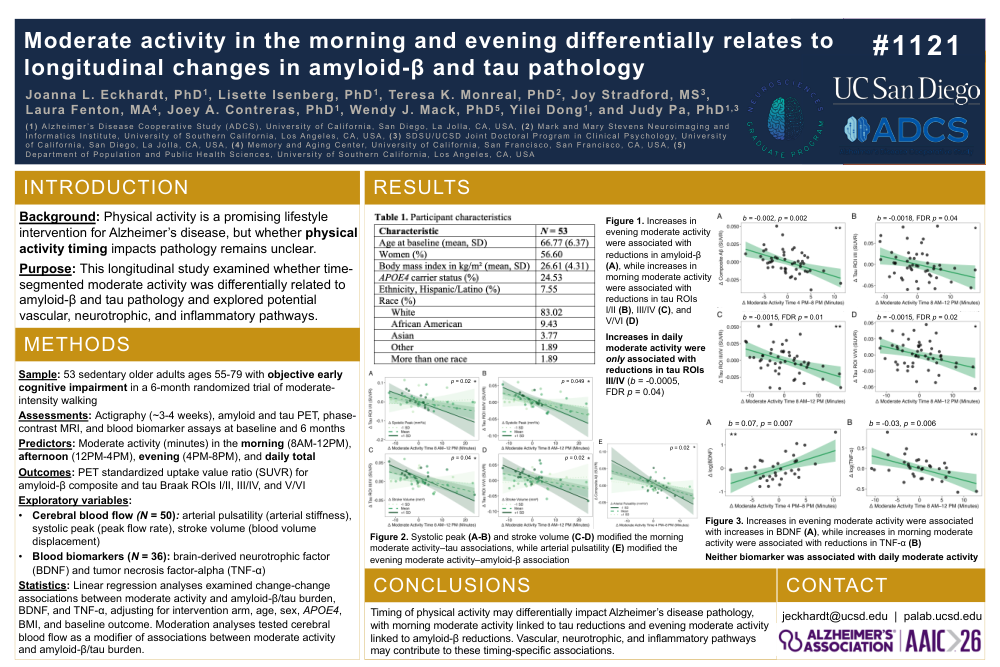
Moderate activity in the morning and evening differentially relates to longitudinal changes in amyloid-β and tau pathology
#1121
Joanna L. Eckhardt, PhD1, Lisette Isenberg, PhD1, Teresa K. Monreal, PhD2, Joy Stradford, MS3, Laura Fenton, MA4, Joey A. Contreras, PhD1, Wendy J. Mack, PhD5, Yilei Dong1, and Judy Pa, PhD1,3
(1) Alzheimer’s Disease Cooperative Study (ADCS), University of California, San Diego, La Jolla, CA, USA, (2) Mark and Mary Stevens Neuroimaging and Informatics Institute, University of Southern California, Los Angeles, CA, USA, (3) SDSU/UCSD Joint Doctoral Program in Clinical Psychology, University of California, San Diego, La Jolla, CA, USA, (4) Memory and Aging Center, University of California, San Francisco, San Francisco, CA, USA, (5) Department of Population and Public Health Sciences, University of Southern California, Los Angeles, CA, USA
INTRODUCTION
Background: Physical activity is a promising lifestyle intervention for Alzheimer’s disease, but whether physical activity timing impacts pathology remains unclear.
Purpose: This longitudinal study examined whether time-segmented moderate activity was differentially related to amyloid-β and tau pathology and explored potential vascular, neurotrophic, and inflammatory pathways.
METHODS
Sample: 53 sedentary older adults ages 55-79 with objective early cognitive impairment in a 6-month randomized trial of moderate-intensity walking
Assessments: Actigraphy (~3-4 weeks), amyloid and tau PET, phase-contrast MRI, and blood biomarker assays at baseline and 6 months
Predictors: Moderate activity (minutes) in the morning (8AM-12PM), afternoon (12PM-4PM), evening (4PM-8PM), and daily total
Outcomes: PET standardized uptake value ratio (SUVR) for amyloid-β composite and tau Braak ROIs I/II, III/IV, and V/VI
Exploratory variables:
Statistics: Linear regression analyses examined change-change associations between moderate activity and amyloid-β/tau burden, BDNF, and TNF-α, adjusting for intervention arm, age, sex, APOE4, BMI, and baseline outcome. Moderation analyses tested cerebral blood flow as a modifier of associations between moderate activity and amyloid-β/tau burden.
RESULTS
Figure 1. Increases in evening moderate activity were associated with reductions in amyloid-β (A), while increases in morning moderate activity were associated with reductions in tau ROIs I/II (B), III/IV (C), and V/VI (D)
Increases in daily moderate activity were only associated with reductions in tau ROIs III/IV (b = -0.0005, FDR p = 0.04)
Figure 2. Systolic peak (A-B) and stroke volume (C-D) modified the morning moderate activity–tau associations, while arterial pulsatility (E) modified the evening moderate activity–amyloid-β association
Figure 3. Increases in evening moderate activity were associated with increases in BDNF (A), while increases in morning moderate activity were associated with reductions in TNF-α (B)
Neither biomarker was associated with daily moderate activity
CONCLUSIONS
Timing of physical activity may differentially impact Alzheimer’s disease pathology, with morning moderate activity linked to tau reductions and evening moderate activity linked to amyloid-β reductions. Vascular, neurotrophic, and inflammatory pathways may contribute to these timing-specific associations.
CONTACT
jeckhardt@ucsd.edu | palab.ucsd.edu
Comments
Email is required but is not shown publicly.
Loading comments...