4,068 posters, 219 videos, 101 topics, 69 sessions, 14,365 authors, 6,128 institutions
ePostersLive by SciGen Technologies S.A. All rights reserved.
Alzheimer's Association International Conference 2026
July 12-15, 2026 | London, United Kingdom, and Online

13881
Metabolic Safety Margin As A Multimodal Biomarker Of Network Vulnerability And Predictor Of Cognitive Decline In Alzheimer's Disease
Poster Presenter
Part of Topic
Biomarkers -> Neuroimaging -> Disease progression measures
Title: Metabolic Safety Margin As A Multimodal Biomarker Of Network Vulnerability And Predictor Of Cognitive Decline In Alzheimer's Disease
Takeaway: The Metabolic Safety Margin (ΔΨ) is a multimodal biomarker quantifying proximity to network failure. Integrating connectivity and metabolism, ΔΨ predicts cognitive decline. Individuals crossing the failure threshold decline six times faster, making it a robust prognostic tool across the Alzheimer’s disease spectrum.
Introduction:Alzheimer's disease (AD) disrupts cerebral metabolism and structural connectivity, yet established biomarkers (amyloid PET, tau PET, and atrophy) primarily index pathologic burden rather than proximity to functional network failure. Consequently, individuals with comparable pathology may differ substantially in their risk of near-term cognitive decline.
We introduce Metabolic Safety Margin (ΔΨ), derived from our proposed Metabolically Constrained Graph Model (MCGM) that mimics the brain as a weighted structural connectome, constructed from diffusion MRI tractography using the AAL-90 atlas. In MCGM, each edge carries a biophysically derived metabolic cost incorporating tract length, white matter integrity (FA), and hub connectivity penalty with a subject-specific collapse threshold (Ψc).
ΔΨ quantifies the distance between current metabolic state and predicted network failure, providing a measure of network resilience rather than accumulated pathology alone. The framework was successfully evaluated with Alzhemier’s Disease Neuroimaging Initiative (ADNI) dataset.
Methods:
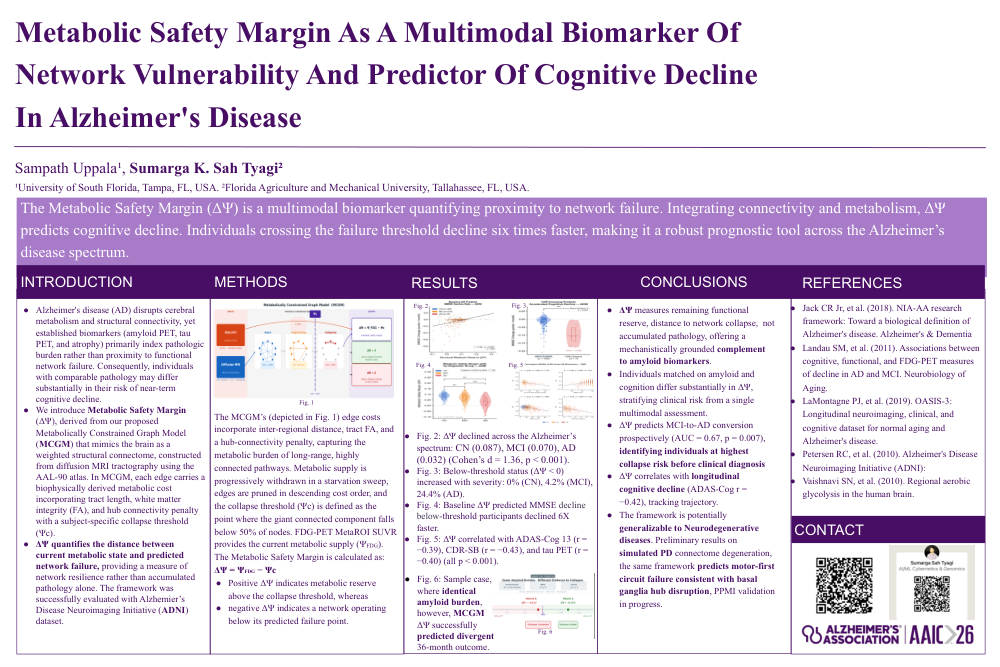
 The MCGM’s edge costs (depicted in Fig. 1) incorporate inter-regional distance, tract FA, and a hub-connectivity penalty, capturing the metabolic burden of long-range, highly connected pathways. Metabolic supply is progressively withdrawn in a starvation sweep, edges are pruned in descending cost order, and the collapse threshold (Ψc) is defined as the point where the giant connected component falls below 50% of nodes. FDG-PET MetaROI SUVR provides the current metabolic supply (ΨFDG). The Metabolic Safety Margin is calculated as: ΔΨ = ΨFDG − Ψc
-
Positive ΔΨ indicates metabolic reserve above the collapse threshold, whereas
-
negative ΔΨ indicates a network operating below its predicted failure point.
-
Fig. 2: ΔΨ declined across the Alzheimer’s spectrum: CN (0.087), MCI (0.070), AD (0.032) (Cohen’s d = 1.36, p < 0.001).
-
Fig. 3: Below-threshold status (ΔΨ < 0) increased with severity: 0% (CN), 4.2% (MCI), 24.4% (AD).
-
Fig. 4: Baseline ΔΨ predicted MMSE decline below-threshold participants declined 6X faster.
-
Fig. 5: ΔΨ correlated with ADAS-Cog 13 (r = −0.39), CDR-SB (r = −0.43), and tau PET (r = −0.40) (all p < 0.001).
-
ΔΨ measures remaining functional reserve, distance to network collapse, not accumulated pathology, offering a mechanistically grounded complement to amyloid biomarkers.
-
Individuals matched on amyloid and cognition differ substantially in ΔΨ, stratifying clinical risk from a single multimodal assessment.
-
ΔΨ predicts MCI-to-AD conversion prospectively (AUC = 0.67, p = 0.007), identifying individuals at the highest collapse risk before clinical diagnosis
-
ΔΨ correlates with longitudinal cognitive decline (ADAS-Cog r = −0.42), tracking trajectory.
-
The framework is potentially generalizable to Neurodegenerative diseases. Preliminary results on simulated PD connectome degeneration, the same framework predicts motor-first circuit failure consistent with basal ganglia hub disruption, PPMI validation in progress.
Comments
Email is required but is not shown publicly.
Loading comments...