4,068 posters, 219 videos, 101 topics, 69 sessions, 14,365 authors, 6,128 institutions
ePostersLive by SciGen Technologies S.A. All rights reserved.
Alzheimer's Association International Conference 2026
July 12-15, 2026 | London, United Kingdom, and Online

1434
Exploratory Factor Analysis Of Acoustic And Semantic Speech Measures In Brazilians With Mild Alzheimer’s Disease
Poster Presenter
Authors
Part of Topic
Background
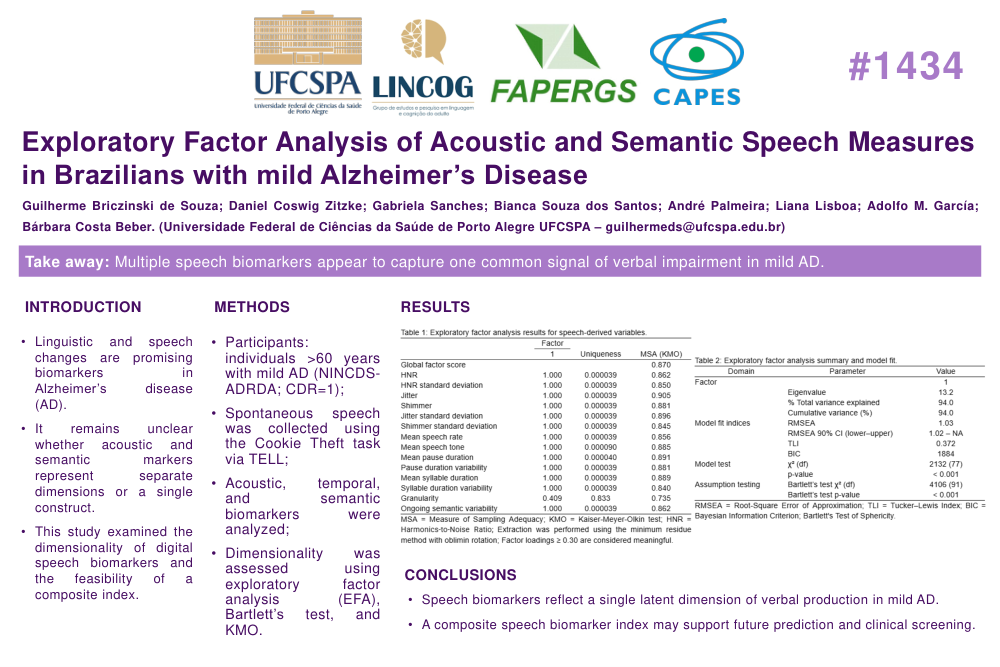
Linguistic and communicative alterations have emerged as potential cognitive biomarkers in Alzheimer's Disease (AD). However, it remains uncertain whether acoustic and semantic measures reflect multiple dimensions or a single construct. This study investigated the structure of a comprehensive set of digital language and speech biomarkers with the aim of identifying their dimensionality and viability for creating a composite index.
Method
Individuals over 60 years, diagnosed with AD according to NINCDS-ADRDA criteria and rated CDR 1, were invited to participate in the study. Spontaneous speech samples were collected using the traditional Cookie Theft picture via the Toolkit to Examine Lifelike Language (TELL), a validated app for recording and analyzing speech and language data. Harmonics-to-Noise Ratio (HNR), HNR standard deviation, jitter, jitter standard deviation, shimmer, shimmer standard deviation, mean speech rate, mean speech tone, mean pause duration, mean syllable duration, pause and syllable duration variability, granularity, and ongoing semantic variability were analyzed. Exploratory factor analysis (EFA) was conducted using minimum residual extraction with oblimin rotation, and sampling adequacy was assessed using Bartlett’s test of sphericity and the Kaiser-Meyer-Olkin test (KMO).
Results
The analysis indicated strong sample adequacy (global KMO = 0.870; all items ≥ 0.73) and sufficient correlations for factoring (Bartlett χ² (91) = 4106, p < .001). EFA (Table 1) revealed a single factor with an eigenvalue of 13.2, accounting for 94% of the total variance, indicating marked unidimensionality among the analyzed biomarkers (Table 2). Factor loadings were extremely high (loadings = 1.00; singularities ≈ 3.9×10⁻⁴), reflecting strong collinearity and a common construct between acoustic and semantic measures (Table 1). Only the granularity variable showed lower fit (loading = 0.409; singularity = 0.833).
Conclusion
The results suggest that the speech biomarkers assessed essentially reflect a single latent dimension of verbal production, possibly related to the overall integrity of acoustic and semantic systems in Alzheimer's disease. The creation of a composite index derived from the factor scores is statistically and clinically justifiable and may represent an integrated measure for future correlation and prediction analyses. These findings reinforce the potential of linguistic markers as sensitive tools for research and clinical screening in AD.
Comments
Email is required but is not shown publicly.
Loading comments...