4,068 posters, 219 videos, 101 topics, 69 sessions, 14,365 authors, 6,128 institutions
ePostersLive by SciGen Technologies S.A. All rights reserved.
Alzheimer's Association International Conference 2026
July 12-15, 2026 | London, United Kingdom, and Online

12944
Longitudinal Prognostic Value Of Brain-derived And Total Plasma Ptau Biomarkers For Amyloid And Clinical Progression In Adni
Poster Presenter
Authors
Valentina Ghisays, Marisa N. Denkinger, Alpana Singh, Tainá M. Marqués, Michael Malek-Ahmadi, Kendall Van-Keuren Jensen, Hillary D. Protas, Javad Sohankar, Dhruman D. Goradia, Vivek Devadas, Yinghua Chen, Shan Li, Jessica B. Langbaum, Michael W. Weiner, Eric M. Reiman, Yi Su, Nicholas J. Ashton, for the Alzheimer's Disease Neuroimaging Initiative
Affiliations
, University of California San Francisco, San Francisco, CA, USA, Banner Alzheimer's Institute, Phoenix, AZ, USA, Banner Sun Health Research Institute, Sun City, AZ, USA; Banner Alzheimer's Institute, Phoenix, AZ, USA, Translational Genomics Research Institute, Phoenix, AZ, USA, Banner Sun Health Research Institute, Sun City, AZ, USA; Banner Alzheimer's Institute, Phoenix, AZ, USA; Department of Psychiatry and Neurochemistry, Institute of Neuroscience & Physiology, Sahlgrenska Academy at the University of Gothenburg, Mölndal, Sweden
Part of Topic
Biomarkers -> Neuroimaging -> Disease progression measures
INTRODUCTION
Background
- Plasma phosphorylated tau biomarkers are increasingly used for Alzheimer’s disease detection, treatment decision-making, and clinical trial enrichment. 1-3
- Brain-derived pTau217 assays selectively measure CNS-type tau species and may improve cross-sectional diagnostic performance compared with total pTau217. 3-5
- Whether this improved diagnostic performance translates to better longitudinal prediction of future disease progression remains unclear. 3-5
- Prognostic performance may differ by outcome, as amyloid PET progression more directly reflects biological AD progression, whereas clinical progression reflects downstream cognitive change influenced by multiple factors. 6,7
Study aims
- Compare the prognostic performance of baseline brain-derived and total plasma pTau biomarkers for predicting future amyloid PET progression.
- Evaluate time-dependent discrimination of plasma biomarkers for A− to A+ progression across follow-up intervals.
- Determine whether brain-derived pTau217 provides added prognostic value for clinical progression from CU to MCI/AD.
METHODS
Study Design
- Longitudinal observational analysis of ADNI1/GO/2/3 participants with baseline plasma NULISAseq measurements.
- Baseline plasma biomarkers were evaluated as predictors of:
- Amyloid PET progression from A− to A+.
- Clinical progression from CU to MCI / AD dementia.
Participants / Samples
- ADNI1/GO/2/3 participants with plasma NULISAseq CNS panel data.
- Total sample: N = 1,427.
- Cognitively unimpaired subset: N = 529.
- Participants included CU, MCI, and AD dementia diagnostic groups.
Measurements
- Plasma biomarkers:BD-pTau217, total pTau217, BD-pTau181.
- Longitudinal amyloid PET and clinical follow-up.
- Amyloid PET positivity: Centiloid ≥ 24.1.6,7
Statistical Analysis
- Cox regression, Kaplan–Meier analyses, and time-dependent AUCs.
RESULTS
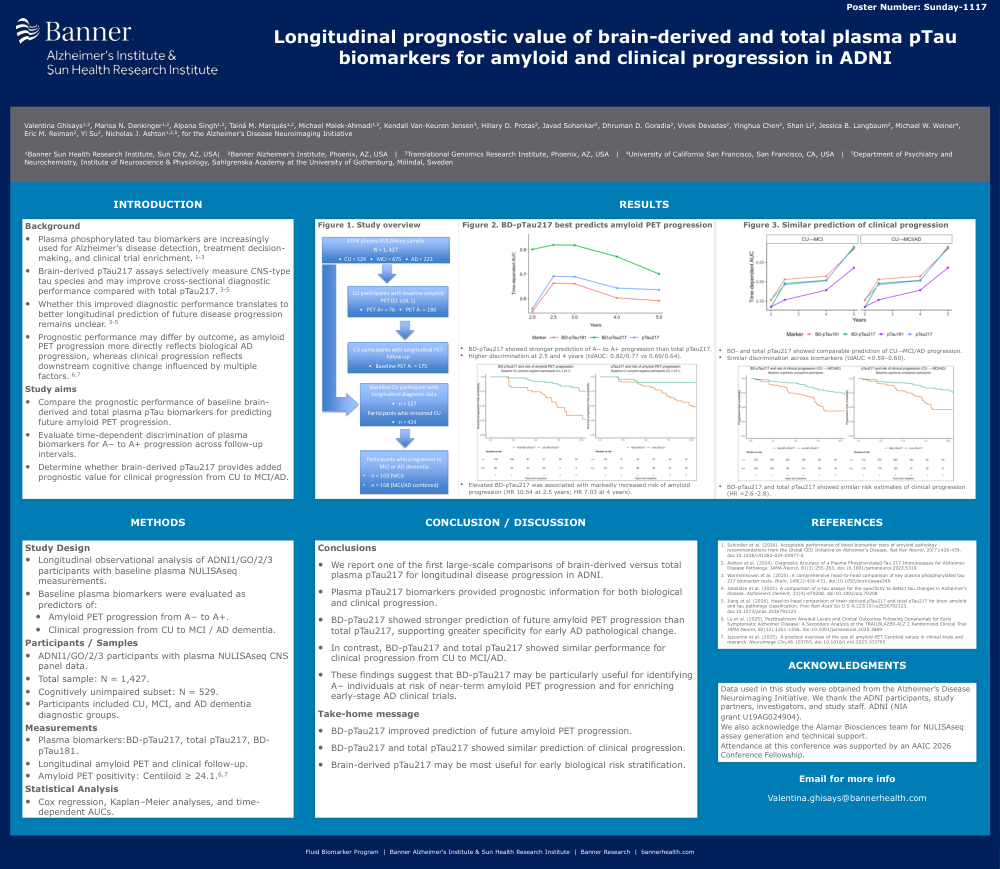
Figure 1. Study overview
Figure 2. BD-pTau217 best predicts amyloid PET progression
- BD-pTau217 showed stronger prediction of A− to A+ progression than total pTau217.
- Higher discrimination at 2.5 and 4 years (tdAUC: 0.82/0.77 vs 0.69/0.64).
- Elevated BD-pTau217 was associated with markedly increased risk of amyloid progression (HR 10.54 at 2.5 years; HR 7.03 at 4 years).
Figure 3. Similar prediction of clinical progression
- BD- and total pTau217 showed comparable prediction of CU→MCI/AD progression.
- Similar discrimination across biomarkers (tdAUC ≈0.59–0.60).
- BD-pTau217 and total pTau217 showed similar risk estimates of clinical progression (HR ≈2.6–2.8).
CONCLUSIONS / DISCUSSION
Conclusions
- We report one of the first large-scale comparisons of brain-derived versus total plasma pTau217 for longitudinal disease progression in ADNI.
- Plasma pTau217 biomarkers provided prognostic information for both biological and clinical progression.
- BD-pTau217 showed stronger prediction of future amyloid PET progression than total pTau217, supporting greater specificity for early AD pathological change.
- In contrast, BD-pTau217 and total pTau217 showed similar performance for clinical progression from CU to MCI/AD.
- These findings suggest that BD-pTau217 may be particularly useful for identifying A− individuals at risk of near-term amyloid PET progression and for enriching early-stage AD clinical trials.
Take-home message
- BD-pTau217 improved prediction of future amyloid PET progression.
- BD-pTau217 and total pTau217 showed similar prediction of clinical progression.
- Brain-derived pTau217 may be most useful for early biological risk stratification.
REFERENCES
- Schindler et al. (2024). Acceptable performance of blood biomarker tests of amyloid pathology - recommendations from the Global CEO Initiative on Alzheimer's Disease. Nat Rev Neurol, 20(7):426-439. doi:10.1038/s41582-024-00977-5
- Ashton et al. (2024). Diagnostic Accuracy of a Plasma Phosphorylated Tau 217 Immunoassay for Alzheimer Disease Pathology. JAMA Neurol, 81(3):255-263. doi:10.1001/jamaneurol.2023.5319
- Warmenhoven et al. (2025). A comprehensive head-to-head comparison of key plasma phosphorylated tau 217 biomarker tests. Brain, 148(2):416-431. doi:10.1093/brain/awae346
- Janelidze et al. (2025). A comparison of p-tau assays for the specificity to detect tau changes in Alzheimer's disease. Alzheimers Dement, 21(4):e70208. doi:10.1002/alz.70208
- Jiang et al. (2026). Head-to-head comparison of brain-derived pTau217 and total pTau217 for brain amyloid and tau pathology classification. Proc Natl Acad Sci U S A,123(10):e2536792123. doi:10.1073/pnas.2536792123
- Lu et al. (2025). Posttreatment Amyloid Levels and Clinical Outcomes Following Donanemab for Early Symptomatic Alzheimer Disease: A Secondary Analysis of the TRAILBLAZER-ALZ 2 Randomized Clinical Trial. JAMA Neurol, 82(12):1251-1256. doi:10.1001/jamaneurol.2025.3869
- Iaccarino et al. (2025). A practical overview of the use of amyloid-PET Centiloid values in clinical trials and research. Neuroimage Clin,46:103765. doi:10.1016/j.nicl.2025.103765
ACKNOWLEDGMENTS
Data used in this study were obtained from the Alzheimer’s Disease Neuroimaging Initiative. We thank the ADNI participants, study partners, investigators, and study staff. ADNI (NIA grant U19AG024904). We also acknowledge the Alamar Biosciences team for NULISAseq assay generation and technical support. Attendance at this conference was supported by an AAIC 2026 Conference Fellowship.
Comments
Email is required but is not shown publicly.
Loading comments...