4,068 posters, 219 videos, 101 topics, 69 sessions, 14,365 authors, 6,128 institutions
ePostersLive by SciGen Technologies S.A. All rights reserved.
Alzheimer's Association International Conference 2026
July 12-15, 2026 | London, United Kingdom, and Online

11911
Longitudinal Changes In Blood-based Biomarkers Of Alzheimer’S Disease Across Age Groups And Their Associations With Cognitive Function
Poster Presenter
Authors
Kengo Ishiki, Keiko Kondo, Masaki Nakano, Shun Murakami, Kazuto Yamashita, Masahiro Miura, Aya Kadota, Shigeki Iwanaga, Toshiyuki Sato, Masaki Nishimura, Katsuyuki Miura
Affiliations
, Central Research Laboratories, Sysmex Corporation, Hyogo, Japan, NCD Epidemiology Research Center, Shiga University of Medical Science, Shiga, Japan, Molecular Neuroscience Research Center, Shiga University of Medical Science, Shiga, Japan
Part of Topic
Biomarkers -> Biomarkers (non-neuroimaging) -> Fluid biomarkers
Background
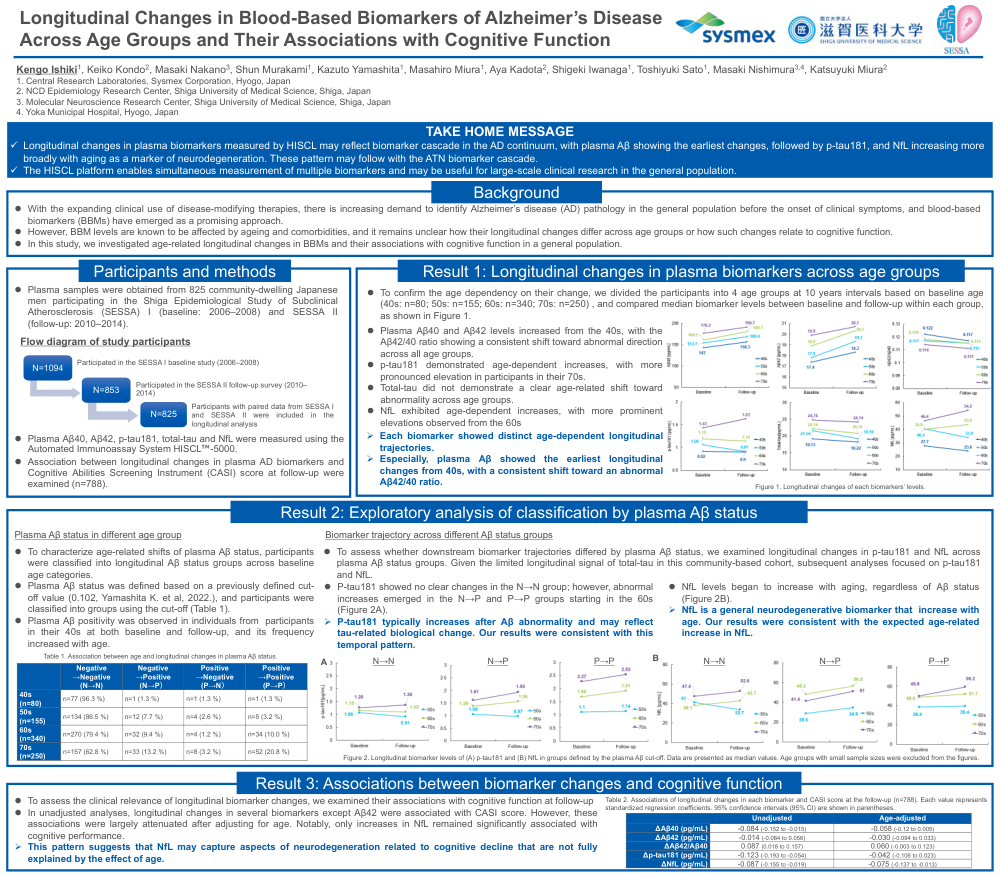
With the expanding clinical use of disease-modifying therapies, there is increasing demand to identify Alzheimer’s disease (AD) pathology in the general population before the onset of clinical symptoms, and blood-based biomarkers (BBMs) have emerged as a promising approach. However, BBMs levels are known to be affected by ageing and comorbidities, and it remains unclear how their longitudinal changes differ across age groups or how such changes relate to cognitive decline. Therefore, we investigated age-related longitudinal changes in BBMs and their associations with cognitive function in a general population.
Methods
Plasma samples were obtained from 826 community-dwelling Japanese men participating in the Shiga Epidemiological Study of Subclinical Atherosclerosis (SESSA) I (baseline: 2006–2008) and SESSA II (follow‑up: 2010–2014). Plasma Aβ40, Aβ42, p‑tau181, total-tau, and NfL were measured using the Automated Immunoassay System HISCL™-5000. Age groups were defined based on baseline age (40s: n=80; 50s: n=155; 60s: n=340; 70s: n=250). Longitudinal changes in BBMs were compared across age groups. Furthermore, associations between biomarker changes and cognitive function, assessed by the Cognitive Abilities Screening Instrument (CASI), were examined using both unadjusted and age‑adjusted models (n=788).
Results
Median plasma Aβ40 and Aβ42 levels increased from the 40s, with the Aβ42/40 ratio showing a consistent shift toward relatively abnormal distributions across age groups. In contrast, median levels of NfL and p-tau181 showed age‑dependent increases, with shifts toward abnormal distributions becoming evident mainly in participants in their 60s and 70s. Total-tau did not demonstrate a clear age‑related shift toward abnormality across age groups. Longitudinal changes in all biomarkers except Aβ42 were significantly associated with CASI score in unadjusted analysis. However, after adjustment for age, only increases in NfL remained significantly and inversely associated with CASI scores.
Conclusion
Plasma Aβs showed the earliest longitudinal changes, with increases from the 40s and consistent shifts in the Aβ42/40 ratio toward abnormality across age groups. In contrast, longitudinal increases in NfL were independently associated with cognitive performance after age adjustment. These findings indicate that Aβ may serve as a sensitive marker of the earliest pathological changes, whereas the other markers provide complementary information on downstream pathologies, supporting the utility of multi biomarkers.
Comments
Email is required but is not shown publicly.
Loading comments...