4,068 posters, 219 videos, 101 topics, 69 sessions, 14,365 authors, 6,128 institutions
ePostersLive by SciGen Technologies S.A. All rights reserved.
Alzheimer's Association International Conference 2026
July 12-15, 2026 | London, United Kingdom, and Online

12809
Latent White Matter Hyperintensity Signatures Of Amyloid, Tau And Clinical Severity In Alzheimer’S Disease Continuum
Poster Presenter
Authors
Part of Topic
Biomarkers -> Neuroimaging -> Early detection measures
INTRODUCTION
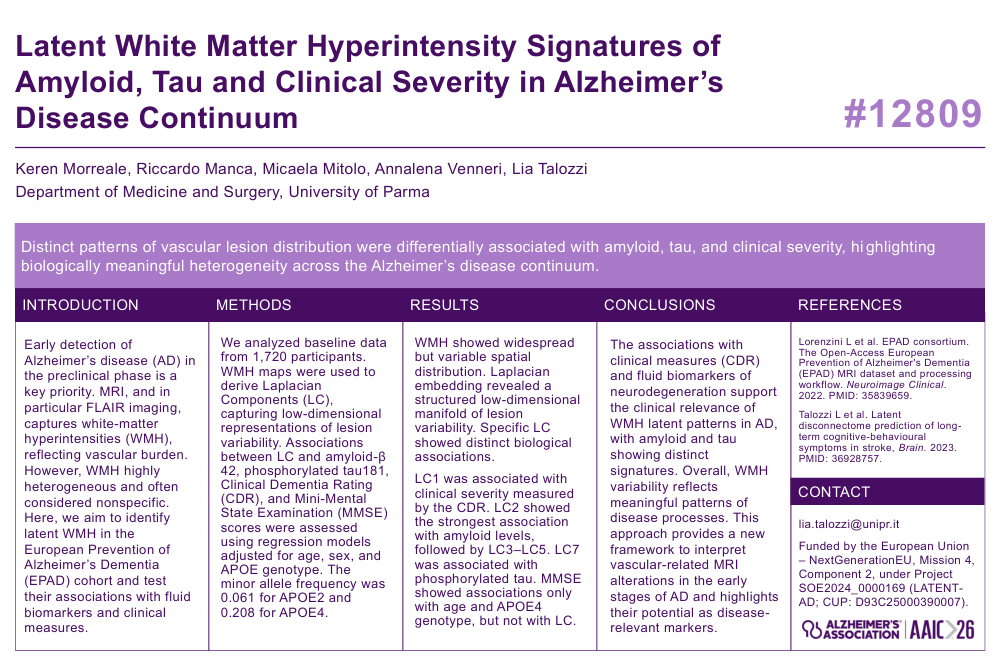
Early detection of Alzheimer’s disease (AD) in the preclinical phase is a key priority. MRI, and in particular FLAIR imaging, captures white-matter hyperintensities (WMH), reflecting vascular burden. However, WMH highly heterogeneous and often considered nonspecific. Here, we aim to identify latent WMH in the European Prevention of Alzheimer’s Dementia (EPAD) cohort and test their associations with fluid biomarkers and clinical measures.
METHODS
We analyzed baseline data from 1,720 participants. WMH maps were used to derive Laplacian Components (LC), capturing low-dimensional representations of lesion variability. Associations between LC and amyloid-β 42, phosphorylated tau181, Clinical Dementia Rating (CDR), and Mini-Mental State Examination (MMSE) scores were assessed using regression models adjusted for age, sex, and APOE genotype. The minor allele frequency was 0.061 for APOE2 and 0.208 for APOE4.
RESULTS
WMH showed widespread but variable spatial distribution. Laplacian embedding revealed a structured low-dimensional manifold of lesion variability. Specific LC showed distinct biological associations.
LC1 was associated with clinical severity measured by the CDR. LC2 showed the strongest association with amyloid levels, followed by LC3–LC5. LC7 was associated with phosphorylated tau. MMSE showed associations only with age and APOE4 genotype, but not with LC.
CONCLUSIONS
The associations with clinical measures (CDR) and fluid biomarkers of neurodegeneration support the clinical relevance of WMH latent patterns in AD, with amyloid and tau showing distinct signatures. Overall, WMH variability reflects meaningful patterns of disease processes. This approach provides a new framework to interpret vascular-related MRI alterations in the early stages of AD and highlights their potential as disease-relevant markers.
REFERENCES
Lorenzini L et al. EPAD consortium. The Open-Access European Prevention of Alzheimer's Dementia (EPAD) MRI dataset and processing workflow. Neuroimage Clinical. 2022. PMID: 35839659.
Talozzi L et al. Latent disconnectomeprediction of long-term cognitive-behaviouralsymptoms in stroke, Brain. 2023. PMID: 36928757.
CONTACT
lia.talozzi@unipr.it
Funded by the European Union – NextGenerationEU, Mission 4, Component 2, under Project SOE2024_0000169 (LATENT-AD; CUP: D93C25000390007).
Comments
Email is required but is not shown publicly.
Loading comments...