4,068 posters, 219 videos, 101 topics, 69 sessions, 14,365 authors, 6,128 institutions
ePostersLive by SciGen Technologies S.A. All rights reserved.
Alzheimer's Association International Conference 2026
July 12-15, 2026 | London, United Kingdom, and Online

10769
Plasma Metabolites Associated With Plasma Amyloid-β42/40 Ratios In Alzheimer's Disease
Poster Presenter
Authors
Part of Topic
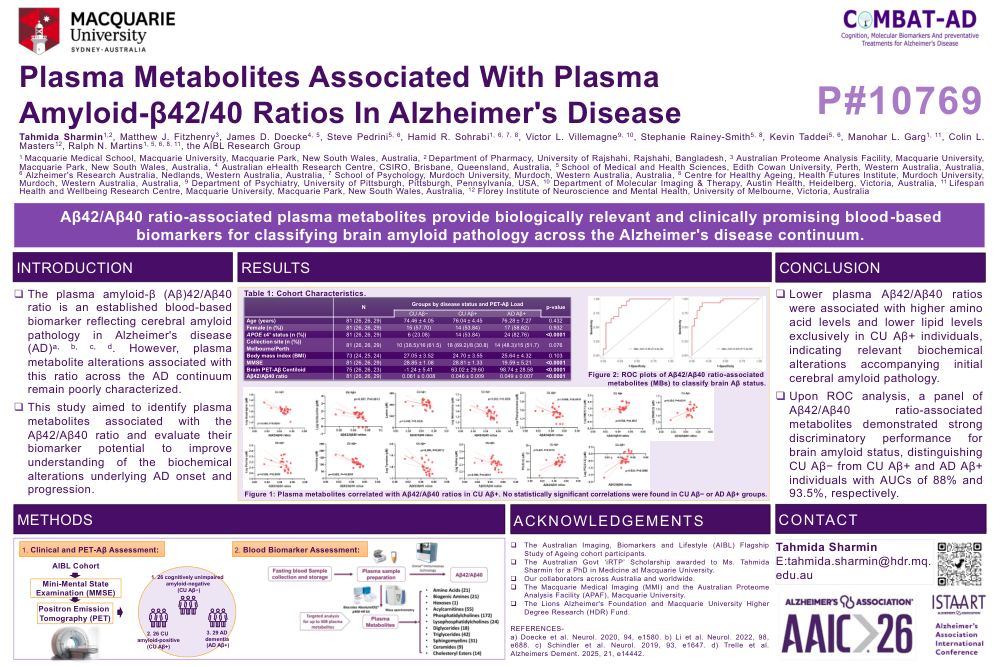
Background: The plasma amyloid-β (Aβ)42/Aβ40 ratio is an established blood-based biomarker reflecting cerebral amyloid pathology in Alzheimer's disease (AD). However, plasma metabolomic alterations associated with this ratio across the AD continuum remain poorly characterised. This study investigated plasma metabolites associated with the Aβ42/Aβ40 ratio and evaluated their biomarker potential to elucidate biochemical mechanisms underlying AD onset and progression.
Methods: Plasma samples from 81 participants from the Australian Imaging, Biomarkers and Lifestyle (AIBL) Flagship Study of Ageing cohort, comprising 26 cognitively unimpaired amyloid-negative (CU Aβ−), 26 cognitively unimpaired amyloid-positive (CU Aβ+), and 29 AD dementia (AD Aβ+), were analysed using targeted metabolomics. Cross-sectional associations between individual plasma metabolites and the plasma Aβ42/Aβ40 ratio, quantified via ultra-sensitive Quanterix Simoa technology, were examined separately within each group using Spearman correlation analyses, followed by generalised linear models adjusted for confounding variables with false discovery rate correction. Metabolites significantly associated with Aβ42/Aβ40 were further evaluated for their potential to distinguish brain amyloid status using receiver operating characteristic (ROC) analyses.
Results: Several amino-acid and lipid–related metabolites were significantly associated with plasma Aβ42/Aβ40 ratios. In CU Aβ+ individuals, lower Aβ42/Aβ40 ratios were associated with higher amino acid levels and lower lipid levels only, indicating alterations in biochemical pathways accompanying cerebral amyloid pathology. ROC analyses showed that a panel of these metabolites discriminated brain amyloid status between CU Aβ− and CU Aβ+, and between CU Aβ− and AD Aβ+, with AUCs of 88% and 93.5%, respectively.
Conclusion: Plasma metabolites associated with the Aβ42/Aβ40 ratio reflect biologically meaningful pathways linked to amyloid pathology. Importantly, a panel of these metabolites demonstrated strong discriminatory performance in classifying brain amyloid status among individuals with preclinical AD and AD dementia compared to healthy controls. These findings highlight the potential utility of the Aβ42/Aβ40 ratio-associated metabolites as complementary blood-based markers for early AD detection and for monitoring disease progression.
Comments
Email is required but is not shown publicly.
Loading comments...