4,068 posters, 219 videos, 101 topics, 69 sessions, 14,365 authors, 6,128 institutions
ePostersLive by SciGen Technologies S.A. All rights reserved.
Alzheimer's Association International Conference 2026
July 12-15, 2026 | London, United Kingdom, and Online

13120
Language Alterations In Asymptomatic Middle-aged Adults Across Apoe Genotype And Amyloid Burden Groups
Poster Presenter
Authors
Maya Zadok, Nitay Calderon, Yoav Wald, Michal Schnaider Beeri, Roi Reichart
Affiliations
Part of Topic
Biomarkers -> Biomarkers (non-neuroimaging) -> Digital Health Technologies / Digital Biomarkers
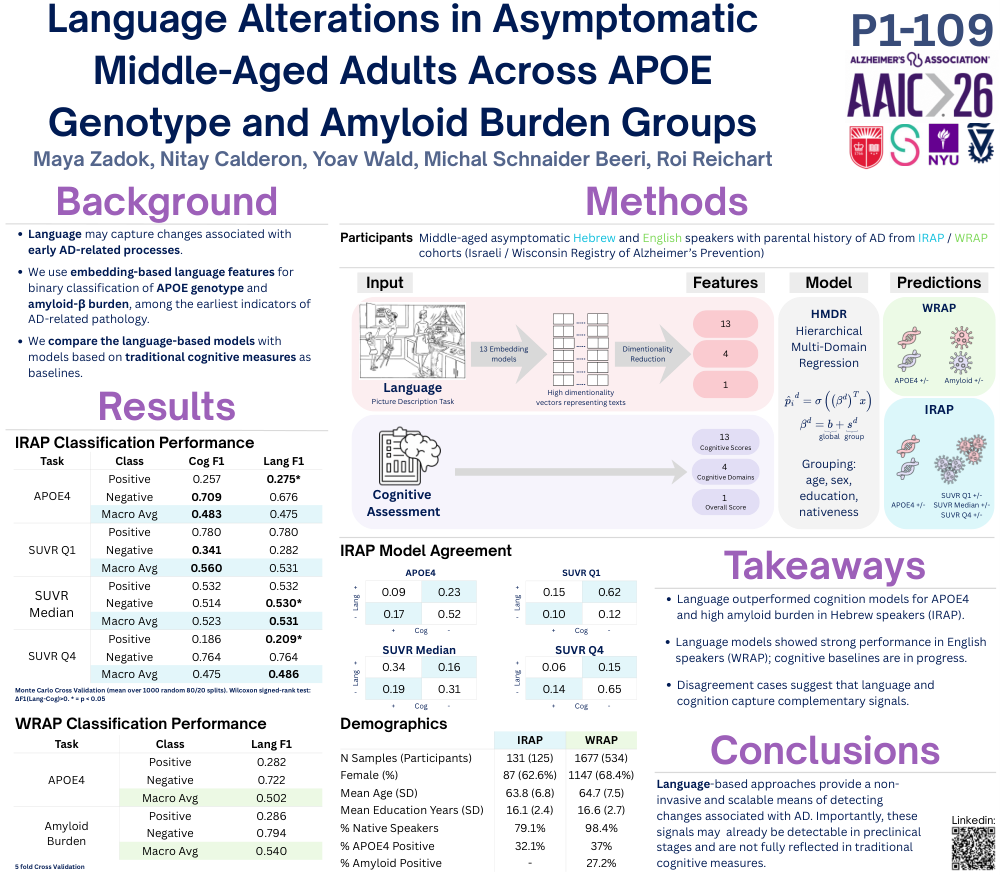
Language may capture subtle changes associated with early Alzheimer’s disease (AD)-related processes. In this study, we examine whether linguistic representations derived from transcribed speech using Large Language Models (LLMs), referred to as embeddings, capture differences in language use across groups defined by APOE genotype and amyloid-β burden. We focus on APOE and amyloid-β as early markers of AD-related risk and pathology, and compare models based on language-derived embeddings with models based on traditional cognitive measures commonly used to assess AD-related status.
We evaluate these approaches in two cohorts of asymptomatic middle-aged adults with a parental history of AD: Hebrew speakers from the Israeli Registry for Alzheimer’s Prevention (IRAP) and English speakers from the Wisconsin Registry for Alzheimer’s Prevention (WRAP). We used HMDR, a mixed-effects modeling framework that estimates both global effects shared across the full sample and group-specific effects. In WRAP, amyloid status was determined based on expert clinical judgment. In IRAP, because very few participants met criteria for amyloid positivity, we defined three within-sample amyloid burden thresholds to construct classification tasks at different levels of amyloid burden.
In IRAP, language-based models outperformed models based on cognitive features for APOE4 status and amyloid burden above the median. In WRAP, language-based models also showed strong classification performance, while comparisons with cognitive-feature models are still ongoing. Together, these findings suggest that language-based approaches may provide a non-invasive and scalable way to detect subtle differences associated with early AD-related processes. Importantly, disagreement cases between language-based and cognitive-feature models suggest that language and cognition may capture complementary signals, supporting the added value of language for detecting preclinical AD-related changes that may not be fully reflected in traditional cognitive measures.
Comments
Email is required but is not shown publicly.
Loading comments...