4,068 posters, 219 videos, 101 topics, 69 sessions, 14,365 authors, 6,128 institutions
ePostersLive by SciGen Technologies S.A. All rights reserved.
Alzheimer's Association International Conference 2026
July 12-15, 2026 | London, United Kingdom, and Online

13352
Intracranial Atherosclerotic Stenosis Of The Carotid Arteries And Cognitive Decline: A Case-control Study
Poster Presenter
Part of Topic
Biomarkers -> Neuroimaging -> Early detection measures
INTRODUCTION
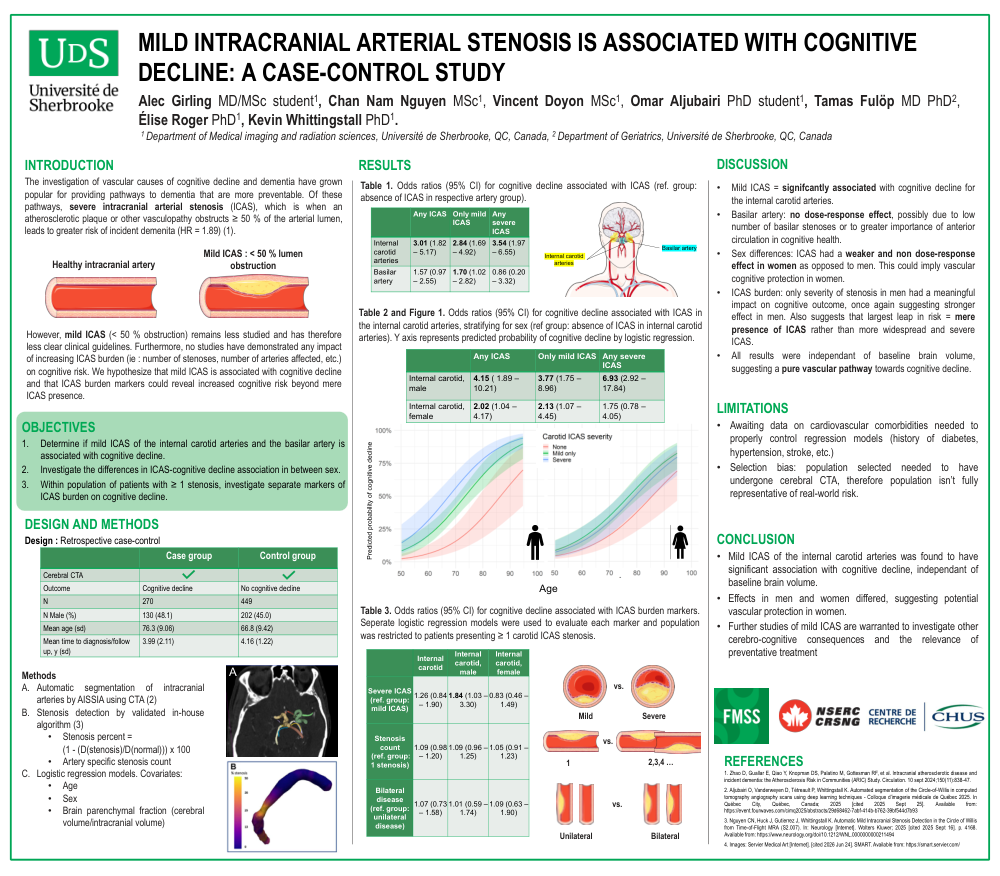
The investigation of vascular causes of cognitive decline and dementia have grown popular for providing pathways to dementia that are more preventable. Of these pathways, severe intracranial arterial stenosis (ICAS), which is when an atherosclerotic plaque or other vasculopathy obstructs ≥ 50 % of the arterial lumen, leads to greater risk of incident demenita (HR = 1.89) (1).
However, mild ICAS (< 50 % obstruction) remains less studied and has therefore less clear clinical guidelines. Furthermore, no studies have demonstrated any impact of increasing ICAS burden (ie : number of stenoses, number of arteries affected, etc.) on cognitive risk. We hypothesize that mild ICAS is associated with cognitive decline and that ICAS burden markers could reveal increased cognitive risk beyond mere ICAS presence.
OBJECTIVES
DESIGN AND METHODS
Design : Retrospective case-control
Methods
(1 - (D(stenosis)/D(normal))) x 100
RESULTS
Table 1. Odds ratios (95% CI) for cognitive decline associated with ICAS (ref. group: absence of ICAS in respective artery group).
Table 2 and Figure 1. Odds ratios (95% CI) for cognitive decline associated with ICAS in the internal carotid arteries, stratifying for sex (ref group: absence of ICAS in internal carotid arteries). Y axis represents predicted probability of cognitive decline by logistic regression.
Table 3. Odds ratios (95% CI) for cognitive decline associated with ICAS burden markers. Seperate logistic regression models were used to evaluate each marker and population was restricted to patients presenting ≥ 1 carotid ICAS stenosis.
DISCUSSION
LIMITATIONS
CONCLUSION
REFERENCES
1. Zhao D, Guallar E, Qiao Y, Knopman DS, Palatino M, Gottesman RF, et al. Intracranial atherosclerotic disease and incident dementia: the Atherosclerosis Risk in Communities (ARIC) Study. Circulation. 10 sept 2024;150(11):838‑47.
2. Aljubairi O, Vanderweyen D, Tétreault P, Whittingstall K. Automated segmentation of the Circle-of-Willis in computed tomography angiography scans using deep learning techniques - Colloque d’imagerie médicale de Québec 2025. In Québec City, Québec, Canada; 2025 [cited 2025 Sept 25]. Available from: https://event.fourwaves.com/cimq2025/abstracts/29d68462-7abf-414b-b762-39bf544d7b93
3. Nguyen CN, Huck J, Gutierrez J, Whittingstall K. Automatic Mild Intracranial Stenosis Detection in the Circle of Willis from Time-of-Flight MRA (S2.007). In: Neurology [Internet]. Wolters Kluwer; 2025 [cited 2025 Sept 16]. p. 4168. Available from: https://www.neurology.org/doi/10.1212/WNL.0000000000211494
4. Images: Servier Medical Art [Internet]. [cited 2026 Jun 24]. SMART. Available from: https://smart.servier.com/
Comments
Email is required but is not shown publicly.
Loading comments...