4,068 posters, 219 videos, 101 topics, 69 sessions, 14,365 authors, 6,128 institutions
ePostersLive by SciGen Technologies S.A. All rights reserved.
Alzheimer's Association International Conference 2026
July 12-15, 2026 | London, United Kingdom, and Online

13253
Integrated Blood Transcriptomic And Proteomic Analyses Identify Biomarkers Of Lecanemab Response In Early Alzheimer’S Disease
Part of Topic
Biomarkers -> Biomarkers (non-neuroimaging) -> Fluid biomarkers
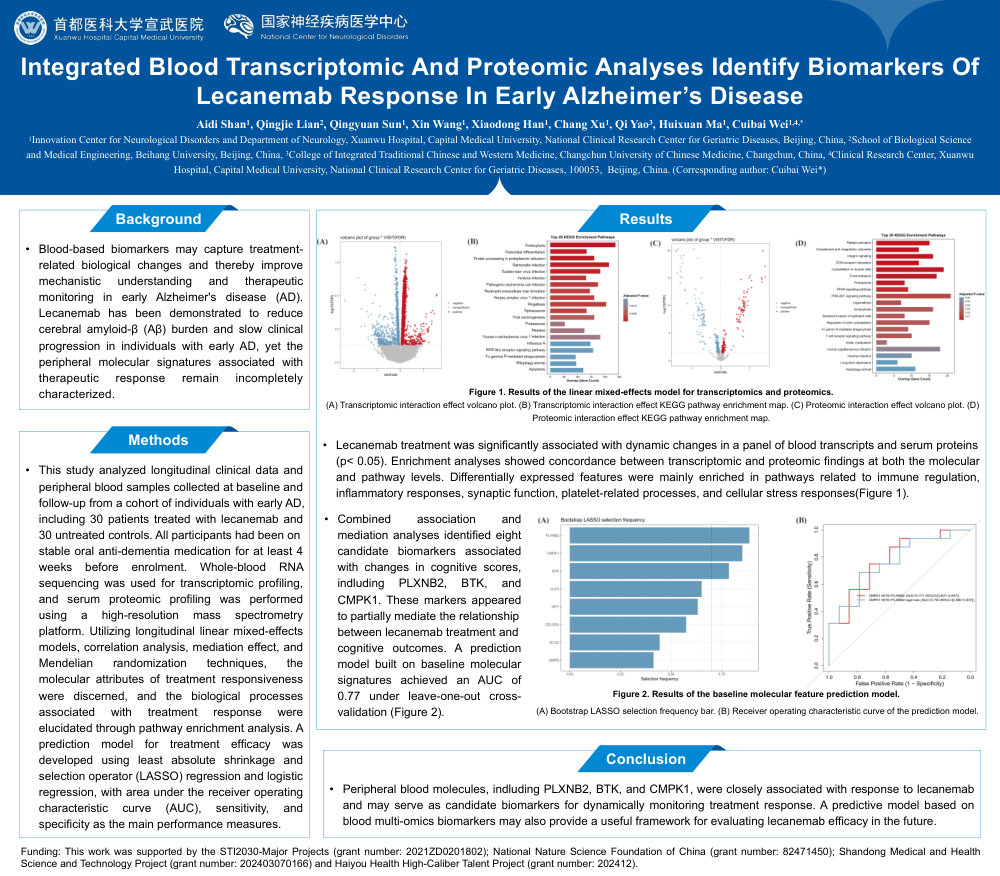
Integrated longitudinal blood transcriptomic and proteomic analyses identify biomarkers predictive of lecanemab response in early Alzheimer’s disease
Aidi Shan1, Qingjie Lian2, Qingyuan Sun1, Xin Wang1, Xiaodong Han1, Chang Xu1, Qi Yao3, Huixuan Ma1, Cuibai Wei1, 4, 5, *
1Innovation Center for Neurological Disorders and Department of Neurology, Xuanwu Hospital, Capital Medical University, National Clinical Research Center for Geriatric Diseases, Beijing, China.
2School of Biological Science and Medical Engineering, Beihang University, Beijing, China.
3College of Integrated Traditional Chinese and Western Medicine, Changchun University of Chinese Medicine, Changchun, China.
4Clinical Research Center, Xuanwu Hospital, Capital Medical University, National Clinical Research Center for Geriatric Diseases, 100053, Beijing, China.
5Jinan Hospital of Xuanwu Hospital, Shandong First Medical University, 250102, Jinan, China.
*Corresponding author: Cuibai Wei, PhD. Innovation Center for Neurological Disorders and Department of Neurology, Xuanwu Hospital, Capital Medical University, National Clinical Research Center for Geriatric Diseases, 100053, Beijing, China. Email: weicb@xwhosp.org (C. Wei)
Background: Blood-based biomarkers may capture treatment-related biological changes and thereby improve mechanistic understanding and therapeutic monitoring in early Alzheimer’s disease (AD). Lecanemab has been demonstrated to reduce cerebral amyloid-β (Aβ) burden and slow clinical progression in individuals with early AD, yet the peripheral molecular signatures associated with therapeutic response remain incompletely characterized.
Methods: This study analyzed longitudinal clinical data and peripheral blood samples collected at baseline and follow-up from a cohort of individuals with early AD, including 30 patients treated with lecanemab and 30 untreated controls. All participants had been on stable oral anti-dementia medication for at least 4 weeks before enrolment. Whole-blood RNA sequencing was used for transcriptomic profiling, and serum proteomic profiling was performed using a high-resolution mass spectrometry platform. Utilizing longitudinal linear mixed-effects models, correlation analysis, mediation effect, and Mendelian randomization techniques, the molecular attributes of treatment responsiveness were discerned, and the biological processes associated with treatment response were elucidated through pathway enrichment analysis. A prediction model for treatment efficacy was developed using least absolute shrinkage and selection operator (LASSO) regression and logistic regression, with area under the receiver operating characteristic curve (AUC), sensitivity, and specificity as the main performance measures.
Results: Lecanemab treatment was significantly associated with dynamic changes in a panel of blood transcripts and serum proteins (P<0.05). Enrichment analyses showed concordance between transcriptomic and proteomic findings at both the molecular and pathway levels. Differentially expressed features were mainly enriched in pathways related to immune regulation, inflammatory responses, synaptic function, platelet-related processes, and cellular stress responses. Combined association and mediation analyses identified eight candidate biomarkers associated with changes in cognitive scores, including PLXNB2, BTK, and CMPK1. These markers appeared to partially mediate the relationship between lecanemab treatment and cognitive outcomes. A prediction model built on baseline molecular signatures achieved an AUC of 0.77 under leave-one-out cross-validation.
Conclusions: Peripheral blood molecules, including PLXNB2, BTK, and CMPK1, were closely associated with response to lecanemab and may serve as candidate biomarkers for dynamically monitoring treatment response. A predictive model based on blood multi-omics biomarkers may also provide a useful framework for evaluating lecanemab efficacy in the future.
Comments
Email is required but is not shown publicly.
Loading comments...