4,068 posters, 219 videos, 101 topics, 69 sessions, 14,365 authors, 6,128 institutions
ePostersLive by SciGen Technologies S.A. All rights reserved.
Alzheimer's Association International Conference 2026
July 12-15, 2026 | London, United Kingdom, and Online

10661
Sleep Quality And Cardiovascular Burden Moderates The Association Between Neuroinflammation And Cognitive-functional Decline
Poster Presenter
Authors
Angel Collie, MS, Mark Bernard, PhD, Louisina Morancy, BS, Tamare V. Adrien, MS, Layaly Shihadeh, MA, Krithika Sivaramakrishnan, MA, Monica Rosselli, PhD, Warren Barker, BS, Michael Marsiske, PhD, Melissa Armstrong, MD, MSc, Franchesca Arias, PhD, Breton Asken, PhD, Steven DeKosky, MD, Stephon Coombes, PhD, Karen Velasquez De Lopez, MD, Idaly Velez-Uribe, PhD, Lenoard Sokol, MD, Rosie Curiel Cid, PsyD, David Loewenstein, PhD, Ranjan Duara, MD, Glenn Smith, PhD, Shellie-Anne Levy, PhD
Affiliations
University of Miami, Florida Atlantic University, University of Florida, Mount Sinai Medical Center, NYU Grossman School of Medicine
Part of Topic
Background: Poor sleep is a modifiable risk factor for cognitive and functional decline. Sleep disruption is associated with vascular dysregulation, cardiovascular disease (CVD) risk, and inflammation, each of which independently contribute to cognitive decline and dementia. However, the combined influence of poor sleep, vascular burden, and neuroinflammatory processes on cognitive trajectories in AD remains unclear. Plasma glial fibrillary acidic protein (GFAP), a peripheral marker of astrocytic reactivity, may provide insight into the neuroinflammatory pathways linking sleep, cardiovascular health, and cognitive decline. This study investigated whether sleep characteristics and CVD burden modify longitudinal associations between GFAP and cognitive-functional decline in older adults.
Methods: Participants included 129 older adults (Mage = 64.49 ± 7.73) enrolled in the 1Florida Alzheimer’s Disease Research Center. At baseline, sleep quality was assessed using the Pittsburgh Sleep Quality Index (PSQI). Plasma GFAP levels were assayed (QuanterixSimoa), and cognitive-functional decline was measured with the Clinical Dementia Rating Scale–Sum of Boxes (CDR-SB). Depressive symptoms were assessed using the Geriatric Depression Scale. CVD burden was calculated as the sum of hypertension, hypercholesterolemia, diabetes, stroke, heart attack, atrial fibrillation, congestive heart failure, smoking, sleep apnea, and obesity. Linear mixed-effects models tested whether sleep quality and CVD burden moderated longitudinal associations between GFAP and CDR-SB, adjusting for age, sex, education, depression, and APOE ε4 status. To account for multiple testing, p-values were adjusted using false discovery rate (FDR) correction (Benjamini–Hochberg).
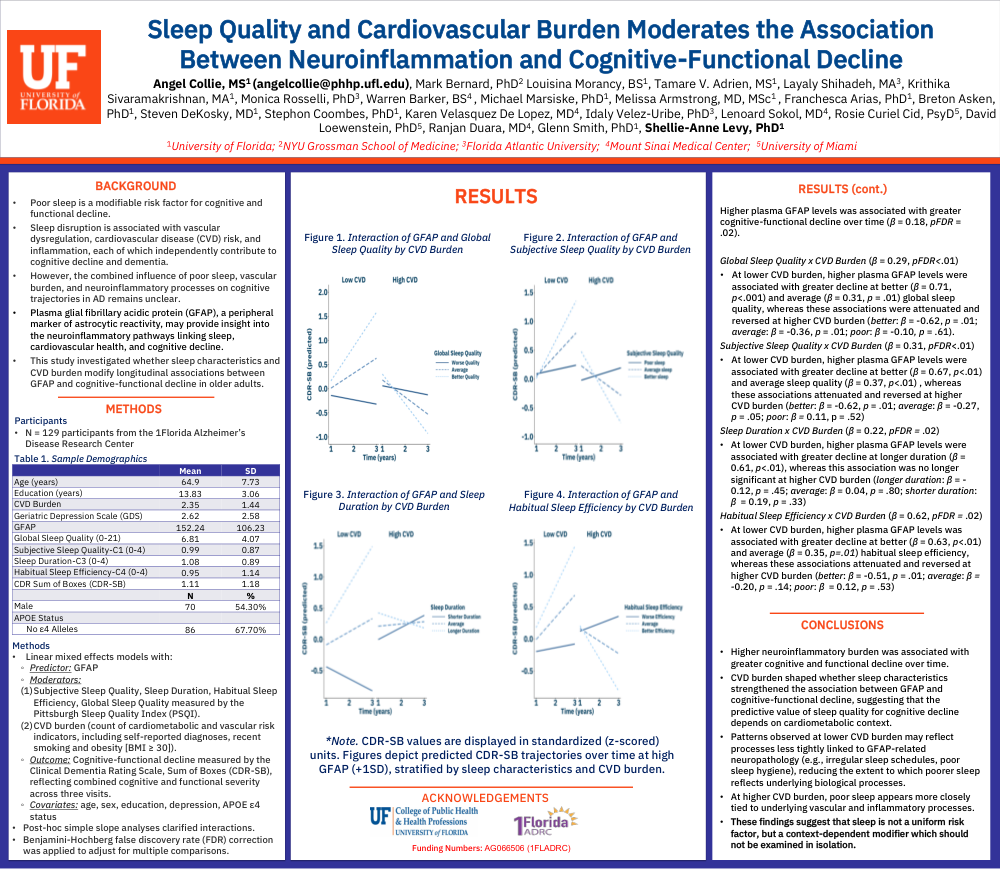
Results: Higher plasma GFAP levels was associated with greater cognitive-functional decline over time (β = 0.18, pFDR = .02).
GFAP x Global Sleep Quality x CVD Burden (β = 0.29, pFDR<.01): At lower CVD burden, higher plasma GFAP levels were associated with greater decline at better (β = 0.71, p<.001) and average (β = 0.31, p = .01) global sleep quality, whereas these associations were attenuated and reversed at higher CVD burden (better: β = -0.62, p = .01; average: β = -0.36, p = .01; poor: β = -0.10, p = .61).
GFAP x Subjective Sleep Quality x CVD Burden (β = 0.31, pFDR<.01): At lower CVD burden, higher plasma GFAP levels were associated with greater decline at better (β = 0.67, p<.01) and average sleep quality (β = 0.37, p<.01) , whereas these associations attenuated and reversed at higher CVD burden (better: β = -0.62, p = .01; average: β = -0.27, p = .05; poor: β = 0.11, p = .52)
GFAP x Sleep Duration x CVD Burden (β = 0.22, pFDR = .02): At lower CVD burden, higher plasma GFAP levels were associated with greater decline at longer duration (β = 0.61, p<.01), whereas this association was no longer significant at higher CVD burden (longer duration: β = -0.12, p = .45; average: β = 0.04, p = .80; shorter duration: β = 0.19, p = .33)
GFAP x Habitual Sleep Efficiency x CVD Burden (β = 0.62, pFDR = .02): At lower CVD burden, higher plasma GFAP levels was associated with greater decline at better (β = 0.63, p<.01) and average (β = 0.35, p=.01) habitual sleep efficiency, whereas these associations attenuated and reversed at higher CVD burden (better: β = -0.51, p = .01; average: β = -0.20, p = .14; poor: β = 0.12, p = .53)
Conclusions: Higher neuroinflammatory burden was associated with greater cognitive and functional decline over time. CVD burden shaped whether sleep characteristics strengthened the association between GFAP and cognitive-functional decline, suggesting that the predictive value of sleep quality for cognitive decline depends on cardiometabolic context. Patterns observed at lower CVD burden may reflect processes less tightly linked to GFAP-related neuropathology (e.g., irregular sleep schedules, poor sleep hygiene), reducing the extent to which poorer sleep reflects underlying biological processes. At higher CVD burden, poor sleep appears more closely tied to underlying vascular and inflammatory processes. These findings suggest that sleep is not a uniform risk factor, but a context-dependent modifier which should not be examined in isolation.
Comments
Email is required but is not shown publicly.
Loading comments...