4,068 posters, 219 videos, 101 topics, 69 sessions, 14,365 authors, 6,128 institutions
ePostersLive by SciGen Technologies S.A. All rights reserved.
Alzheimer's Association International Conference 2026
July 12-15, 2026 | London, United Kingdom, and Online

13887
Evidence-linked Knowledge Graph For Alzheimer's Disease: Integrating Biomarkers, Mechanisms, And Outcomes
Poster Presenter
Authors
Part of Topic
Biomarkers -> Biomarkers (non-neuroimaging) -> Method development and/or quality control
Video
Alzheimer's disease is one of the most active fields in science — and at the same time, one of the most fragmented. We have molecular data, biomarkers, imaging, clinical outcomes — but this knowledge lives scattered across thousands of publications, disconnected from one another.
The question that motivated us was straightforward: can we bring all of this together into a single, intelligible, traceable structure that supports hypothesis generation?
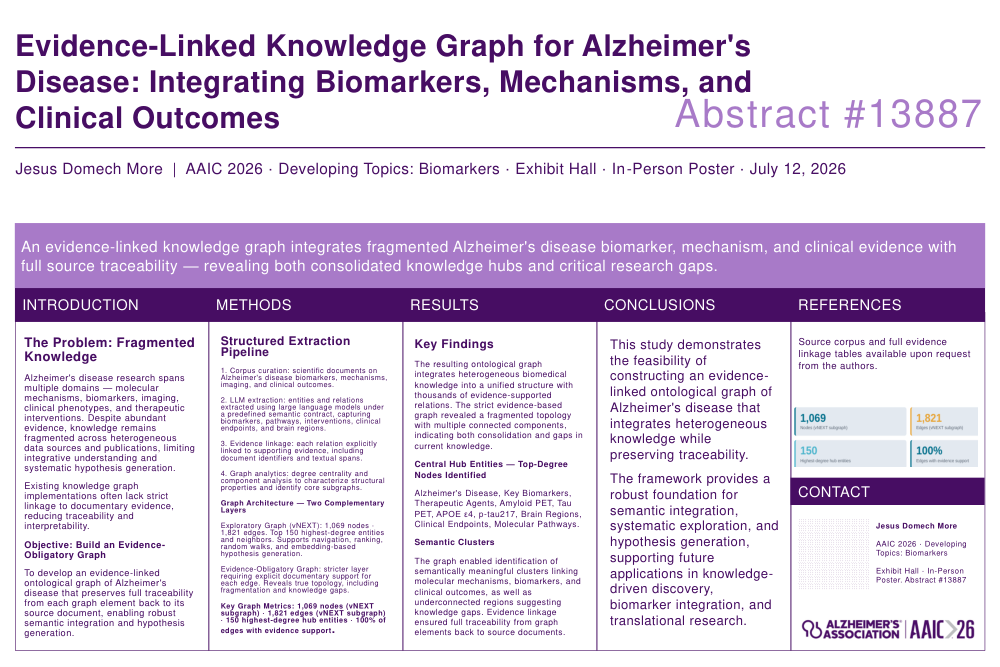
Our answer was to build an evidence-linked ontological knowledge graph — with one key feature that sets it apart from previous approaches: every relation in the graph is explicitly tied to the scientific document that supports it.
We used large language models to extract entities and relations from a corpus of scientific articles, following a predefined semantic contract — ensuring consistency and end-to-end traceability.
The result is a two-layer structure. The exploratory graph — with over a thousand nodes and nearly two thousand edges — supports navigation, ranking, and embedding-based hypothesis generation. The evidence-obligatory graph is stricter: every edge requires explicit documentary support. It reveals a fragmented topology — which is itself informative: it shows us where knowledge is still thin.
The central entities of the graph — its highest-connectivity nodes — include Alzheimer's disease itself, amyloid PET, plasma p-tau217, APOE epsilon 4, and key brain regions. These are the nodes that bridge multiple domains and organize the semantic space of the research field.
This work demonstrates that it is feasible to build a knowledge map of Alzheimer's disease that is both comprehensive and traceable. This is not an academic exercise — it is an infrastructure for systematic discovery, biomarker prioritization, and translational hypothesis generation.
In the next poster, we will show how this graph was transformed into a semantic landscape — one that can tell us where to investigate first. Thank you.
Comments
Email is required but is not shown publicly.
Loading comments...