4,068 posters, 219 videos, 101 topics, 69 sessions, 14,365 authors, 6,128 institutions
ePostersLive by SciGen Technologies S.A. All rights reserved.
Alzheimer's Association International Conference 2026
July 12-15, 2026 | London, United Kingdom, and Online

13855
Evaluating Biomarker Utility In A Real World Clinical Setting
Poster Presenter
Part of Topic
Biomarkers -> Biomarkers (non-neuroimaging) -> Prognostic utility
Introduction
•The advent of disease modifying
treatments for Alzheimer's disease
(AD) has created a rapid increase in
demand for clinical and biological
confirmation.
• Plasma blood-based biomarkers
(BBMs) may support biological
confirmation though uncertainty
remains regarding their integration
and performance against long-
standing reference standards.
• We evaluated the "real-world"
context of use and diagnostic
performance of BBMs for AD in a
multidisciplinary memory disorders
clinic
Methods
• We conducted a retrospective analysis
of patients evaluated at a single
memory disorders clinic who underwent
biomarker testing for suspected
Alzheimer's disease.
• Modalities included plasma mass
spectrometry (MS), CSF biomarkers
obtained by lumbar puncture, plasma
immunoassay, and amyloid PET
imaging.
• Demographics were extracted from the
electronic medical record to evaluate
biomarker utilization, testing patterns,
and influence on diagnosis and care
planning.
Methods
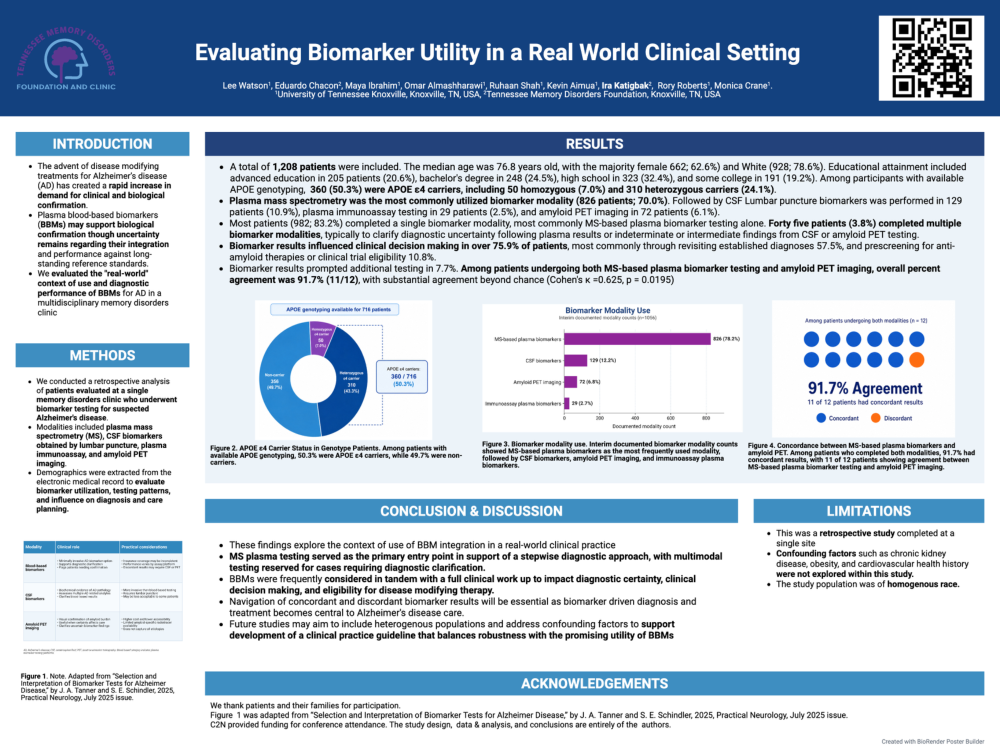
• A total of 1,208 patients were included. The median age was 76.8 years old, with the majority female 662; 62.6%) and White (928; 78.6%). Educational attainment included
advanced education in 205 patients (20.6%), bachelor's degree in 248 (24.5%), high school in 323 (32.4%), and some college in 191(19.2%). Among participants with available
APOE genotyping, 360 (50.3%) were APOE E4 carriers, including 50 homozygous (7.0%) and 310 heterozygous carriers (24.1%).
• Plasma mass spectrometry was the most commonly utilized biomarker modality (826 patients; 70.0%). Followed by CSF Lumbar puncture biomarkers was performed in 129
patients (10.9%), plasma immunoassay testing in 29 patients (2.5%), and amyloid PET imaging in 72 patients (6.1%).
• Most patients (982; 83.2%) completed a single biomarker modality, most commonly MS-based plasma biomarker testing alone. Forty five patients (3.8%) completed multiple
biomarker modalities, typically to clarify diagnostic uncertainty following plasma results or indeterminate or intermediate findings from CSF or amyloid PET testing.
• Biomarker results influenced clinical decision making in over 75.9% of patients, most commonly through revisiting established diagnoses 57.5%, and prescreening for anti-
amyloid therapies or clinical trial eligibility 10.8%.
• Biomarker results prompted additional testing in 7.7%. Among patients undergoing both MS-based plasma biomarker testing and amyloid PET imaging, overall percent
agreement was 91.7% (11/12), with substantial agreement beyond chance (Cohen's =0.625, p= 0.0195)
CONCLUSION & DISCUSSION
- These findings explore the context of use of BBM integration in a real-world clinical practice
- MS plasma testing served as the primary entry point in support of a stepwise diagnostic approach, with multimodal testing reserved for cases requiring diagnostic clarification.
- BBMs were frequently considered in tandem with a full clinical work up to impact diagnostic certainty, clinical decision making, and eligibility for disease modifying therapy.
- Navigation of concordant and discordant biomarker results will be essential as biomarker driven diagnosis and treatment becomes central to Alzheimer's disease care.
- Future studies may aim to include heterogenous populations and address confounding factors to support development of a clinical practice guideline that balances robustness with the promising utility of BBMs
LIMITATIONS
- This was a retrospective study completed at a single site
- Confounding factors such as chronic kidney disease, obesity, and cardiovascular health history were not explored within this study.
- The study population was of homogenous race.
ACKNOWLEDGEMENTS
We thank patients and their families for participation.
Figure 1 was adapted from "Selection and Interpretation of Biomarker Tests for Alzheimer Disease, by J. A. Tanner and S. E. Schindler, 2025, Practical Neurology, July 2025 issue.
C2N provided funding for conference attendance. The study design, data & analysis, and conclusions are entirely of the authors.
Created with BioRender Poster Builder
Comments
Email is required but is not shown publicly.
Loading comments...