4,068 posters, 219 videos, 101 topics, 69 sessions, 14,365 authors, 6,128 institutions
ePostersLive by SciGen Technologies S.A. All rights reserved.
Alzheimer's Association International Conference 2026
July 12-15, 2026 | London, United Kingdom, and Online

8902
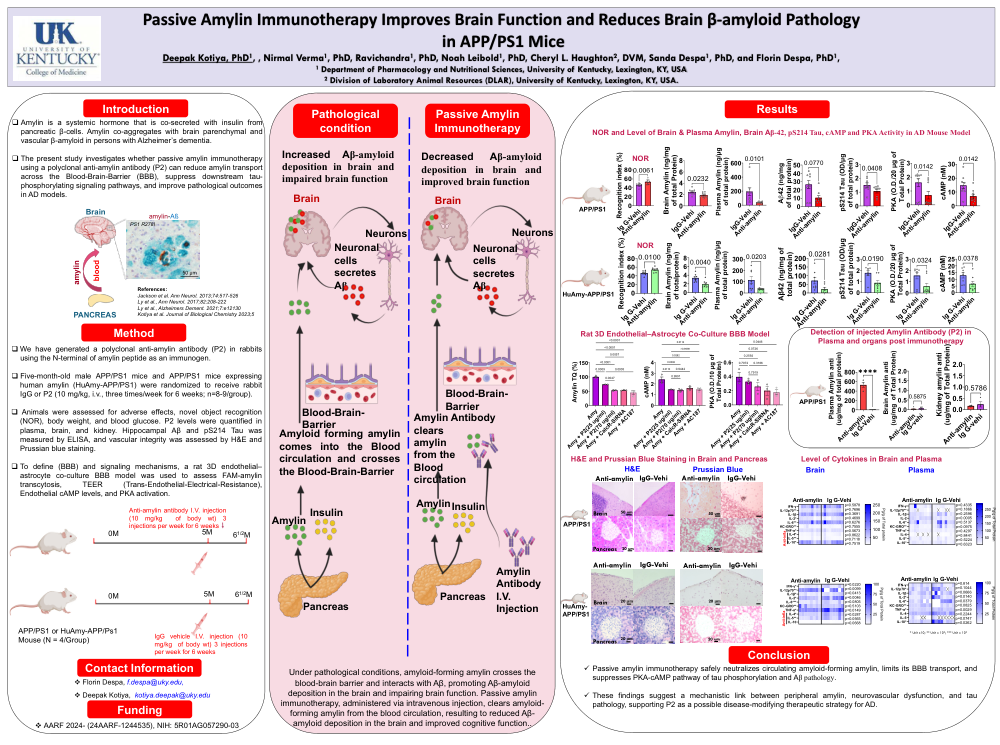
Passive Amylin Immunotherapy Improves Brain Function And Reduces Brain β-amyloid Pathology In APP/PS1 Mice
Poster Presenter
Authors
Deepak Kotiya, Nirmal Verma, Ravichandra Davargaon, Noah Leibold, Cheryl Haughton, Sanda Despa, Florin Despa
Affiliations
Department of Pharmacology and Nutritional Sciences, University of Kentucky, Lexington, KY, USA, Division of Laboratory Animal Resources (DLAR), University of Kentucky, Lexington, KY, USA.
Part of Topic
Title: Passive amylin immunotherapy improves brain function and reduces brain β-amyloid pathology in APP/PS1 mice
Deepak Kotiya1, PhD, Nirmal Verma1, PhD, Ravichandra1, PhD, Noah Leibold1, PhD, Cheryl L. Haughton2, DVM, Sanda Despa1, PhD, and Florin Despa1, PhD,
1.Department of Pharmacology and Nutritional Sciences, University of Kentucky, Lexington, KY, USA. 2. Division of Laboratory Animal Resources (DLAR), University of Kentucky, Lexington, KY, USA.
Background
Amylin is a pancreatic β-cell hormone that co-aggregates with β-amyloid (Aβ) in the brains and cerebral vasculature of patients with Alzheimer’s disease (AD). Circulating amyloid-forming human amylin crosses the blood brain barrier (BBB), promotes neurovascular amyloid deposition, and exacerbates tau pathology. We investigated whether passive amylin immunotherapy using a polyclonal anti-amylin antibody (P2) can reduce amylin transport across the BBB, suppress downstream tau-phosphorylating signaling pathways, and improve pathological outcomes in AD models.
Methods
A polyclonal anti-amylin antibody (P2) was generated in rabbits against the N-terminal amylin epitope. Five-month-old male APP/PS1 mice and APP/PS1 mice expressing human amylin (HuAmy-APP/PS1) were randomized to receive rabbit IgG or P2 (10 mg/kg, i.v., three times/week for 6 weeks; n=8-9/group). Animals were assessed for adverse effects, novel object recognition (NOR), body weight, and blood glucose. P2 levels were quantified in plasma, brain, and kidney. Hippocampal Aβ was measured by ELISA, and vascular integrity was assessed by H&E and Prussian blue staining. To define BBB and signaling mechanisms, a rat 3D endothelial–astrocyte co-culture BBB model was used. FAM-amylin transcytosis, TEER (Trans-Endothelial-Electrical-Resistance), and permeability assays were performed following P2 treatment. Endothelial cAMP levels, PKA activation were quantified by immunoassays.
Results
P2-treated APP/PS1 mice exhibited significantly elevated plasma P2 levels (p<0.001) with no detectable antibody in brain or kidney. Histological analyses showed intact vasculature and absence of microhemorrhages. P2-treated mice showed improved recognition memory (P=0.0061; P=0.0100; respectively) and lower blood glucose (P=0.0481; P=0.0472; respectively) in both APP/PS1 and HuAmy-APP/PS1 cohorts. In the 3D BBB model, P2 significantly reduced amylin transcytosis (P<0.05) across endothelial monolayers and preserved barrier integrity. Mechanistically, P2 suppressed amylin-induced cAMP-PKA activation in 3D BBB model, a pathway involved in tau phosphorylation.
Conclusion
Passive amylin immunotherapy safely neutralizes circulating amyloid-forming amylin, limits its BBB transport, and suppresses PKA-cAMP pathway of tau phosphorylation. These findings suggest a mechanistic link between peripheral amylin, neurovascular dysfunction, and tau pathology, supporting P2 as a possible disease-modifying therapeutic strategy for AD. Further biochemical analyses of collected tissues from these mice are currently in progress.
Comments
Email is required but is not shown publicly.
Loading comments...