4,068 posters, 219 videos, 101 topics, 69 sessions, 14,365 authors, 6,128 institutions
ePostersLive by SciGen Technologies S.A. All rights reserved.
Alzheimer's Association International Conference 2026
July 12-15, 2026 | London, United Kingdom, and Online

13024
Comparison Of Plasma Biomarkers For Early Detection Of Amyloid Pathology In A Cognitively Unimpaired Population
Poster Presenter
Part of Topic
Biomarkers -> Biomarkers (non-neuroimaging) -> Fluid biomarkers
Comparison Of Plasma Biomarkers For Early Detection Of Amyloid Pathology In A CognitivelyUnimpaired Population
Author Block:
Luna Buitrago1, Francesca I. De Simone1, M. Craig Miller1, Natalya Benina1, Rachel R.Radwan1, Nathalie Le Bastard2, Amanda Calabro1, Jessica Junfola1, Diana Dickson1, Douglas Hawkins3.
1Fujirebio Diagnostics, Inc, Malvern, PA, USA,
2Fujirebio Europe N.V., Ghent, Belgium,
3School of Statistics,University of Minnesota, Minneapolis, MN, USA.
Abstract:
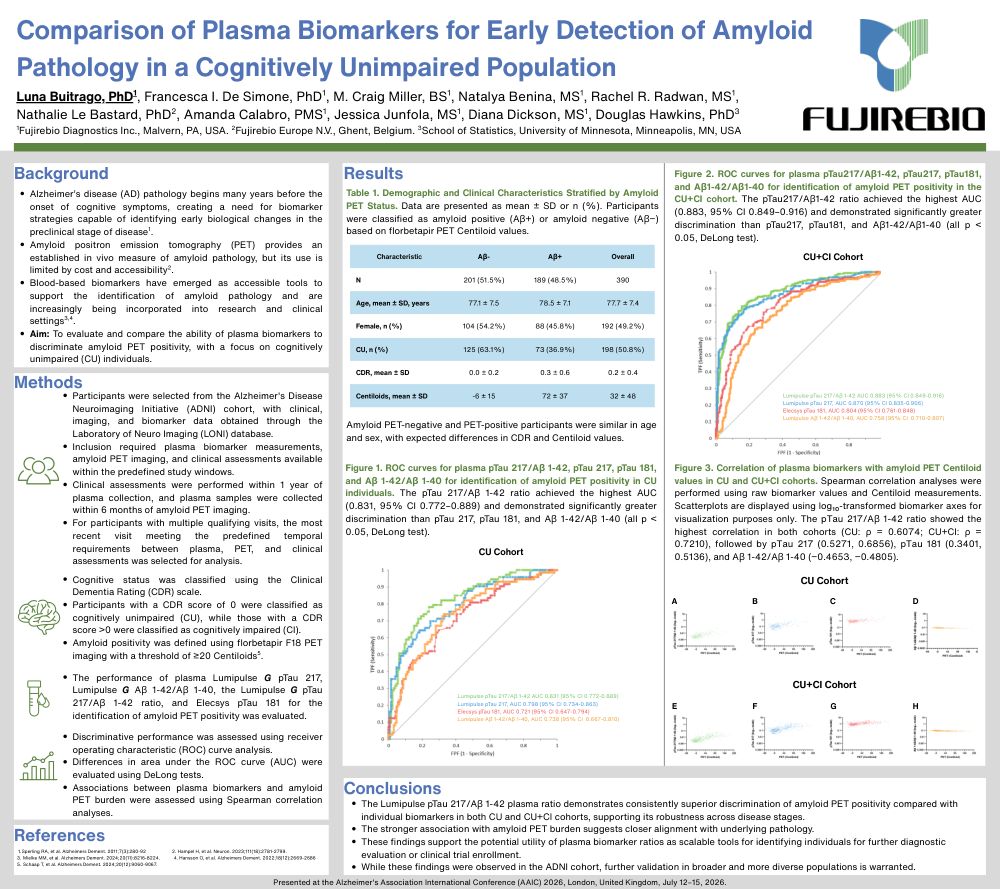
Background: Plasma biomarkers are increasingly used to identify Alzheimer’s disease (AD) pathology;however, performance in cognitively unimpaired individuals remains to be elucidated. This exploratorystudy investigated the relative discrimination of early plasma biomarker strategies across the ADcontinuum, encompassing cognitively unimpaired and impaired populations.
Methods: Well-characterized participants from the Alzheimer's Disease Neuroimaging Initiative database(ADNI; adni.loni.usc.edu) were included, with clinical data collected within 1 year of plasma collection andplasma samples collected within 6 months of amyloid PET; all included participants had clinical and PETassessments within 1 year. For individuals with multiple samples meeting these time criteria, the mostrecent sample was selected. Participants with a Clinical Dementia Rating (CDR) score of 0 were classified ascognitively unimpaired (CU), and those with CDR >0 as cognitively impaired (CI). Amyloid positivity wasdetermined using Florbetapir F18 PET (>20 Centiloids). Plasma biomarkers included Lumipulse pTau217,Lumipulse Aβ42/40, Lumipulse pTau217/Aβ42 ratio, and Elecsys pTau181. Discriminative performance wasassessed using the area under the receiver operating characteristic curve (AUC) with comparisons byDeLong tests in the CU and combined CU+CI populations. Correlations with PET Centiloids were assessedusing Spearman’s correlations.
Results: In the CU cohort, the pTau217/Aβ42 ratio showed the highest discrimination for amyloid positivity(AUC 0.831, 95% CI 0.772-0.889), with significantly improved discrimination vs pTau217 (AUC 0.798, p =0.0045), Aβ42/40 (AUC 0.738, p = 0.0136), and pTau181 (AUC 0.721, p = 0.0005) (Figure A). ThepTau217/Aβ42 ratio also showed the strongest correlation with amyloid PET Centiloids (Spearman ρ =0.6074), followed by pTau217 alone (ρ = 0.5271), with all biomarkers showing an association with PETburden (all p < 0.0001). In the CU+CI cohort, the ratio achieved the highest AUC (0.883, 95% CI 0.849-0.916), with modest but significant improvement vs pTau217 (AUC 0.870, p = 0.0435) (Figure B), andremained the strongest correlate of PET burden (ρ = 0.7210), followed by pTau217 (ρ = 0.6856).
Conclusion: The Lumipulse pTau217/Aβ42 plasma ratio demonstrated the strongest discriminativeperformance for amyloid positivity and association with amyloid PET burden across cognitively unimpairedand mixed-stage populations, supporting its potential role across the AD continuum.
Comments
Email is required but is not shown publicly.
Loading comments...