4,068 posters, 219 videos, 101 topics, 69 sessions, 14,365 authors, 6,128 institutions
ePostersLive by SciGen Technologies S.A. All rights reserved.
Alzheimer's Association International Conference 2026
July 12-15, 2026 | London, United Kingdom, and Online

13270
Cognitive-pathological Dissociation During Cognitive Reversal In AD-related MCI: Insights From Multimodal Trajectory Modeling
Poster Presenter
Authors
Qingyuan Sun, Qingjie Lian, Xiaodong Han, Aidi Shan, Cuibai Wei
Affiliations
Innovation Center for Neurological Disorders and Department of Neurology, Xuanwu Hospital, Capital Medical University, National Clinical Research Center for Geriatric Diseases, Beijing, 100053, China., School of Biological Science and Medical Engineering, Beihang University, Beijing, 100191, China.
Part of Topic
Biomarkers -> Biomarkers (non-neuroimaging) -> Mixed-pathology
Introduction:
Mild cognitive impairment (MCI) is a heterogeneous stage along the Alzheimer’s disease (AD) continuum, with individuals showing diverse cognitive trajectories. Pathological burden has traditionally been considered closely linked to cognitive function, with pathological progression generally accompanied by cognitive decline. However, whether cognitive improvement reflects true pathological recovery or instead altered disease dynamics remains unclear. We aimed to construct an overall pathological trajectory using 11 data modalities , including Aβ PET, tau PET, structural MRI, metabolomics, proteomics, and transcriptomics, and to clarify the pathological changes during cognitive reversal.
Methods:
We integrated 11 multimodal datasets comprising 7,019 visits from 1,996 individuals in the Alzheimer’s Disease Neuroimaging Initiative (ADNI). A latent factor space was constructed using Multi-Omics Factor Analysis (MOFA), from which individualized progression velocity was derived. Multimodal Pathological Burden (MPB) was estimated using the Potential of Heat-diffusion for Affinity-based Transition Embedding (PHATE) algorithm, with hyperparameters optimized in an internal validation cohort. Paired longitudinal analyses were performed to assess within-individual changes in MPB, progression velocity, and molecular features.
Results:
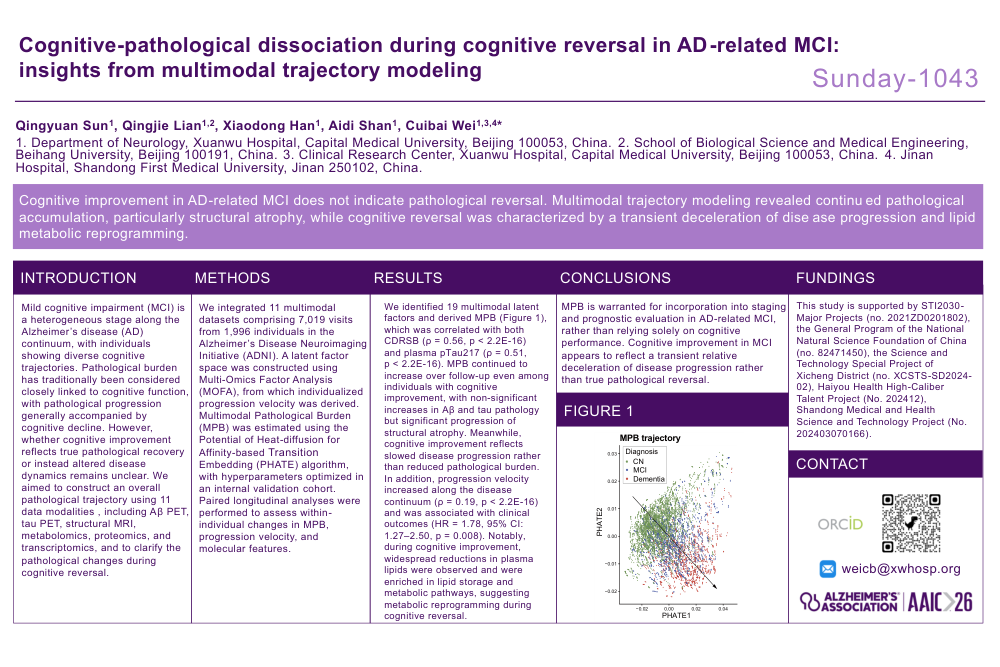
We identified 19 multimodal latent factors and derived MPB (Figure 1), which was correlated with both CDRSB (ρ = 0.56, p < 2.2E-16) and plasma pTau217 (ρ = 0.51, p < 2.2E-16). MPB continued to increase over follow-up even among individuals with cognitive improvement, with non-significant increases in Aβ and tau pathology but significant progression of structural atrophy. Meanwhile, cognitive improvement reflects slowed disease progression rather than reduced pathological burden. In addition, progression velocity increased along the disease continuum (ρ = 0.19, p < 2.2E-16) and was associated with clinical outcomes (HR = 1.78, 95% CI: 1.27–2.50, p = 0.008). Notably, during cognitive improvement, widespread reductions in plasma lipids were observed and were enriched in lipid storage and metabolic pathways, suggesting metabolic reprogramming during cognitive reversal.
Conclusions:
MPB is warranted for incorporation into staging and prognostic evaluation in AD-related MCI, rather than relying solely on cognitive performance. Cognitive improvement in MCI appears to reflect a transient relative deceleration of disease progression rather than true pathological reversal.
Fundings:
This study is supported by STI2030-Major Projects (no. 2021ZD0201802), the General Program of the National Natural Science Foundation of China (no. 82471450), the Science and Technology Special Project of Xicheng District (no. XCSTS-SD2024-02), Haiyou Health High-Caliber Talent Project (No. 202412), Shandong Medical and Health Science and Technology Project (No. 202403070166).
Comments
Email is required but is not shown publicly.
Loading comments...