4,068 posters, 219 videos, 101 topics, 69 sessions, 14,365 authors, 6,128 institutions
ePostersLive by SciGen Technologies S.A. All rights reserved.
Alzheimer's Association International Conference 2026
July 12-15, 2026 | London, United Kingdom, and Online

13255
Cognitive Function And Plasma Biomarkers Dynamics In Alzheimer's Disease During Lecanemab Treatment: A Real-world Clinical Study
Poster Presenter
Authors
Part of Topic
Biomarkers -> Biomarkers (non-neuroimaging) -> Fluid biomarkers
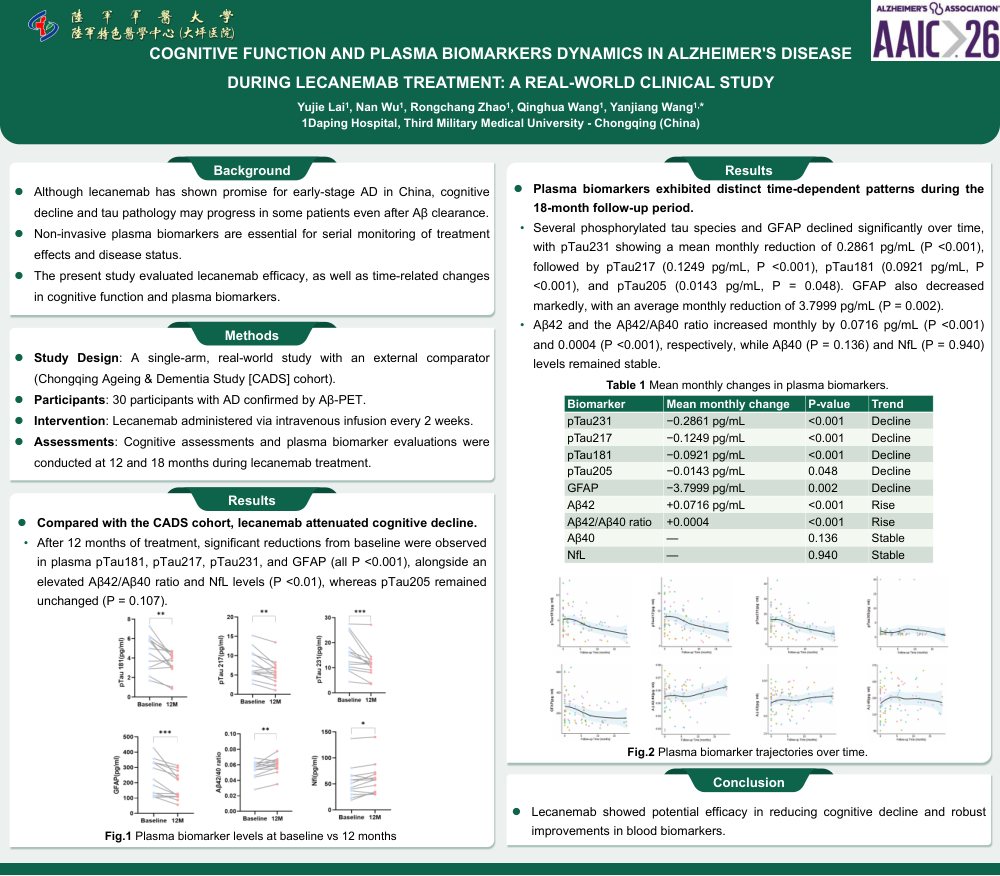
Cognitive Function and Plasma Biomarkers dynamics in Alzheimer's Disease During Lecanemab Treatment: A Real-World Clinical Study
Lai Yu-Jie1, Wu Nan1, Zhao Rong-Chang1, Wang Qing-Hua1, Wang Yan-Jiang1,*
1Daping Hospital, Third Military Medical University - Chongqing (China)
Abstract
Background
Although lecanemab has shown promise for early-stage AD in China, cognitive decline and tau pathology may progress in some patients even after Aβ clearance. Hence, plasma biomarkers are crucial for noninvasive dynamic monitoring of treatment response and disease progression. This study evaluated lecanemab's efficacy and the time-dependent changes in cognition and plasma biomarkers.
Methods
In this single-arm, real-world study, we enrolled 30 participants with AD confirmed by Aβ-PET. Lecanemab was administered via intravenous infusion every 2 weeks. Chongqing Ageing & Dementia Study (CADS) cohort was selected as a comparator. Follow-up cognitive assessments and plasma biomarker evaluations were conducted at 12 and 18 months during lecanemab treatment. Plasma biomarkers were performed on the fully automated Chemilu-minescence immunoassay platform Elf S240 (Vazyme, Nanjing, China).
Results
Lecanemab slowed cognitive decline relative to the CADS cohort. At 12 months, significant reductions from baseline were observed for pTau181, pTau217, pTau231, and GFAP (all P<0.001), while the Aβ42/Aβ40 ratio and NfL levels were significantly increased (P<0.01); pTau205 showed no significant change (P = 0.107).
Plasma biomarkers exhibited distinct time-dependent trajectories during the follow-up 18 months period. (1) Several phosphorylated tau species and GFAP declined significantly over time. pTau231 decreased by an average of 0.2861 pg/mL per month (P < 0.001), followed by pTau217 (mean monthly decrease: 0.1249 pg/mL, P < 0.001) and pTau181 (mean monthly decrease: 0.0921 pg/mL, P < 0.001). pTau205 also showed a slower but statistically significant decline (mean monthly decrease: 0.0143 pg/mL, P = 0.048). GFAP levels also decreased markedly over time, with an average monthly reduction of 3.7999 pg/mL (P = 0.002). (2) In contrast, amyloid-beta markers demonstrated upward trends. Aβ42 increased significantly by an average of 0.0716 pg/mL per month (P < 0.001). Similarly, the Aβ42/40 ratio showed a significant increasing trend, with a mean monthly increase of 0.0004 (P < 0.001). (3) The trajectories of Aβ40 and NfL remained relatively stable over time (P = 0.136 and P = 0.940, respectively).
Conclusion
Lecanemab showed a potential efficacy on cognitive decline and robust blood biomarker improvements.
Comments
Email is required but is not shown publicly.
Loading comments...