4,068 posters, 219 videos, 101 topics, 69 sessions, 14,365 authors, 6,128 institutions
ePostersLive by SciGen Technologies S.A. All rights reserved.
Alzheimer's Association International Conference 2026
July 12-15, 2026 | London, United Kingdom, and Online

13546
Causal Discovery Of Alzheimer’s Disease Biomarkers Using The Fast Causal Inference Algorithm
Poster Presenter
Authors
Affiliations
Part of Topic
Biomarkers -> Biomarkers (non-neuroimaging) -> Fluid biomarkers
Traditional Alzheimer's disease (AD) biomarker research predominantly relies on associational analyses, limiting the ability to distinguish correlation from causation and infer underlying disease mechanisms. Causal discovery methods offer a framework for inferring directional relationships from observational data while accounting for latent confounding. Here, we apply constraint-based causal discovery to plasma and neuroimaging biomarkers to investigate the causal positioning of established AD markers within disease progression.
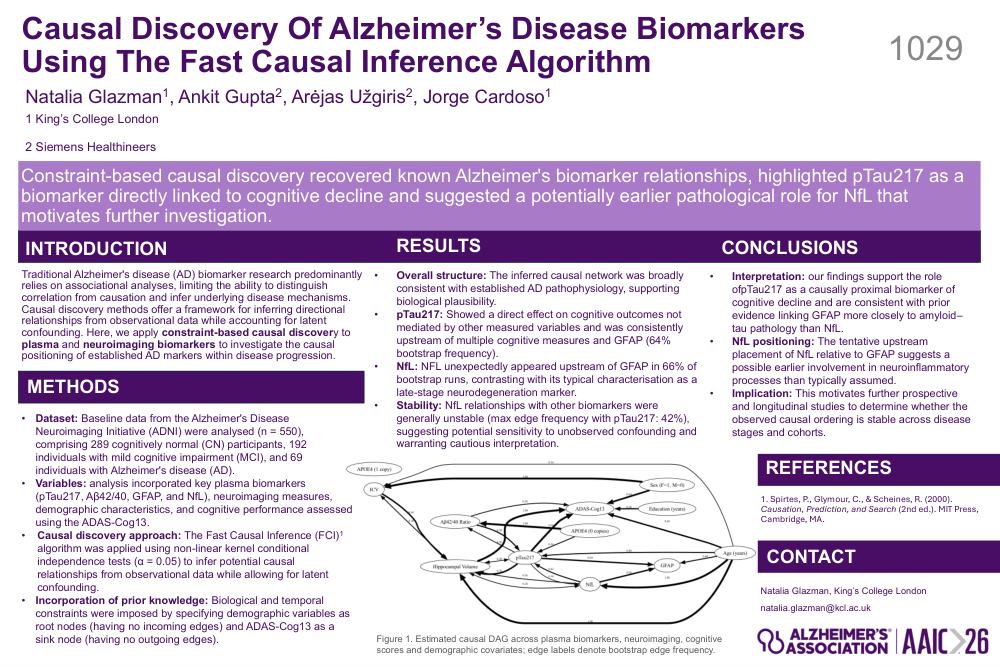
Overall structure: The inferred causal network was broadly consistent with established AD pathophysiology, supporting biological plausibility.
pTau217: Showed a direct effect on cognitive outcomes not mediated by other measured variables and was consistently upstream of multiple cognitive measures and GFAP (64% bootstrap frequency).
NfL: NFL unexpectedly appeared upstream of GFAP in 66% of bootstrap runs, contrasting with its typical characterisation as a late-stage neurodegeneration marker.
Stability: NfL relationships with other biomarkers were generally unstable (max edge frequency with pTau217: 42%), suggesting potential sensitivity to unobserved confounding and warranting cautious interpretation.
Interpretation: our findings support the role ofpTau217 as a causally proximal biomarker of cognitive decline and are consistent with prior evidence linking GFAP more closely to amyloid–tau pathology than NfL.
NfL positioning: The tentative upstream placement of NfL relative to GFAP suggests a possible earlier involvement in neuroinflammatory processes than typically assumed.
Implication: This motivates further prospective and longitudinal studies to determine whether the observed causal ordering is stable across disease stages and cohorts.
Comments
Email is required but is not shown publicly.
Loading comments...