Loading...

4,068 posters, 219 videos, 101 topics, 69 sessions, 14,365 authors, 6,128 institutions

ePostersLive by SciGen Technologies S.A. All rights reserved.

Alzheimer's Association International Conference 2026

July 12-15, 2026 | London, United Kingdom, and Online

Alzheimer's Association International Conference 2026 banner

13036

Brain Fluid Pulsation Energy May Increase With Amyloid Burden Early In The Alzheimer's Pathophysiological Spectrum
Part of Topic

Biomarkers -> Neuroimaging -> Early detection measures

Brain Fluid Pulsation Energy May Increase With Amyloid Burden Early In The Alzheimer’s Pathophysiological Spectrum

Introduction

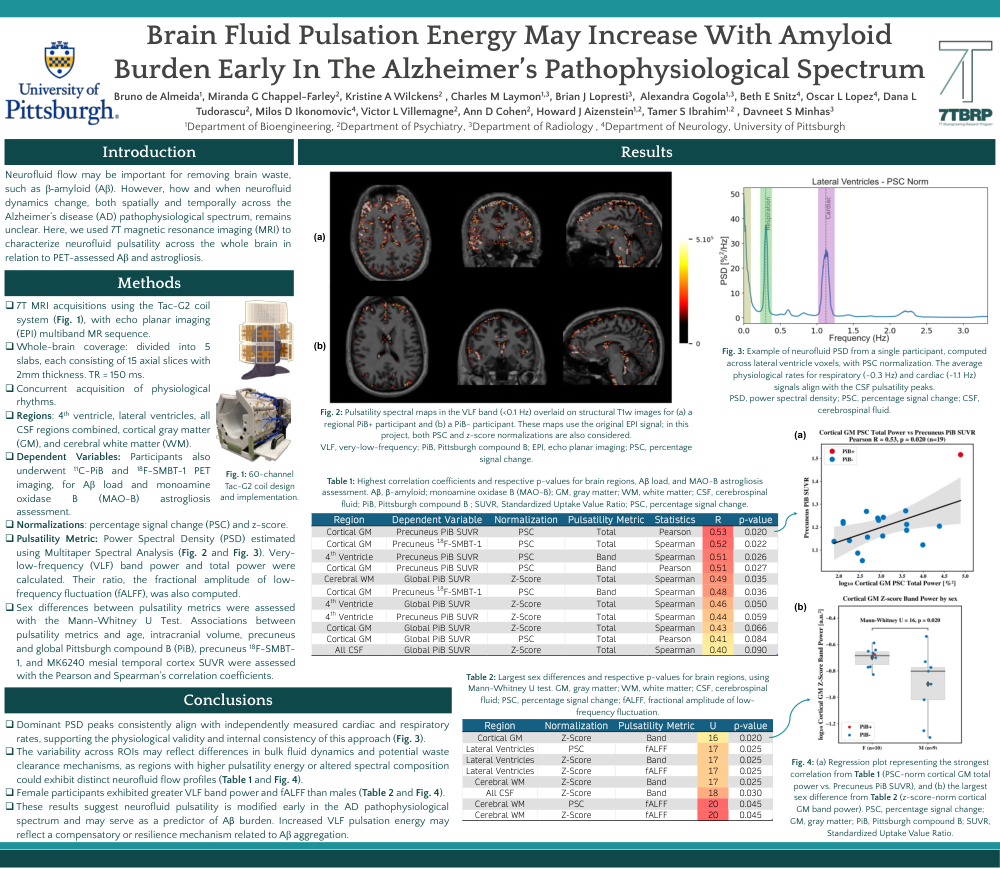
Neurofluid flow may be important for removing brain waste, such as β-amyloid (Aβ). However, how and when neurofluid dynamics change, both spatially and temporally across the Alzheimer’s disease (AD) pathophysiological spectrum, remains unclear. Here, we used 7T magnetic resonance imaging (MRI) to characterize neurofluid pulsatility across the whole brain in relation to PET-assessed Aβ and astrogliosis.

Methods

- 7T MRI acquisitions using the Tac-G2 coil system (Fig. 1), with echo planar imaging (EPI) multiband MR sequence.
- Whole-brain coverage: divided into 5 slabs, each consisting of 15 axial slices with 2mm thickness. TR = 150 ms.
- Concurrent acquisition of physiological rhythms.
- Regions: 4th ventricle, lateral ventricles, all CSF regions combined, cortical gray matter (GM), and cerebral white matter (WM).
- Dependent Variables: Participants also underwent 11C-PiB and 18F-SMBT-1 PET imaging, for Aβ load and monoamine oxidase B (MAO-B) astrogliosis assessment.
- Normalizations: percentage signal change (PSC) and z-score.
- Pulsatility Metric: Power Spectral Density (PSD) estimated using Multitaper Spectral Analysis (Fig. 2 and Fig. 3). Very-low-frequency (VLF) band power and total power were calculated. Their ratio, the fractional amplitude of low-frequency fluctuation (fALFF), was also computed.
- Sex differences between pulsatility metrics were assessed with the Mann-Whitney U Test. Associations between pulsatility metrics and age, intracranial volume, precuneus and global Pittsburgh compound B (PiB), precuneus 18F-SMBT-1, and MK6240 mesial temporal cortex SUVR were assessed with the Pearson and Spearman’s correlation coefficients.
 
Conclusions
 
- Dominant PSD peaks consistently align with independently measured cardiac and respiratory rates, supporting the physiological validity and internal consistency of this approach (Fig. 3).
- The variability across ROIs may reflect differences in bulk fluid dynamics and potential waste clearance mechanisms, as regions with higher pulsatility energy or altered spectral composition could exhibit distinct neurofluid flow profiles (Table 1 and Fig. 4).
- Female participants exhibited greater VLF band power and fALFF than males (Table 2 and Fig. 4).
- These results suggest neurofluid pulsatility is modified early in the AD pathophysiological spectrum and may serve as a predictor of Aβ burden. Increased VLF pulsation energy may reflect a compensatory or resilience mechanism related to Aβ aggregation.

Comments

Email is required but is not shown publicly.

Loading comments...

aaic2026 banner
Copyright © 2015-2026, ePostersLive® SciGen is a registered trademark of SciGen Technologies S.A. Patent pending.

This website and third-party tools we use rely on cookies for the best user experience. By selecting "I agree", you agree to cookie usage as described in our Privacy Policy.