4,068 posters, 219 videos, 101 topics, 69 sessions, 14,365 authors, 6,128 institutions
ePostersLive by SciGen Technologies S.A. All rights reserved.
Alzheimer's Association International Conference 2026
July 12-15, 2026 | London, United Kingdom, and Online

12967
Both Cerebrovascular And Cardiac Reactivity Are Impaired In A Preclinical Model Of Vascular Cognitive Impairment And Dementia
Poster Presenter
Authors
Affiliations
Part of Topic
Biomarkers -> Neuroimaging -> Multi-modal comparisons
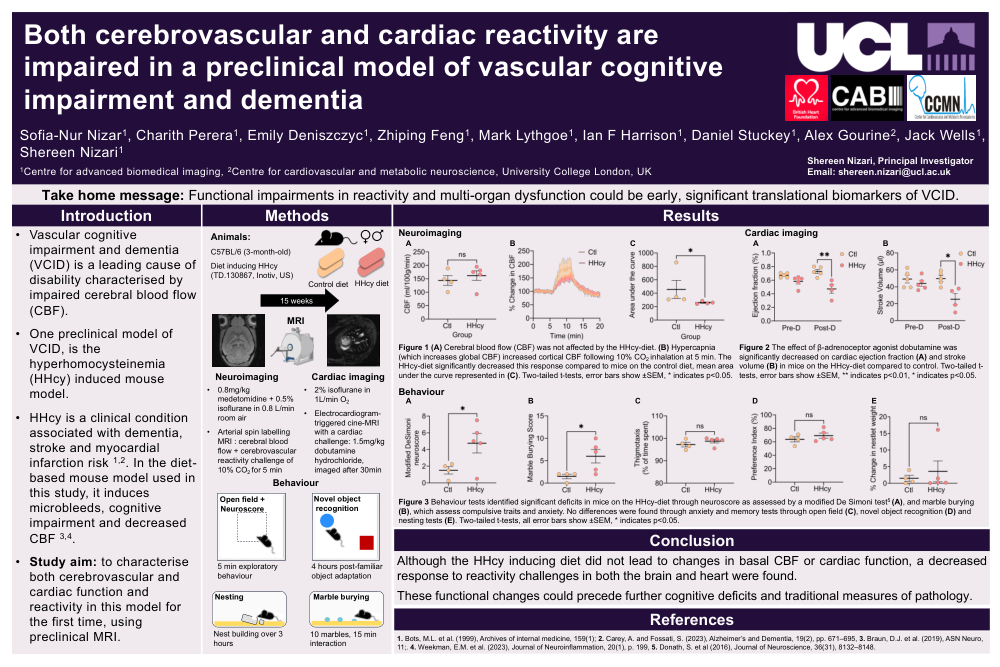
Vascular-cognitive-impairment and dementia (VCID) is a leading cause of disability in an increasingly ageing population. Impaired cerebrovascular function, a contributor to neurological dysfunction and key characteristic of this dementia, has few effective preclinical models. In this study, we aim to characterise changes in both cerebrovascular and cardiac function using MRI in the novel hyperhomocysteinemia (HHcy) induced mouse model of VCID.
C57BL6 mice of both sexes were subject to either a HHcy inducing diet, which is known to develop cognitive impairment and cerebral microbleeds, or a control diet (n=5 per group). Mice underwent nesting, open field, novel object recognition and marble burying behavioural testing. An ELISA confirmed a significant increase in homocysteine plasma levels. Cerebral-blood-flow (CBF) and cerebrovascular reactivity to hypercapnia (10% CO2) were quantified using arterial-spin-labelling MRI (9.4T Bruker) under medetomidine anaesthesia. As HHcy is a risk factor for cardiac dysfunction, cardiac function was imaged using electrocardiogram-triggered cine-MRI (9.4T Agilent) and was challenged using the adrenergic agonist dobutamine (1.5mg/kg intraperitoneally administrated).
By 15 weeks, significant differences in behaviour were found between control and HHcy diet treated mice following the marble burying (p<0.05) and neuroscore (p<0.05) tests, indicative of cognitive deficits. Although no differences in basal CBF were detected, cerebrovascular reactivity to hypercapnia was significantly reduced in mice on the HHcy diet compared to those on the control diet (p<0.05, figure 1). Basal cardiac function was not found to be significantly affected by the HHcy inducing diet, but the response of stroke volume and ejection fraction to dobutamine were significantly decreased in HHcy diet treated mice (p<0.05, Figure 2).
Although the HHcy inducing diet did not lead to changes in basal CBF or cardiac function, a decreased response to reactivity challenges in brain and heart was found. This is suggestive of simultaneously disrupted functional changes, which could precede further cognitive deficits and traditional measures of pathology. Studies are underway to understand the mechanisms driving these impairments, the significance of multi-organ dysfunction and their potential as early translational biomarkers of VCID.
Comments
Email is required but is not shown publicly.
Loading comments...