4,068 posters, 219 videos, 101 topics, 69 sessions, 14,365 authors, 6,128 institutions
ePostersLive by SciGen Technologies S.A. All rights reserved.
Alzheimer's Association International Conference 2026
July 12-15, 2026 | London, United Kingdom, and Online

13667
Blood Trpc6 Mrna As A Diagnostic And Candidate Longitudinal Monitoring Biomarker For Alzheimer’S Disease
Poster Presenter
Authors
Mei Pu, Yujing Chen, Yutong Wen, Liliang Zhu, Chunjiu Zhong, Qianhua Zhao, Yizheng Wang
Affiliations
National Clinical Research Center for Aging and Medicine, Huashan Hospital, State Key Laboratory of Medical Neurobiology, Fudan University, Shanghai 200040, China., Department of Neurology, Zhongshan Hospital, Fudan University, Shanghai 200032, China.
Part of Topic
Biomarkers -> Biomarkers (non-neuroimaging) -> Novel biomarkers
Blood TRPC6 mRNA as a diagnostic and candidate longitudinal monitoring biomarker for Alzheimer’s disease: a multicenter study in China
Background
The diagnosis of Alzheimer’s disease (AD) still relies largely on amyloid and tau biomarkers assessed by positron emission tomography (PET) imaging or cerebrospinal fluid (CSF), which are costly and invasive. With the advent of disease-modifying therapies (DMTs), accessible blood biomarkers are increasingly needed for screening, diagnosis, and longitudinal monitoring. We investigated whether blood transient receptor potential canonical 6 (TRPC6) mRNA, a molecule involved in synaptogenesis and neuronal survival, could serve as a minimally invasive diagnostic and longitudinal monitoring biomarker for AD.
Methods
In this nationwide multicenter study, 1,254 participants were enrolled, including 366 patients with AD, 735 cognitively unimpaired (CU) individuals, and 153 individuals with non-AD disorders. Diagnostic performance was evaluated using receiver operating characteristic (ROC) analyses. In an exploratory longitudinal subgroup, baseline and follow-up data were available for 50 lecanemab-treated patients and 62 AD patients without DMT. Linear mixed-effects models were used to assess the potential value of TRPC6 mRNA as a treatment-monitoring biomarker.
Results
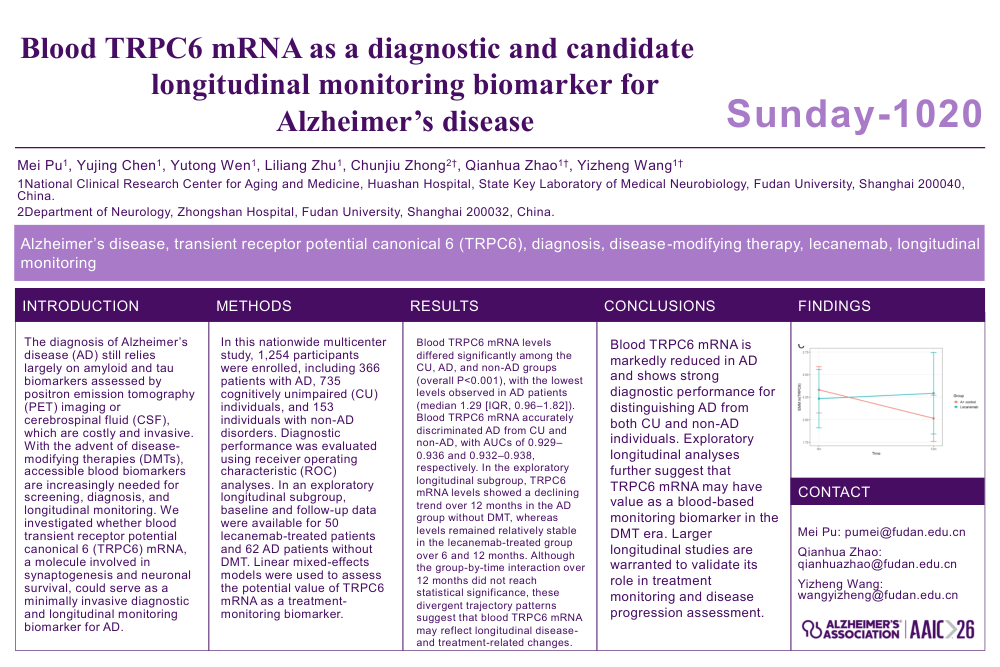
Blood TRPC6 mRNA levels differed significantly among the CU, AD, and non-AD groups (overall P<0.001), with the lowest levels observed in AD patients (median 1.29 [IQR, 0.96–1.82]) compared with CU individuals (median 4.51 [IQR, 2.95–6.99]) and non-AD participants (median 3.76 [IQR, 2.91–4.87]). Blood TRPC6 mRNA accurately discriminated AD from CU and non-AD, with AUCs of 0.929–0.936 and 0.932–0.938, respectively. In the exploratory longitudinal subgroup, TRPC6 mRNA levels showed a declining trend over 12 months in the AD group without DMT, whereas levels remained relatively stable in the lecanemab-treated group over 6 and 12 months. Although the group-by-time interaction over 12 months did not reach statistical significance, these divergent trajectory patterns suggest that blood TRPC6 mRNA may reflect longitudinal disease- and treatment-related changes.
Conclusions
Blood TRPC6 mRNA is markedly reduced in AD and shows strong diagnostic performance for distinguishing AD from both CU and non-AD individuals. Exploratory longitudinal analyses further suggest that TRPC6 mRNA may have value as a blood-based monitoring biomarker in the DMT era. Larger longitudinal studies are warranted to validate its role in treatment monitoring and disease progression assessment.
Keywords
Alzheimer’s disease, transient receptor potential canonical 6 (TRPC6), diagnosis, disease-modifying therapy, lecanemab, longitudinal monitoring
Comments
Email is required but is not shown publicly.
Loading comments...