4,068 posters, 219 videos, 101 topics, 69 sessions, 14,365 authors, 6,128 institutions
ePostersLive by SciGen Technologies S.A. All rights reserved.
Alzheimer's Association International Conference 2026
July 12-15, 2026 | London, United Kingdom, and Online

10911
In Vitro Models Of Human Olfactory Neural Precursor Cells To Study Early Mechanisms Of Progressive Supranuclear Palsy
Poster Presenter
Part of Topic
Background: Progressive Supranuclear Palsy (PSP) is a rare neurodegenerative tauopathy
characterized by the predominant accumulation of the 4-repeat (4R) tau isoform. It is mostly
sporadic and typically begins during the sixth decade of life. Currently, there is no adequate
diagnostic method for PSP and the underlying pathophysiological mechanisms remain poorly
understood. Human olfactory neuroepithelium - derived neural precursor cells (hONE-NPCs)
represent a valuable source of peripheral brain-related cells obtained via a non-invasive
procedure. In addition, exposure to the environmental neurotoxin Annonacin has been
associated with the induction of 4R tau overexpression. Thus, the establishment of in vitro
models using hONE-NPCs from PSP patients and healthy donors, combined with pharmacological
induction of tau pathology, may contribute to the identification of molecular pathways involved
in PSP. The main objective of this study was to establish and characterize these in vitro models
for the study of PSP.
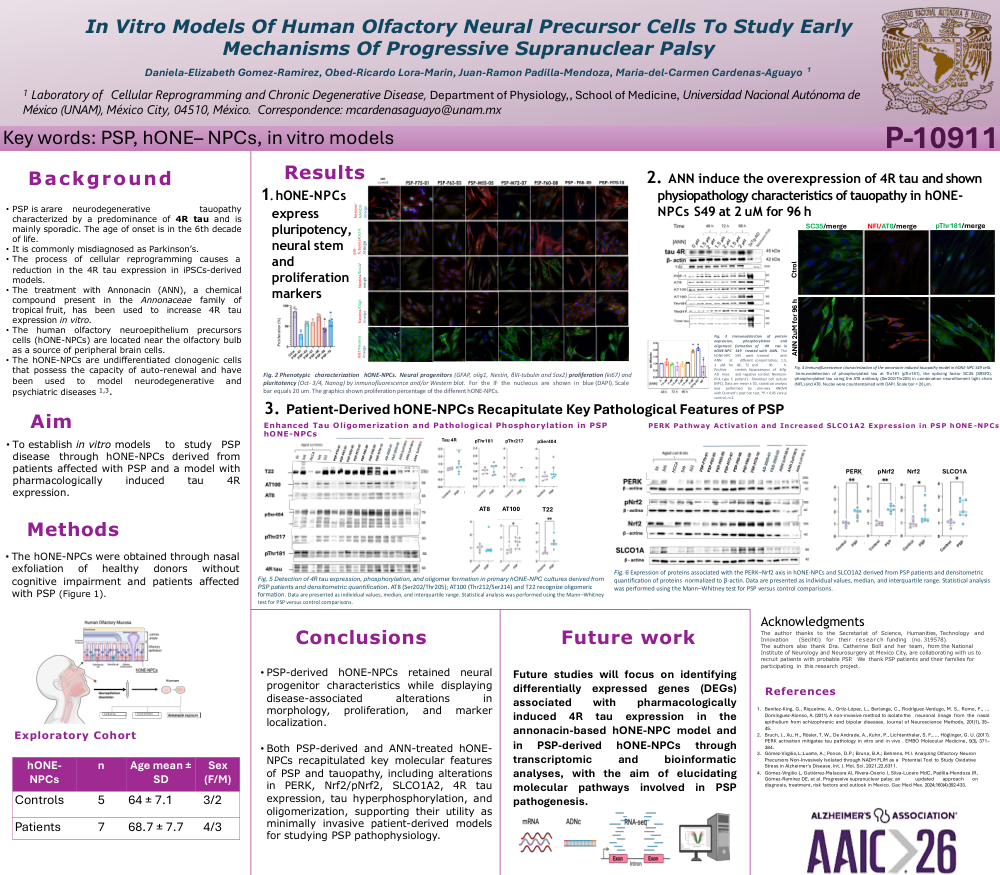
Methods: hONE-NPC cultures were obtained by nasal exfoliation from three PSP patients and
healthy donors without cognitive impairment. Cells were characterized by immunofluorescence
and Western blot. Cell viability assays were performed at different Annonacin concentrations and
exposure times. 4R tau overexpression and hyperphosphorylation were analyzed by Western
blot, along with PSP-associated proteins including PERK, Nrf2, Syntaxin 6, and SLCO1A.
Results: hONE-NPCs derived from PSP patients exhibited altered morphology and differential
expression of stem cell markers (SOX2, Oct3/4, NANOG) as well as neural lineage and
proliferation markers (βIII-tubulin, Nestin, GFAP, Olig1, and Ki67) compared with healthy donor-
derived hONE-NPCs. Pharmacological treatment with Annonacin induced a significant increase in
the 4R tau isoform at a concentration of 2 μM after 96 hours of exposure. Notably, PERK and
Nrf2 expression patterns were different between PSP patient-derived hONE-NPCs and healthy
donors hONE-NPCs with Annonacin-induced 4R tau overexpression.
Conclusion: The non-invasive isolation and maintenance of hONE-NPCs were successfully
standardized in our laboratory. Both hONE-NPCs derived from PSP patients and Annonacin-
induced 4R tau overexpression models demonstrate molecular features relevant to PSP,
Comments
Email is required but is not shown publicly.
Loading comments...