4,068 posters, 219 videos, 101 topics, 69 sessions, 14,365 authors, 6,128 institutions
ePostersLive by SciGen Technologies S.A. All rights reserved.
Alzheimer's Association International Conference 2026
July 12-15, 2026 | London, United Kingdom, and Online

13113
Baseline Plasma Ptau217 And Concordance With Csf aί42/40 In The Phase 3 Polaris-ad Study
Poster Presenter
Authors
Part of Topic
Biomarkers -> Biomarkers (non-neuroimaging) -> Fluid biomarkers
Title: Baseline Plasma pTau-217 and Concordance With CSF Aβ42/40 in the Phase 3 POLARIS-AD Study
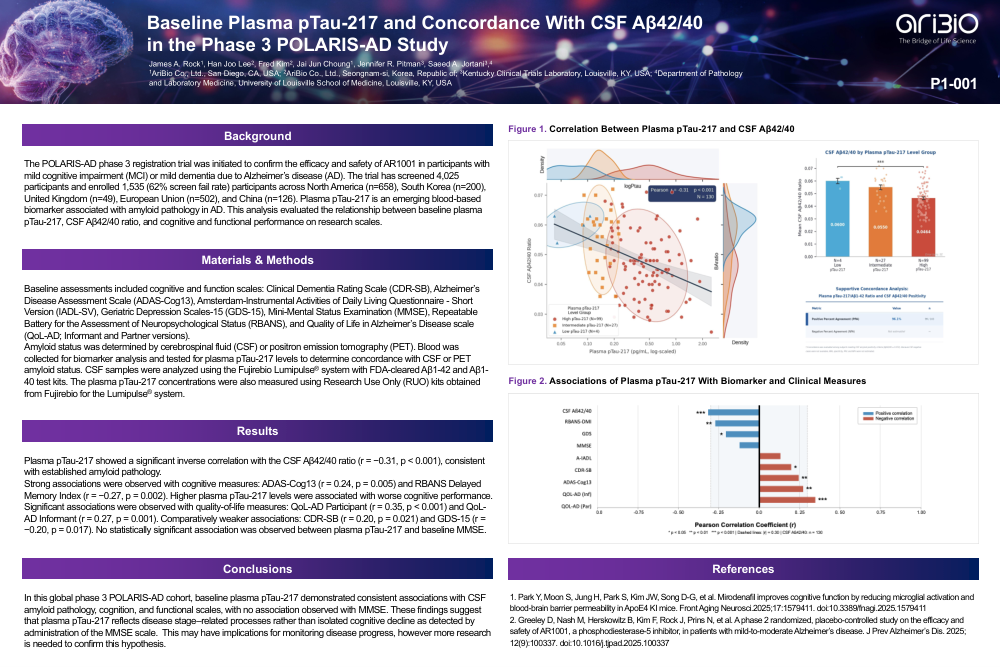
Background: The POLARIS-AD phase 3 registration trial was initiated to confirm the efficacy and safety of AR1001 in participants withmild cognitive impairment (MCI) or mild dementia due to Alzheimer’s disease (AD). The trial has screened 4,025participants and enrolled 1,535 (62% screen fail rate) participants across North America (n=658), South Korea (n=200),United Kingdom (n=49), European Union (n=502), and China (n=126). Plasma pTau-217 is an emerging blood-basedbiomarker associated with amyloid pathology in AD. This analysis evaluated the relationship between baseline plasmapTau-217, CSF Aβ42/40 ratio, and cognitive and functional performance on research scales.
Material and Methods: Baseline assessments included cognitive and function scales: Clinical Dementia Rating Scale (CDR-SB), Alzheimer’s Disease Assessment Scale (ADAS-Cog13), Amsterdam-Instrumental Activities of Daily Living Questionnaire - Short Version (IADL-SV), Geriatric Depression Scales-15 (GDS-15), Mini-Mental Status Examination (MMSE), Repeatable Battery for the Assessment of Neuropsychological Status (RBANS), and Quality of Life in Alzheimer’s Disease scale (QoL-AD; Informant and Partner versions).
Amyloid status was determined by cerebrospinal fluid (CSF) or positron emission tomography (PET). Blood was collected for biomarker analysis and tested for plasma pTau-217 levels to determine concordance with CSF or PET amyloid status.CSF samples were analyzed using the Fujirebio Lumipulse® system with FDA-cleared Aβ1-42 and Aβ1-40 test kits. The plasma pTau-217 concentrations were also measured using Research Use Only (RUO) kits obtained from Fujirebio for the Lumipulse® system.
Results: Plasma pTau-217 showed a significant inverse correlation with the CSF Aβ42/40 ratio (r = −0.31, p < 0.001), consistentwith established amyloid pathology.
Strong associations were observed with cognitive measures: ADAS-Cog13 (r = 0.24, p = 0.005) and RBANS DelayedMemory Index (r = −0.27, p = 0.002). Higher plasma pTau-217 levels were associated with worse cognitive performance.
Significant associations were observed with quality-of-life measures: QoL-AD Participant (r = 0.35, p < 0.001) and QoL-AD Informant (r = 0.27, p = 0.001). Comparatively weaker associations: CDR-SB (r = 0.20, p = 0.021) and GDS-15 (r =−0.20, p = 0.017). No statistically significant association was observed between plasma pTau-217 and baseline MMSE.
Conclusion: In this global phase 3 POLARIS-AD cohort, baseline plasma pTau-217 demonstrated consistent associations with CSF amyloid pathology, cognition, and functional scales, with no association observed with MMSE. These findings suggest that plasma pTau-217 reflects disease stage–related processes rather than isolated cognitive decline as detected by administration of the MMSE scale. This may have implications for monitoring disease progress, however more research is needed to confirm this hypothesis.
Comments
Email is required but is not shown publicly.
Loading comments...