4,068 posters, 219 videos, 101 topics, 69 sessions, 14,365 authors, 6,128 institutions
ePostersLive by SciGen Technologies S.A. All rights reserved.
Alzheimer's Association International Conference 2026
July 12-15, 2026 | London, United Kingdom, and Online

13175
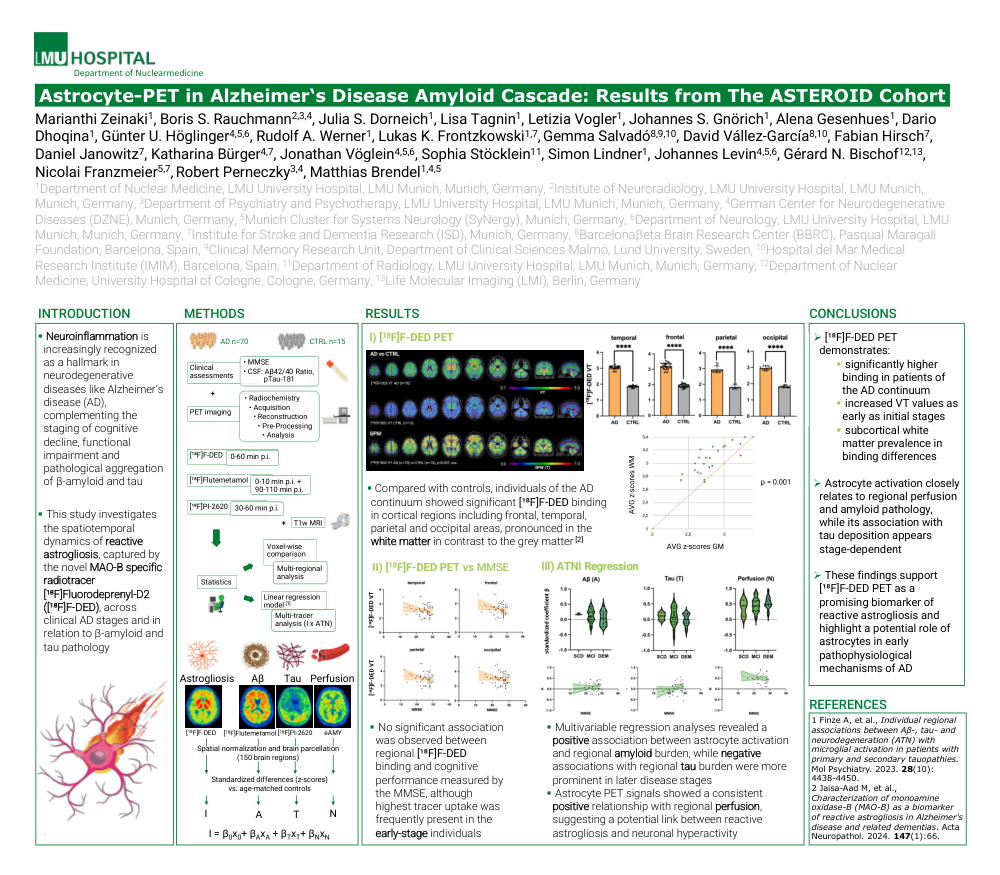
Astrocyte-PET In Alzheimer‘s Disease Amyloid Cascade: Results From The Asteroid Cohort
Poster Presenter
Authors
Marianthi Zeinaki, Boris S. Rauchmann, Julia S. Dorneich, Lisa Tagnin, Letizia Vogler, Johannes S. Gnörich, Alena Gesenhues, Dario Dhoqina, Günter U. Höglinger, Rudolf A. Werner, Lukas K. Frontzkowski, Gemma Salvadó, David Vállez-García, Fabian Hirsch, Daniel Janowitz, Katharina Bürger, Jonathan Vöglein, Sophia Stöcklein, Simon Lindner, Johannes Levin, Gérard N. Bischof, Nicolai Franzmeier, Robert Perneczky, Matthias Brendel
Affiliations
German Center for Neurodegenerative Diseases (DZNE), Munich, Germany, Department of Nuclear Medicine, LMU University Hospital, LMU Munich, Munich, Germany, Institute of Neuroradiology, LMU University Hospital, LMU Munich, Munich, Germany, Department of Neurology, LMU University Hospital, LMU Munich, Munich, Germany, Institute for Stroke and Dementia Research (ISD), Munich, Germany, Barcelonaβeta Brain Research Center (BBRC), Pasqual Maragall Foundation, Barcelona, Spain, Department of Radiology, LMU University Hospital, LMU Munich, Munich, Germany, Life Molecular Imaging (LMI), Berlin, Germany, Munich Cluster for Systems Neurology (SyNergy), Munich, Germany, Department of Psychiatry and Psychotherapy, LMU University Hospital, LMU Munich, Munich, Germany
Part of Topic
Biomarkers -> Neuroimaging -> Novel imaging methods
Introduction:
Neuroinflammation is increasingly recognized as a hallmark in neurodegenerative diseases like Alzheimer’s disease (AD), complementing the staging of cognitive decline, functional impairment and pathological aggregation of β-amyloid and tau. This study investigates the spatiotemporal dynamics of reactive astrogliosis, captured by the novel MAO-B specific radiotracer [¹⁸F]Fluorodeprenyl-D2 ([¹⁸F]F-DED), across clinical AD stages and in relation to β-amyloid and tau pathology.
Methods:
AD n=70 CTRL n=15
Clinical assessments (MMSE, CSF: Aβ42/40 Ratio, pTau-181) + PET imaging (Radiochemistry, Acquisition, Reconstruction, Pre-Processing, Analysis):
[¹⁸F]F-DED 0-60 min p.i., [¹⁸F]Flutemetamol 0-10 min p.i. + 90-110 min p.i., [¹⁸F]PI-2620 30-60 min p.i. + T1w MRI
-> Statistics: Voxel-wise comparison (Multi-regional analysis), Linear regression model [1] (Multi-tracer analysis (I x ATN))
Astrogliosis ([18F]F-DED), Aβ ([18F]Flutemetamol), Tau ([18F]PI-2620), eAMY -> Spatial normalization and brain parcellation (150 brain regions) -> Standardized differences (z-scores) vs. age-matched controls -> I A T N
I = β0x0+ βAxA + βTxT+ βNxN
Results:
I) [18F]F-DED PET
Compared with controls, individuals of the AD continuum showed significant [¹⁸F]F-DED binding in cortical regions including frontal, temporal, parietal and occipital areas, pronounced in the white matter in contrast to the grey matter [2]
II) [18F]F-DED PET vs MMSE
No significant association was observed between regional [¹⁸F]F-DED binding and cognitive performance measured by the MMSE, although highest tracer uptake was frequently present in the early-stage individuals
III) ATNI Regression
Multivariable regression analyses revealed a positive association between astrocyte activation and regional amyloid burden, while negative associations with regional tau burden were more prominent in later disease stages
Astrocyte PET signals showed a consistent positive relationship with regional perfusion, suggesting a potential link between reactive astrogliosis and neuronal hyperactivity
Conclusions:
[¹⁸F]F-DED PET demonstrates:
▪ significantly higher binding in patients of the AD continuum
▪ increased VT values as early as initial stages
▪ subcortical white matter prevalence in binding differences
Astrocyte activation closely relates to regional perfusion and amyloid pathology, while its association with tau deposition appears stage-dependent
These findings support [¹⁸F]F-DED PET as a promising biomarker of reactive astrogliosis and highlight a potential role of astrocytes in early pathophysiological mechanisms of AD
References:
1 Finze A, et al., Individual regional associations between Aβ-, tau- and neurodegeneration (ATN) with microglial activation in patients with primary and secondary tauopathies. Mol Psychiatry. 2023. 28(10): 4438-4450.
2 Jaisa-Aad M, et al., Characterization of monoamine oxidase-B (MAO-B) as a biomarker of reactive astrogliosis in Alzheimer's disease and related dementias. Acta Neuropathol. 2024. 147(1):66.
Comments
Email is required but is not shown publicly.
Loading comments...