4,068 posters, 219 videos, 101 topics, 69 sessions, 14,365 authors, 6,128 institutions
ePostersLive by SciGen Technologies S.A. All rights reserved.
Alzheimer's Association International Conference 2026
July 12-15, 2026 | London, United Kingdom, and Online

13615
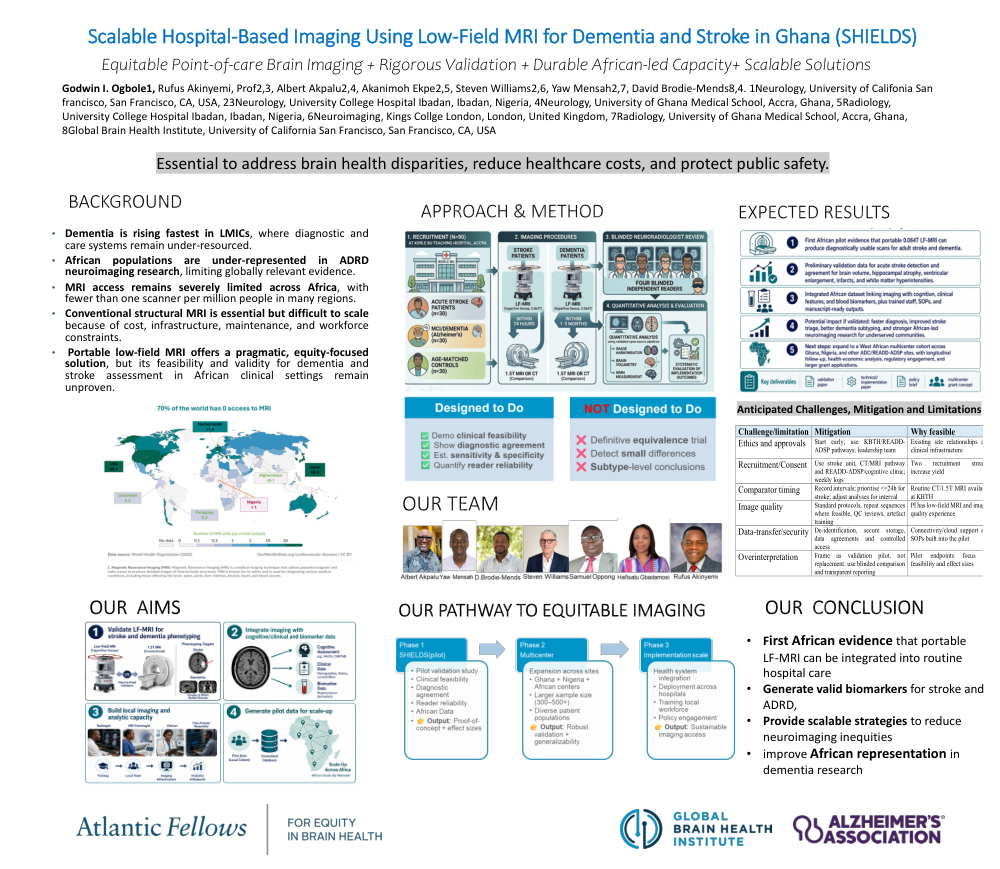
Affordable, Hospital-centred, Scalable Low-field MRI Solutions For Stroke And Dementia In Ghana: An Imaging Pilot Study
Poster Presenter
Authors
Affiliations
Part of Topic
Biomarkers -> Neuroimaging -> Novel imaging methods
Dementia and cerebrovascular disease are increasing rapidly in sub-Saharan Africa, yet access to structural brain imaging—essential for accurate diagnosis, subtype classification, and prognosis—remains severely limited. In much of the region, there are fewer than one MRI scanner per million people, perpetuating diagnostic disparities and excluding populations of African ancestry from basic neuroimaging research.
The SHIELDS–Ghana project (Scalable Hospital-based Imaging Using Low-Field MRI for Dementia and Stroke) tests a pragmatic, scalable solution: clinical validation and deployment of a portable low-field (LF) MRI (Hyperfine Swoop 0.064T) already located at Korle Bu Teaching Hospital. SHIELDS–Ghana is embedded within an established collaborative infrastructure—the NIH-linked READD-ADSP initiative (Recruitment and Retention for Alzheimer’s Disease Diversity in the Alzheimer’s Disease Sequencing Project) and the African Dementia Consortium (AfDC)—ensuring swift access to harmonized cognitive, biomarker, and genomic data, as well as experienced local research teams.
This pilot aims to achieve four integrated goals: (1) clinical validation of LF-MRI (0.064T) against 1.5T MRI for detecting hemorrhage, infarcts, white-matter disease, and neurodegenerative atrophy; (2) integration of imaging with READD-ADSP cognitive, biomarker, and genomic data to enhance dementia and vascular subtype characterization in populations of African ancestry; (3) development of sustainable local imaging and analytical capabilities through practical training, co-developed protocols, and data pipelines at Korle Bu and partner sites; and (4) production of pilot imaging data to inform future large-scale studies. By leveraging existing equipment, institutional partnerships, and trained investigators, the project prioritizes feasibility, immediate clinical relevance, and rapid scalability.
By validating an accessible, hospital-embedded imaging platform and integrating it within a continent-wide research network, SHIELDS–Ghana will facilitate equitable diagnostic capacity, strengthen regional research ecosystems, and produce ancestry-diverse neuroimaging data essential for global progress in dementia genetics, prognosis, and treatment development. This initiative positions West Africa to contribute meaningfully and ethically to the global effort to understand and combat dementia in diverse populations.
Comments
Email is required but is not shown publicly.
Loading comments...