4,068 posters, 219 videos, 101 topics, 69 sessions, 14,365 authors, 6,128 institutions
ePostersLive by SciGen Technologies S.A. All rights reserved.
Alzheimer's Association International Conference 2026
July 12-15, 2026 | London, United Kingdom, and Online

13566
A Local De-identification Pipeline For Clinical Speech Recordings That Preserves Alzheimer's-relevant Biomarker Features
Poster Presenter
Part of Topic
Biomarkers -> Biomarkers (non-neuroimaging) -> Digital Health Technologies / Digital Biomarkers
Toward Shareable Clinical Speech: A Fully Local De-Identification Pathway for Clinical Speech Recordings
Peter S. Pressman, MD Oregon Health & Science University, Layton Aging and Alzheimer's Disease Research Center
Introduction
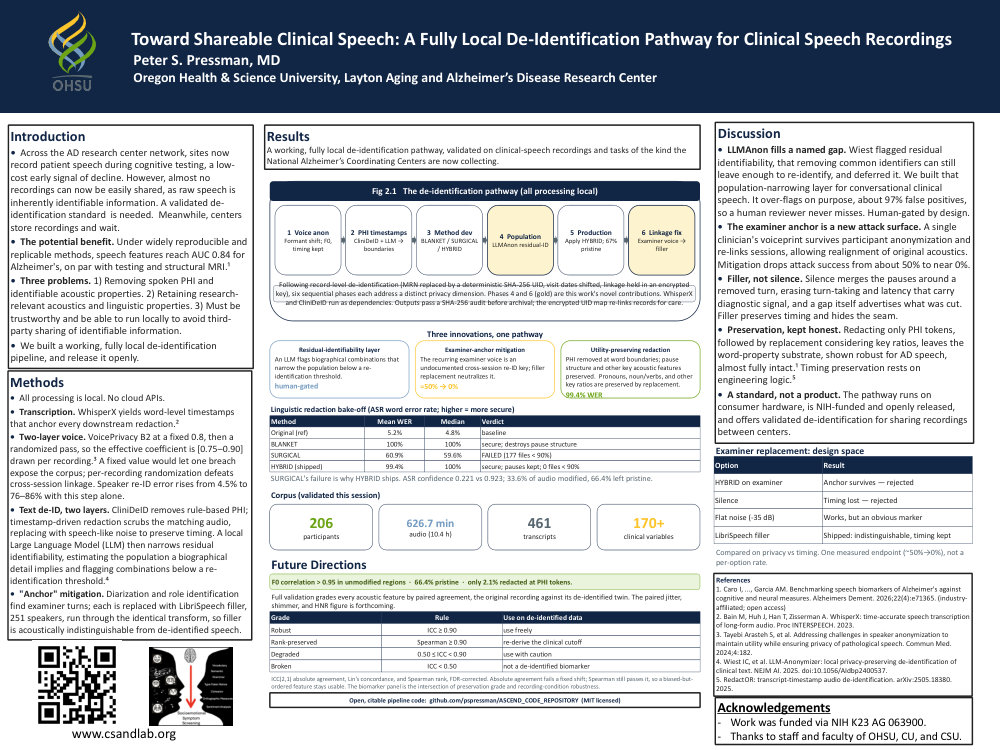
- Across the AD research center network, sites now record patient speech during cognitive testing, a low-cost early signal of decline. However, almost no recordings can now be easily shared, as raw speech is inherently identifiable information. A validated de-identification standard is needed. Meanwhile, centers store recordings and wait.
- The potential benefit. Under widely reproducible and replicable methods, speech features reach AUC 0.84 for Alzheimer's, on par with testing and structural MRI.(1)
- Three problems. 1) Removing spoken PHI and identifiable acoustic properties. 2) Retaining research-relevant acoustics and linguistic properties. 3) Must be trustworthy and run locally to avoid third-party sharing of identifiable information.
- We built a working, fully local de-identification pipeline, and release it openly.
Methods
- All processing is local. No cloud APIs.
- Transcription. WhisperX yields word-level timestamps that anchor every downstream redaction.(2)
- Two-layer voice. VoicePrivacy B2 at a fixed 0.8, then a randomized pass, so the effective coefficient is [0.75-0.90] drawn per recording.(3) A fixed value would let one breach expose the corpus; per-recording randomization defeats cross-session linkage. Speaker re-ID error rises from 4.5% to 76-86% with this step alone.
- Text de-ID, two layers. CliniDeID removes rule-based PHI; timestamp-driven redaction scrubs the matching audio, replacing with speech-like noise to preserve timing. A local LLM then narrows residual identifiability, estimating the population a biographical detail implies and flagging combinations below a re-identification threshold.(4)
- "Anchor" mitigation. Diarization and role identification find examiner turns; each is replaced with LibriSpeech filler, 251 speakers, run through the identical transform, so filler is acoustically indistinguishable from de-identified speech.
Results
A working, fully local de-identification pathway, validated on clinical-speech recordings and tasks of the kind the National Alzheimer's Coordinating Centers are now collecting.
Discussion
- LLMAnon fills a named gap. Wiest flagged residual identifiability, that removing common identifiers can still leave enough to re-identify, and deferred it. We built that population-narrowing layer for conversational clinical speech. It over-flags on purpose, about 97% false positives, so a human reviewer never misses. Human-gated by design.
- The examiner anchor is a new attack surface. A single clinician's voiceprint survives participant anonymization and re-links sessions, allowing realignment of original acoustics. Mitigation drops attack success from about 50% to near 0%.
- Filler, not silence. Silence merges the pauses around a removed turn, erasing turn-taking and latency that carry diagnostic signal, and a gap itself advertises what was cut. Filler preserves timing and hides the seam.
- Preservation, kept honest. Redacting only PHI tokens, followed by replacement considering key ratios, leaves the word-property substrate, shown robust for AD speech, almost fully intact.(1) Timing preservation rests on engineering logic.(5)
- A standard, not a product. The pathway runs on consumer hardware, is NIH-funded and openly released, and offers validated de-identification for sharing recordings between centers.
The de-identification pathway (all processing local)
Following record-level de-identification (MRN replaced by a deterministic SHA-256 UID, visit dates shifted, linkage held in an encrypted key), six sequential phases each address a distinct privacy dimension. Phases 4 and 6 (gold) are this work's novel contributions. WhisperX and CliniDeID run as dependencies. Outputs pass a SHA-256 audit before archival; the encrypted UID map re-links records for care.
- Voice anon - Formant shift; F0, timing kept
- PHI timestamps - CliniDeID + LLM -> boundaries
- Method dev - BLANKET / SURGICAL / HYBRID
- Population - LLMAnon residual-ID
- Production - Apply HYBRID; 67% pristine
- Linkage fix - Examiner voice -> filler
Three innovations, one pathway
- Residual-identifiability layer - An LLM flags biographical combinations that narrow the population below a re-identification threshold. (human-gated)
- Examiner-anchor mitigation - The recurring examiner voice is an undocumented cross-session re-ID key; filler replacement neutralizes it. (~50% -> 0%)
- Utility-preserving redaction - PHI removed at word boundaries; pause structure and other key acoustic features preserved. Pronouns, noun/verbs, and other key ratios preserved by replacement. (99.4% WER)
Examiner replacement: design space
- HYBRID on examiner - Anchor survives, rejected
- Silence - Timing lost, rejected
- Flat noise (-35 dB) - Works, but an obvious marker
- LibriSpeech filler - Shipped: indistinguishable, timing kept (Compared on privacy vs timing. One measured endpoint, ~50%->0%, not a per-option rate.)
Linguistic redaction bake-off (ASR word error rate; higher = more secure)
- Original (ref) - Mean 5.2%, Median 4.8% - baseline
- BLANKET - 100% / 100% - secure; destroys pause structure
- SURGICAL - 60.9% / 59.6% - FAILED (177 files < 90%)
- HYBRID (shipped) - 99.4% / 100% - secure; pauses kept; 0 files < 90% (SURGICAL's failure is why HYBRID ships. ASR confidence 0.221 vs 0.923; 33.6% of audio modified, 66.4% left pristine.)
Corpus (validated this session)
206 participants; 626.7 min audio (10.4 h); 461 transcripts; 170+ clinical variables
Future Directions
F0 correlation > 0.95 in unmodified regions; 66.4% pristine; only 2.1% redacted at PHI tokens. Full validation grades every acoustic feature by paired agreement, the original recording against its de-identified twin. The paired jitter, shimmer, and HNR figure is forthcoming.
- Robust - ICC >= 0.90 - use freely
- Rank-preserved - Spearman >= 0.90 - re-derive the clinical cutoff
- Degraded - 0.50 <= ICC < 0.90 - use with caution
- Broken - ICC < 0.50 - not a de-identified biomarker (ICC(2,1) absolute agreement, Lin's concordance, and Spearman rank, FDR-corrected. Absolute agreement fails a fixed shift; Spearman still passes it, so a biased-but-ordered feature stays usable. The biomarker panel is the intersection of preservation grade and recording-condition robustness.)
References
- Caro I, ..., Garcia AM. Benchmarking speech biomarkers of Alzheimer's against cognitive and neural measures. Alzheimers Dement. 2026;22(4):e71365.
- Bain M, Huh J, Han T, Zisserman A. WhisperX: time-accurate speech transcription of long-form audio. Proc INTERSPEECH. 2023.
- Tayebi Arasteh S, et al. Addressing challenges in speaker anonymization to maintain utility while ensuring privacy of pathological speech. Commun Med. 2024;4:182.
- Wiest IC, et al. LLM-Anonymizer: local privacy-preserving de-identification of clinical text. NEJM AI. 2025. doi:10.1056/AIdbp2400537.
- RedactOR: transcript-timestamp audio de-identification. arXiv:2505.18380. 2025.
Open, citable pipeline code: github.com/pspressman/ASCEND_CODE_REPOSITORY (MIT licensed) | www.csandlab.org
Acknowledgements
- Work was funded via NIH K23 AG 063900.
- Thanks to staff and faculty of OHSU, CU, and CSU.
- Portions of this work were developed with assistance from Claude (Anthropic)
Comments
Email is required but is not shown publicly.
Loading comments...