4,068 posters, 219 videos, 101 topics, 69 sessions, 14,365 authors, 6,128 institutions
ePostersLive by SciGen Technologies S.A. All rights reserved.
Alzheimer's Association International Conference 2026
July 12-15, 2026 | London, United Kingdom, and Online

12837
18F-FD4 PET Visualizes a-syn Pathology And Enables AI-derived Staging In Multiple System Atrophy
Poster Presenter
Authors
Jiaying Lu, Fengtao Liu, Jiang Bian, Jingjie Ge, Xinyi Li, Dan Li, Cong Liu, Jian Wang, Chuantao Zuo
Affiliations
Department of Neurology, Huashan Hospital, Fudan University, Shanghai, CHINA, Department of Nuclear Medicine & PET Center, Huashan Hospital, Fudan University, Shanghai, CHINA, Bio-X Institutes, Key Laboratory for the Genetics of Developmental and Neuropsychiatric Disorders, Shanghai Jiao Tong University, Shanghai, CHINA, Interdisciplinary Research Center on Biology and Chemistry, State Key Laboratory of Chemical Biology, Shanghai Institute of Organic Chemistry, Chinese Academy of Sciences, Shanghai, CHINA
Part of Topic
Biomarkers -> Neuroimaging -> Disease progression measures
Background: Direct in vivo measurement of α-synuclein pathology remains a major unmet need in multiple system atrophy (MSA), constraining biologically informed diagnosis, disease staging and therapeutic development.
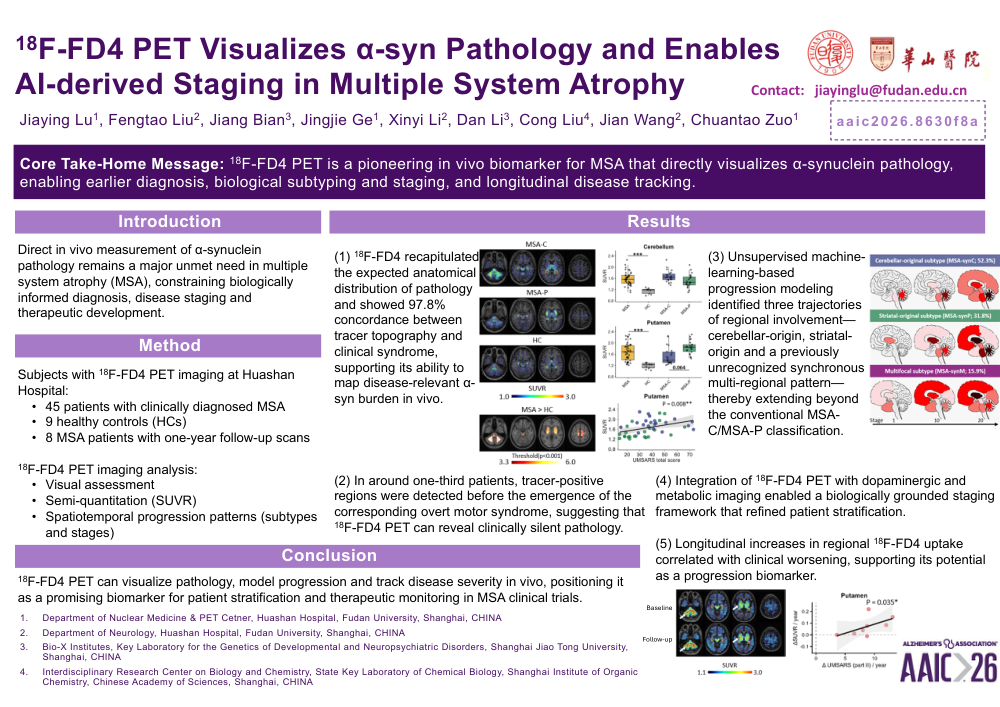
Methods: Forty-five patients with clinically diagnosed MSA and 9 healthy controls underwent 18F-FD4 PET at Huashan Hospital, Fudan University. Images were analyzed visually and semi-quantitatively. Spatiotemporal progression patterns (via event-based modeling) were assessed. Eight patients completed one-year follow-up scans.
Results: Here, we evaluated the α-syn PET tracer 18F-FD4 in 45 patients with MSA. 18F-FD4 recapitulated the expected anatomical distribution of pathology and showed 97.8% concordance between tracer topography and clinical syndrome, supporting its ability to map disease-relevant α-syn burden in vivo. In around one-third of the patients, tracer-positive regions were detected before the emergence of the corresponding overt motor syndrome, suggesting that 18F-FD4 PET can reveal clinically silent pathology. Unsupervised machine-learning-based progression modeling further identified three trajectories of regional involvement—cerebellar-origin, striatal-origin and a previously unrecognized synchronous multi-regional pattern—thereby extending beyond the conventional MSA-C/MSA-P classification. Integration of 18F-FD4 PET with dopaminergic and metabolic imaging enabled a biologically grounded staging framework that refined patient stratification. Finally, longitudinal increases in regional 18F-FD4 uptake correlated with clinical worsening, supporting its potential as a progression biomarker.
Conclusion: Together, these findings provide proof of concept that 18F-FD4 PET can visualize pathology, model progression and track disease severity in vivo, positioning it as a promising biomarker for patient stratification and therapeutic monitoring in MSA clinical trials.
Comments
Email is required but is not shown publicly.
Loading comments...