4,068 posters, 219 videos, 101 topics, 69 sessions, 14,365 authors, 6,128 institutions
ePostersLive by SciGen Technologies S.A. All rights reserved.
Alzheimer's Association International Conference 2026
July 12-15, 2026 | London, United Kingdom, and Online

9391
Neurocognitive Assessment Of Firefighters After The 2025 Wildfires
Poster Presenter
Authors
Zaldy Tan, Sandy Joung, Patrick Herbig, Briana Khuu, Wasay Warsi, Tzu Yu Huang, Mitzi Gonzales, Jeffrey Wertheimer, Susan Cheng
Affiliations
Department of Neurology, Cedars-Sinai Medical Center, Los Angeles, California, USA, Department of Cardiology, Cedars-Sinai Medical Center, Los Angeles, California, USA, Department of Physical Medicine and Rehabilitation, Cedars-Sinai Medical Center, Los Angeles, California, USA
Part of Topic
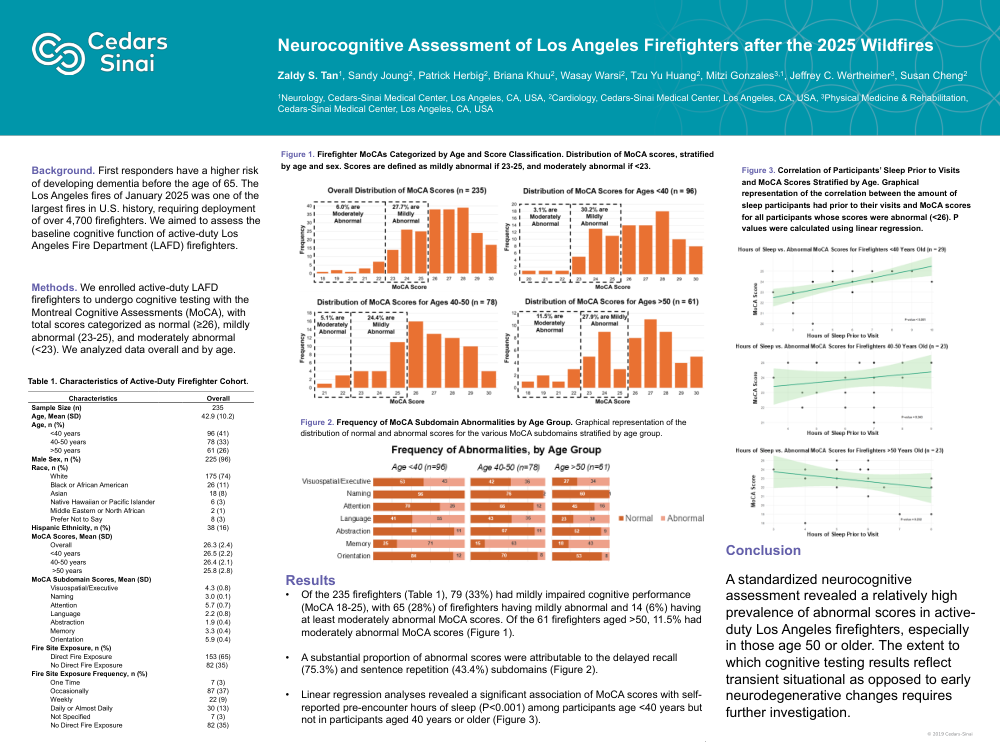
Background. First responders have a higher risk of developing dementia before the age of 65. The Los Angeles fires of January 2025 was one of the largest fires in U.S. history, requiring deployment of over 4,700 firefighters. We aimed to assess the baseline cognitive function of active-duty Los Angeles Fire Department (LAFD) firefighters.
Methods. We enrolled active-duty LAFD firefighters to undergo cognitive testing with the Montreal Cognitive Assessments (MoCA), with total scores categorized as normal (≥26), mildly abnormal (23-25), and moderately abnormal (<23). We analyzed data overall and by age.
Results. Of the 235 firefighters (mean age 42; 96% male), 79 (33%) had mildly impaired cognitive performance (MoCA 18-25), with 65 (28%) of firefighters having mildly abnormal and 14 (6%) having at least moderately abnormal MoCA scores. Of the 61 firefighters aged >50, 11.5% had moderately abnormal MoCA scores. A substantial proportion of abnormal scores were attributable to the delayed recall (75.3%) and sentence repetition (43.4%) subdomains. Linear regression analyses revealed a significant association of MoCA scores with self-reported pre-encounter hours of sleep (P<0.001) among participants age <40 years but not in participants aged 40 years or older.
Conclusion. A standardized neurocognitive assessment revealed a relatively high prevalence of abnormal scores in active-duty Los Angeles firefighters, especially in those age 50 or older. The extent to which cognitive testing results reflect transient situational as opposed to early neurodegenerative changes requires further investigation
Comments
Email is required but is not shown publicly.
Loading comments...