4,068 posters, 219 videos, 101 topics, 69 sessions, 14,365 authors, 6,128 institutions
ePostersLive by SciGen Technologies S.A. All rights reserved.
Alzheimer's Association International Conference 2026
July 12-15, 2026 | London, United Kingdom, and Online

4214
Social Isolation As A Modifiable Risk Factor For Physiological Decline In Midlife Women: Implications For Cognitive Health Prevention
Poster Presenter
Authors
Christine Gierke, Montserrat Fernandez, Paula Muñoz, Monserrat Martinez, Martina Morales, NIcolas Ferrer
Affiliations
Neurology & Neurosurgery Service, Clinical Hospital University of Chile (HCUCH); Social Isolation Research Center (SIRC), Santiago Chile; School of Psychology Diego Portales University, Santiago Chile; SOFIA Initiative - SIRC Chille; ISOFLY Lab, NiBG Biomedical Sciences Institute (ICBM), Faculty of Medicine University of Chile, Psychiatric Medical Center GLANDORF, Chihuahua, Mexico; Social Isolation Research Center (SIRC), Santiago Chile; SOFIA Initiative - SIRC Chile, Social Isolation Research Center (SIRC), Santiago Chile; SOFIA Initiative - SIRC Chile; School of Psychology Academia Humanismo Cristiano University, Santiago Chile., Social Isolation Research Center (SIRC), Santiago Chile; SOFIA Initiative - SIRC Chile; ISOFLY Lab, NiBG Biomedical Sciences Institute, Faculty of Medicine University of Chile., Social Isolation Research Center (SIRC), Santiago Chile; SOFIA Initiative - SIRC Chile; School of Psychology, Las Americas University, Santiago Chile
Part of Topic
Title: Social Isolation as a Modifiable Risk Factor for Physiological Decline in Midlife Women: Implications for Cognitive Health Prevention.
Poster Number: #4214
Authors: Gierke, C., Fernandez, M. M., Muñoz, P., Martinez, M., Morales, M., & Ferrer, N.
Abstract / Poster Summary
Background: Social isolation and loneliness represent critical, yet modifiable risk factors for physiological decline in midlife women. The menopausal transition, particularly perimenopause (approx. 40–51 years), represents a unique window of vulnerability. During this stage, social disconnection can accelerate biological mechanisms linked to cognitive impairment; for instance, isolated perimenopausal women show 40% higher depression rates and elevated cardiovascular risk.
Methods: A systematic review was conducted following PRISMA 2020 guidelines. PubMed, Scopus, and Web of Science were searched (2020–2025) for literature evaluating the impact of objective social isolation and perceived loneliness on the physiological health of women aged 40–65 across different menopausal stages.
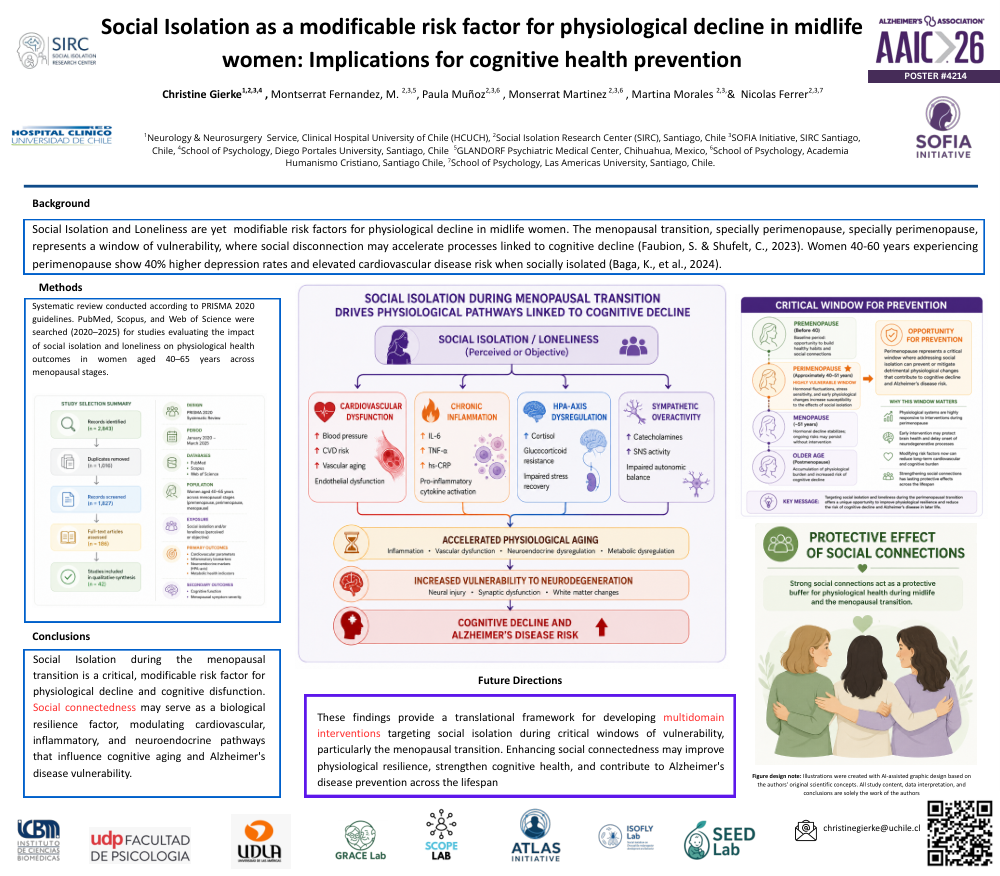
Results: The synthesized evidence demonstrates that social isolation during the menopausal transition drives distinct physiological pathways that converge on cognitive decline:
1) Cardiovascular Dysfunction: Induces elevated blood pressure, increased CVD risk, accelerated vascular aging, and endothelial dysfunction.
2) Chronic Inflammation: Activates pro-inflammatory cytokines, raising levels of IL-6, TNF-α, and hs-CRP
3) HPA-Axis Dysregulation: Elevates cortisol levels, triggers glucocorticoid resistance, and impairs stress recovery
4) Sympathetic Overactivity: Increases catecholamines and SNS activity, impairing autonomic balance
These interconnected pathways lead to accelerated physiological aging (neuroendocrine and metabolic dysregulation) , increasing vulnerability to neurodegeneration via neural injury, synaptic dysfunction, and white matter changes , which ultimately drives cognitive decline and Alzheimer's disease risk.
Conclusions: Perimenopause is a critical preventive window. Strong social connections act as a biological resilience buffer that modulates these adverse pathways. Enhancing social connectedness provides a translational framework for multidomain interventions to strengthen physiological resilience and support lifetime Alzheimer's prevention
Email: christinegierke@uchile.cl
Comments
Email is required but is not shown publicly.
Loading comments...