4,068 posters, 219 videos, 101 topics, 69 sessions, 14,365 authors, 6,128 institutions
ePostersLive by SciGen Technologies S.A. All rights reserved.
Alzheimer's Association International Conference 2026
July 12-15, 2026 | London, United Kingdom, and Online

5381
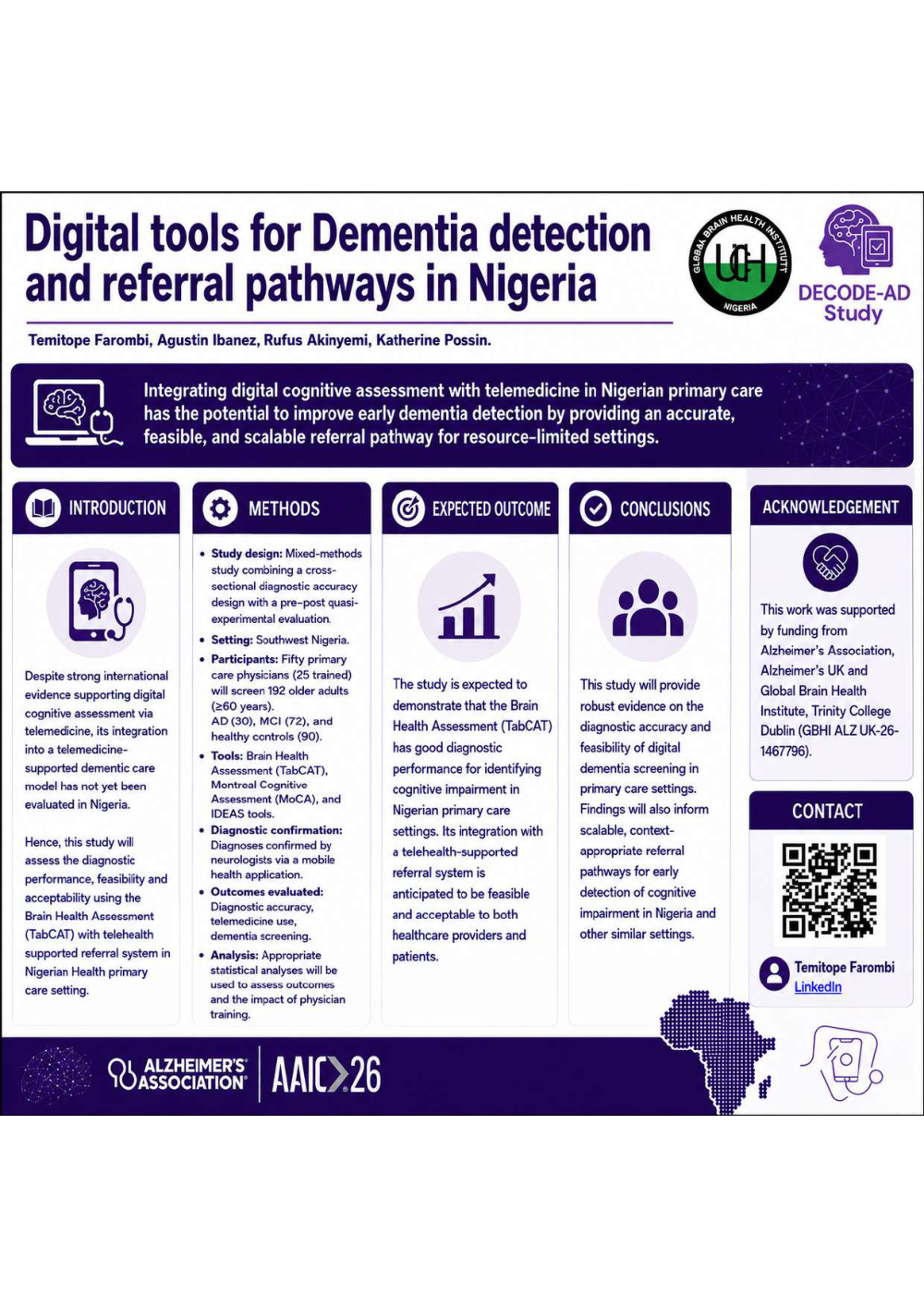
Digital Tools For Dementia Detection And Referral Pathways In Nigeria
Poster Presenter
Authors
Temitope Farombi, Agustin Ibanez, Rufus Akinyemi, Katherine Possin
Affiliations
University College Hospital, Ibadan, Nigeria, Global Brain Health Institute, Trinity College Dublin, Ireland, College of Medicine , University of Ibadan , Nigeria, Weill Institute for Neuroscience , University of California, San Fransisco
Part of Topic
TITLE: Digital tools for Dementia detection and referral pathways in Nigeria
Background: Despite strong international evidence supporting digital cognitive assessment via telemedicine, its integration into a telemedicine-supported dementia care model has not yet been evaluated in Nigeria. Hence, this study will assess the diagnostic performance, feasibility and acceptability using the Brain Health Assessment (BHA) with telehealth supported referral system in Nigerian Health primary care setting.
Methods: This study will employ a mixed-methods approach comprising a cross-sectional diagnostic accuracy design and a pre–post quasi-experimental evaluation. The study will be conducted in Southwest Nigeria. Fifty primary care physicians (PCPs) will be recruited, with 25 allocated to an intervention arm receiving structured training on telemedicine use and dementia screening using the BHA, Montreal Cognitive Assessment (MoCA), and IDEA tools. Consenting adults aged ≥60 years will be consecutively screened by trained PCPs. Sample size for older adult is 192 participants, comprising Alzheimer’s disease (n=30), mild cognitive impairment (n=72), and healthy controls (n=90). All screened participants will be referred through a mobile health application to neurologists in tertiary centres for diagnostic confirmation. PCPs will complete telehealth usability and adoption questionnaire before and 6 months after training. The sensitivity, specificity, positive and negative predictive values, and receiver operating characteristic curves of screening tools will be evaluated. Multivariable logistic regression will adjust for age, sex, and education. Pre–post changes and between-group differences will be analysed using appropriate tests, including difference-in-differences analysis to estimate the effect of physicians’ training.
Expected outcome: The study is expected to demonstrate that the Brain Health Assessment has good diagnostic performance for identifying cognitive impairment in Nigerian primary care settings. Its integration with a telehealth-supported referral system is anticipated to be feasible and acceptable to both healthcare providers and patients.
Conclusion: This study will provide robust evidence on the diagnostic accuracy and feasibility of digital dementia screening in primary care settings. Findings will also inform scalable, context-appropriate referral pathways for early detection of cognitive impairment in Nigeria and other similar settings.
Comments
Email is required but is not shown publicly.
Loading comments...